Michinov Estelle, Michinov Nicolas
Laboratory of Psychology: Cognition, Behavior and Communication (LP3C), Department of Psychology, Univ Rennes, Place du Recteur Henri le Moal, Rennes, France.
Curr Psychol. 2023;42(7):5650-5661. doi: 10.1007/s12144-021-01885-3. Epub 2021 May 29.
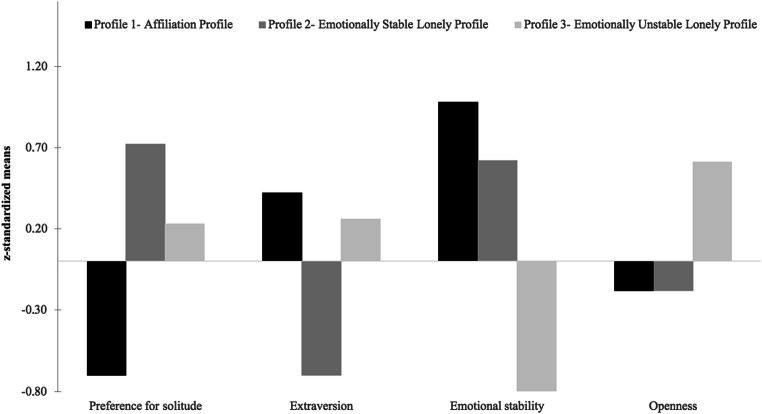
With the COVID-19 outbreak, the population was suddenly forced to "stay at home". Although research suggests that social isolation affects health and wellbeing, reactions may vary depending on individuals. The current study assessed the relationships between personality variables (preference for solitude and Big Five personality), mental health (anxiety, stress, loneliness), and creativity, and tried to determine whether the identified personality profiles affect individuals' mental health and creativity. French respondents ( = 430) filled in an online questionnaire during the first lockdown in Spring 2020. The results showed that the preference for solitude and personality variables of the Big Five predicted individuals' mental health and creativity. Moreover, a cluster analysis revealed three profiles of individuals: "Affiliation", "Emotionally Stable Lonely" and "Emotionally Unstable Lonely". Results showed that individuals with "Affiliation" and "Emotionally Unstable Lonely" profiles expressed higher stress and anxiety, and the latter performed better on a divergent creative thinking task. By contrast, those with an "Emotionally Stable Lonely" profile expressed a lower level of loneliness, and performed better on a creative insight task. These findings reveal the importance of personality profiles in psychological reactions during lockdowns. With this knowledge, health professionals could develop appropriate interventions to accompany high-risk individuals in situations of social isolation.
The online version contains supplementary material available at 10.1007/s12144-021-01885-3.
随着新冠疫情的爆发,人们突然被迫“居家隔离”。尽管研究表明社交隔离会影响健康和幸福感,但不同个体的反应可能会有所不同。本研究评估了人格变量(对独处的偏好和大五人格)、心理健康(焦虑、压力、孤独感)和创造力之间的关系,并试图确定所识别出的人格特征是否会影响个体的心理健康和创造力。法国受访者(n = 430)在2020年春季首次封锁期间填写了一份在线问卷。结果表明,对独处的偏好和大五人格变量能够预测个体的心理健康和创造力。此外,聚类分析揭示了三类个体:“社交型”、“情绪稳定的孤独型”和“情绪不稳定的孤独型”。结果显示,具有“社交型”和“情绪不稳定的孤独型”特征的个体表现出更高的压力和焦虑,后者在发散性创造性思维任务上表现更好。相比之下,具有“情绪稳定的孤独型”特征的个体孤独感较低,在创造性洞察力任务上表现更好。这些发现揭示了人格特征在封锁期间心理反应中的重要性。有了这些认识,健康专业人员可以制定适当的干预措施,在社会隔离情况下陪伴高风险个体。
在线版本包含可在10.1007/s12144-021-01885-3获取的补充材料。