The LEO Foundation Skin Immunology Research Center, Department of Immunology and Microbiology, University of Copenhagen, Faculty of Health and Medical Sciences, Copenhagen, Denmark.
Novo Nordisk Foundation Center for Protein Research, University of Copenhagen, Faculty of Health and Medical Sciences, Copenhagen, Denmark.
Front Immunol. 2021 May 19;12:684015. doi: 10.3389/fimmu.2021.684015. eCollection 2021.
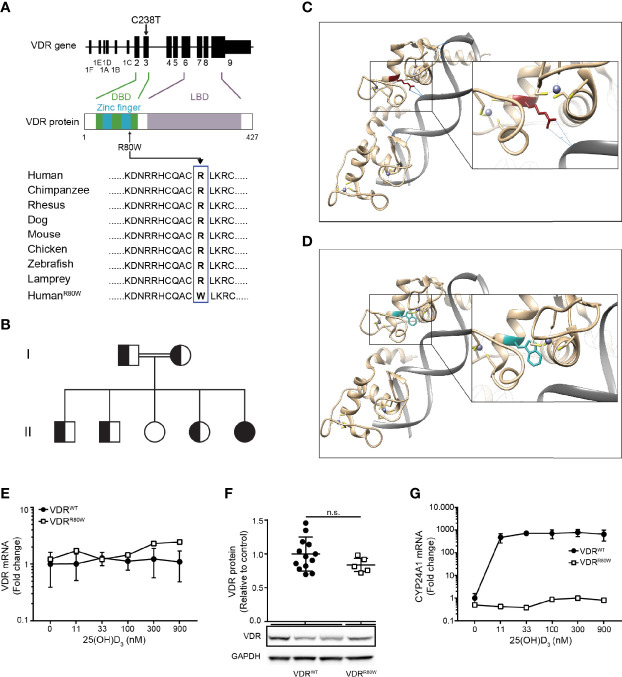
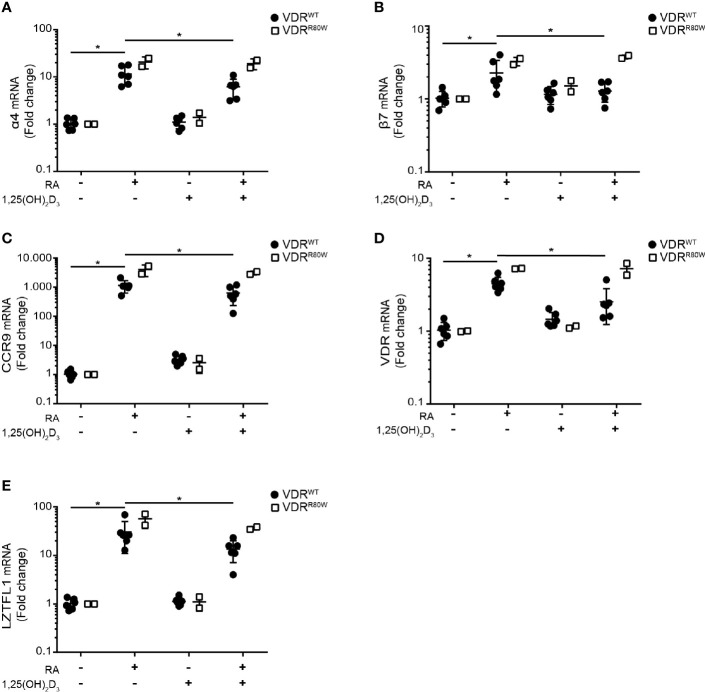
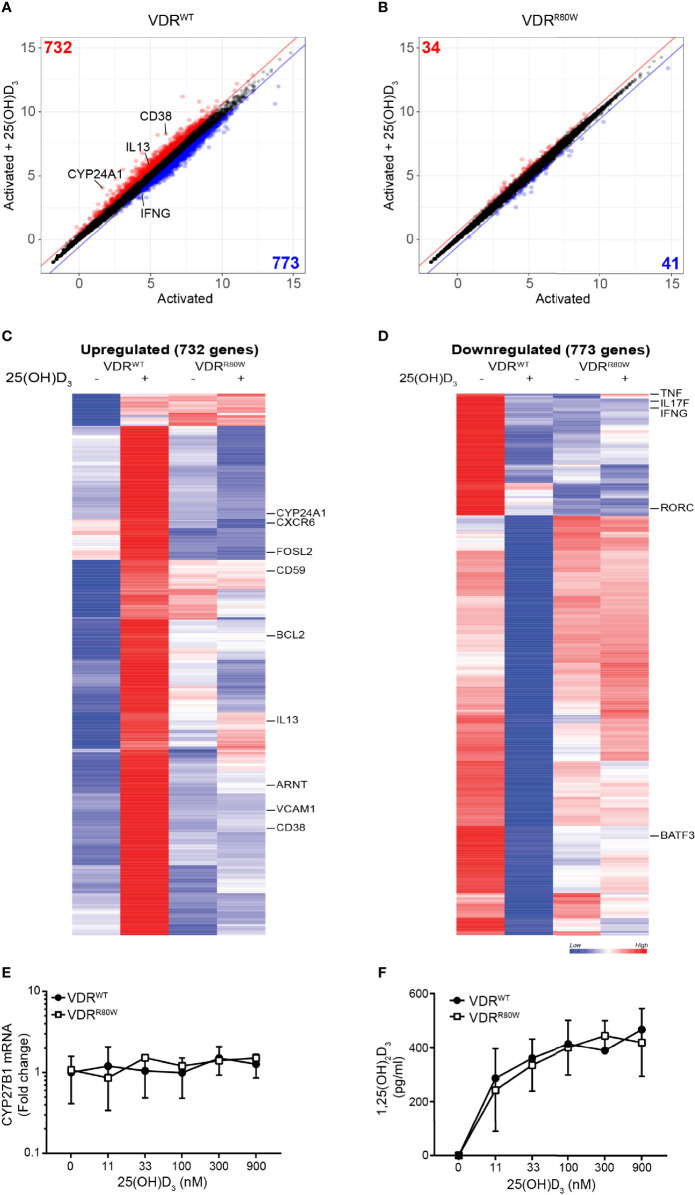
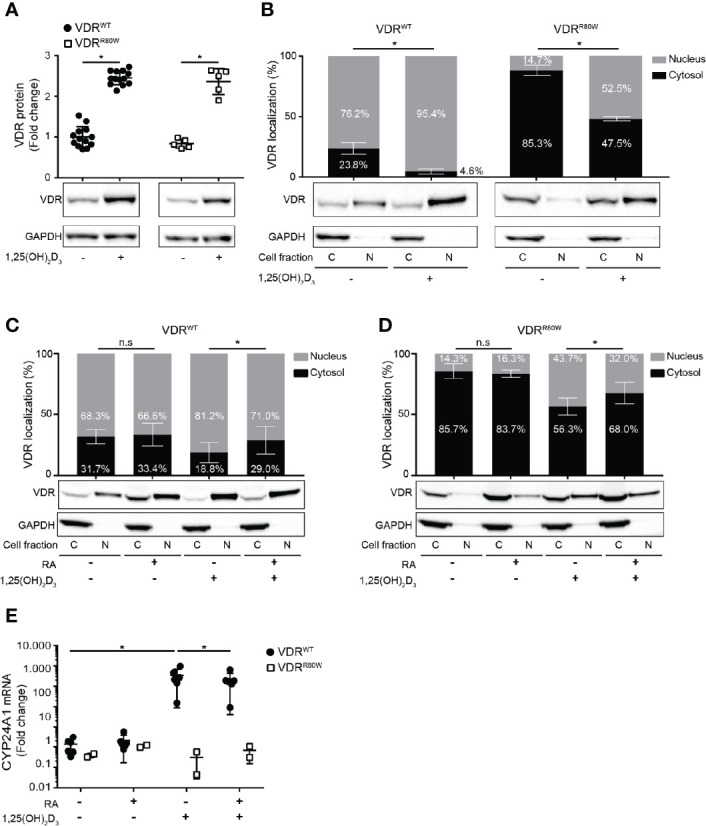
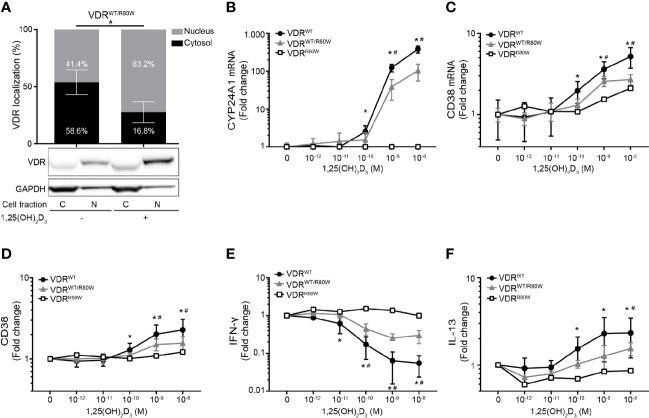
The active form of vitamin D, 1,25-dihydroxyvitamin D (1,25(OH)D), mediates its immunomodulatory effects by binding to the vitamin D receptor (VDR). Here, we describe a new point mutation in the DNA-binding domain of the VDR and its consequences for 1,25(OH)D signaling in T cells from heterozygous and homozygous carriers of the mutation. The mutation did not affect the overall structure or the ability of the VDR to bind 1,25(OH)D and the retinoid X receptor. However, the subcellular localization of the VDR was strongly affected and the transcriptional activity was abolished by the mutation. In heterozygous carriers of the mutation, 1,25(OH)D-induced gene regulation was reduced by ~ 50% indicating that the expression level of wild-type VDR determines 1,25(OH)D responsiveness in T cells. We show that vitamin D-mediated suppression of vitamin A-induced gene regulation depends on an intact ability of the VDR to bind DNA. Furthermore, we demonstrate that vitamin A inhibits 1,25(OH)D-induced translocation of the VDR to the nucleus and 1,25(OH)D-induced up-regulation of CYP24A1. Taken together, this study unravels novel aspects of vitamin D signaling and function of the VDR in human T cells.
维生素 D 的活性形式 1,25-二羟维生素 D(1,25(OH)D)通过与维生素 D 受体(VDR)结合来介导其免疫调节作用。在这里,我们描述了 VDR DNA 结合域中的一个新点突变及其对突变杂合子和纯合子携带者 T 细胞中 1,25(OH)D 信号转导的影响。该突变不影响 VDR 的整体结构或结合 1,25(OH)D 和视黄酸 X 受体的能力。然而,VDR 的亚细胞定位受到强烈影响,突变使其转录活性被完全废除。在突变的杂合子携带者中,1,25(OH)D 诱导的基因调节减少了约 50%,这表明野生型 VDR 的表达水平决定了 T 细胞中 1,25(OH)D 的反应性。我们表明,维生素 D 介导的对维生素 A 诱导的基因调节的抑制依赖于 VDR 结合 DNA 的完整能力。此外,我们证明维生素 A 抑制 1,25(OH)D 诱导的 VDR 向核内易位和 1,25(OH)D 诱导的 CYP24A1 上调。总之,这项研究揭示了维生素 D 信号转导和 VDR 在人类 T 细胞中的功能的新方面。