Ha Tae-Woong, Jung Hae-Un, Kim Dong Jun, Baek Eun Ju, Lee Won Jun, Lim Ji Eun, Kim Han Kyul, Kang Ji-One, Oh Bermseok
Department of Biochemistry and Molecular Biology, School of Medicine, Kyung Hee University, Seoul, South Korea.
Department of Biomedical Science, Graduate School, Kyung Hee University, Seoul, South Korea.
Front Genet. 2021 May 20;12:639905. doi: 10.3389/fgene.2021.639905. eCollection 2021.
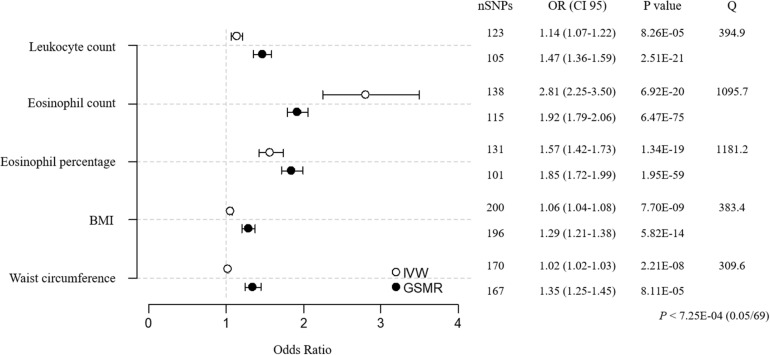
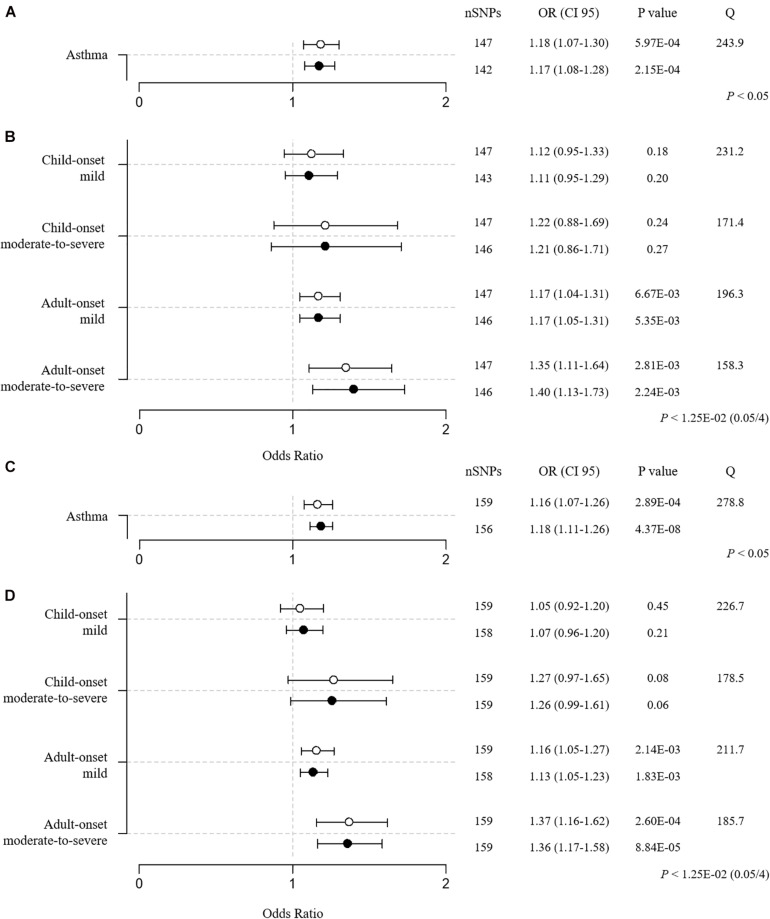
Although asthma is one of the most common chronic diseases throughout all age groups, its etiology remains unknown, primarily due to its heterogeneous characteristics. We examined the causal effects of various environmental factors on asthma using Mendelian randomization and determined whether the susceptibility to asthma due to the causal effect of a risk factor differs between asthma subtypes, based on age of onset, severity of asthma, and sex. We performed Mendelian randomization analyses (inverse variance weighted, weighted median, and generalized summary-data-based Mendelian randomization) using UK Biobank data to estimate the causal effects of 69 environmental factors on asthma. Additional sensitivity analyses (MR-Egger regression, Cochran's Q test, clumping, and reverse Mendelian randomization) were performed to ensure minimal or no pleiotropy. For confirmation, two-sample setting analyses were replicated using BMI SNPs that had been reported by a meta-genome-wide association study in Japanese and European (GIANT) populations and a genome-wide association study in control individuals from the UK Biobank. We found that BMI causally affects the development of asthma and that the adult-onset moderate-to-severe asthma subtype is the most susceptible to causal inference by BMI. Further, it is likely that the female subtype is more susceptible to BMI than males among adult asthma cases. Our findings provide evidence that obesity is a considerable risk factor in asthma patients, particularly in adult-onset moderate-to-severe asthma cases, and that weight loss is beneficial for reducing the burden of asthma.
尽管哮喘是所有年龄组中最常见的慢性疾病之一,但其病因仍不清楚,主要是由于其具有异质性特征。我们使用孟德尔随机化方法研究了各种环境因素对哮喘的因果效应,并根据发病年龄、哮喘严重程度和性别,确定了危险因素因果效应导致的哮喘易感性在哮喘亚型之间是否存在差异。我们使用英国生物银行的数据进行了孟德尔随机化分析(逆方差加权、加权中位数和基于广义汇总数据的孟德尔随机化),以估计69种环境因素对哮喘的因果效应。进行了额外的敏感性分析(MR-Egger回归、 Cochr an's Q检验、聚类和反向孟德尔随机化),以确保最小程度的多效性或无多效性。为了进行验证,我们使用了在日本和欧洲人群的一项元全基因组关联研究以及英国生物银行对照个体的一项全基因组关联研究中报告的BMI单核苷酸多态性,重复进行了两样本设定分析。我们发现BMI对哮喘的发展有因果影响,并且成人发病的中度至重度哮喘亚型最容易受到BMI的因果推断。此外,在成人哮喘病例中,女性亚型可能比男性更容易受到BMI的影响。我们的研究结果提供了证据,表明肥胖是哮喘患者的一个重要危险因素,特别是在成人发病的中度至重度哮喘病例中,并且减肥有利于减轻哮喘负担。