Jimmy Huang Po-Jung, Yang Jeffy, Chong Kellie, Ma Qianyi, Li Miao, Zhang Fang, Moon Woohyun J, Zhang Guomei, Liu Juewen
Department of Chemistry, Waterloo Institute for Nanotechnology, University of Waterloo Waterloo ON N2L 3G1 Canada
School of Chemistry and Chemical Engineering, Shanxi University Taiyuan 030006 China.
Chem Sci. 2020 Jun 8;11(26):6795-6804. doi: 10.1039/d0sc01080d.
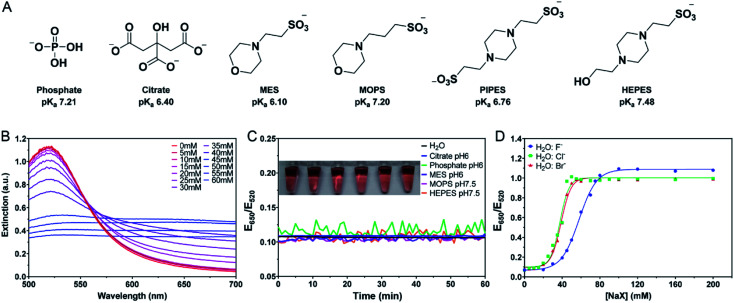
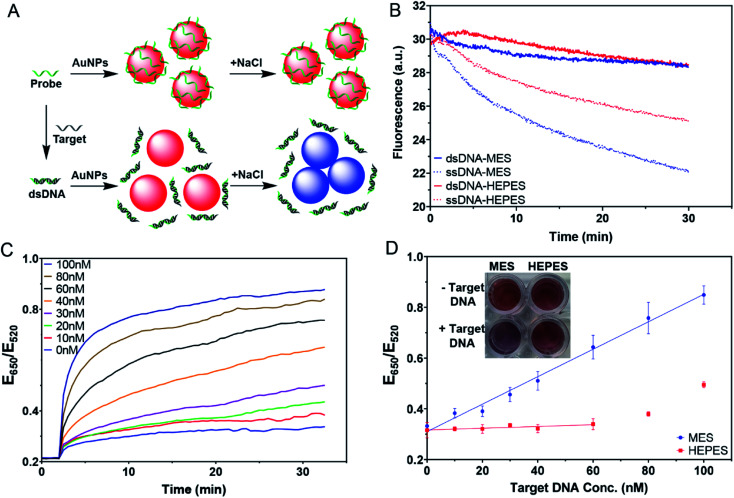
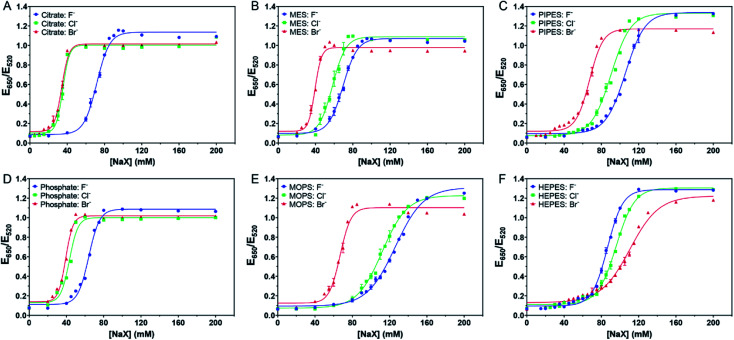
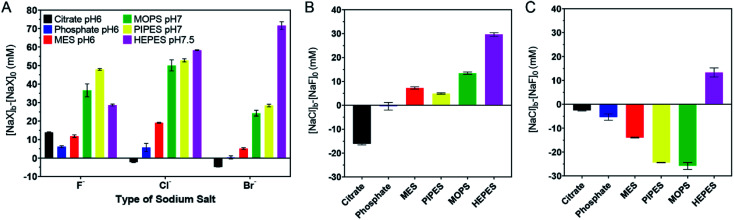
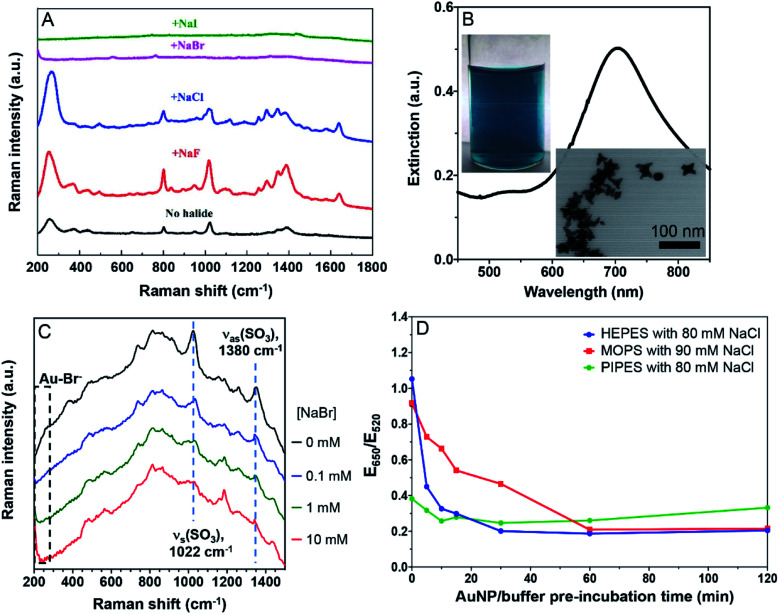
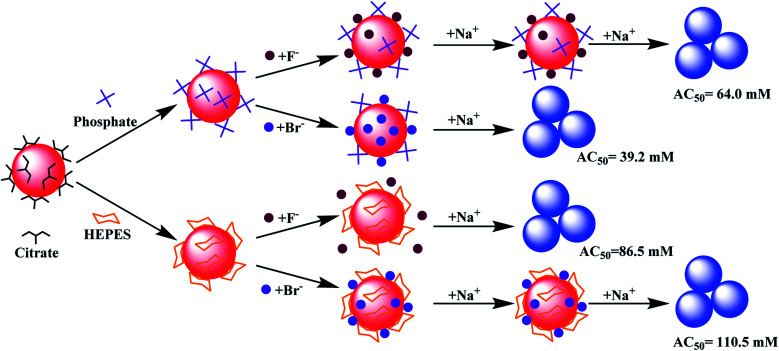
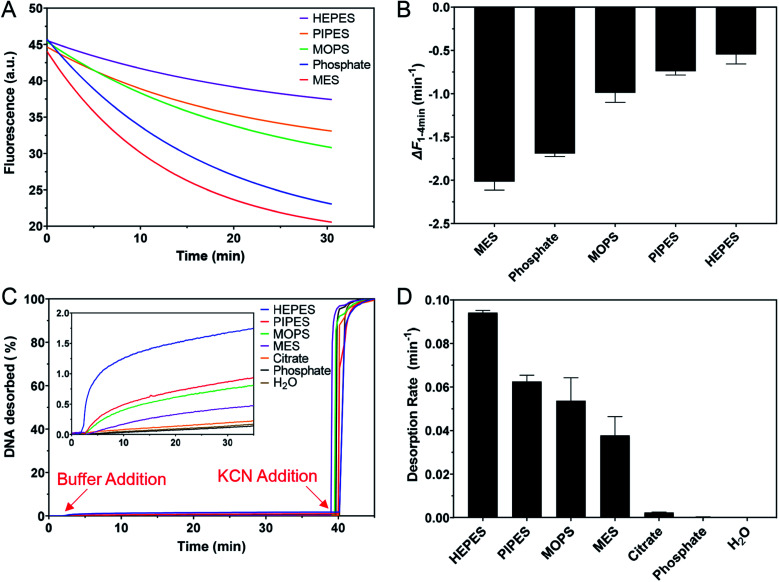
Citrate-capped gold nanoparticles (AuNPs) are highly important for sensing, drug delivery, and materials design. Many of their reactions take place in various buffers such as phosphate and Good's buffers. The effect of buffer on the surface properties of AuNPs is critical, yet this topic has not been systematically explored. Herein, we used halides such as fluoride, chloride, and bromide as probes to measure the relative adsorption strength of six common buffers. Among them, HEPES had the highest adsorption affinity, while MES, citrate and phosphate were weakly adsorbed with an overall ranking of HEPES > PIPES > MOPS > MES > citrate, phosphate. The adsorption strength was reflected from the inhibited adsorption of DNA and from the displacement of pre-adsorbed DNA. This conclusion is also supported by surface enhanced Raman spectroscopy. Furthermore, some buffer molecules did not get adsorbed instantaneously, and the MOPS buffer took up to 1 h to reach equilibrium. Finally, a classic label-free AuNP-based colorimetric sensor was tested. Its sensitivity increased by 15.7-fold when performed in a MES buffer compared to a HEPES buffer. This study has articulated the importance of buffer for AuNP-based studies and how it can improve sensors and yield more reproducible experimental systems.
柠檬酸盐包覆的金纳米颗粒(AuNPs)在传感、药物递送和材料设计方面非常重要。它们的许多反应发生在各种缓冲液中,如磷酸盐缓冲液和Good's缓冲液。缓冲液对AuNPs表面性质的影响至关重要,但这一主题尚未得到系统的探索。在此,我们使用氟化物、氯化物和溴化物等卤化物作为探针来测量六种常见缓冲液的相对吸附强度。其中,HEPES具有最高的吸附亲和力,而MES、柠檬酸盐和磷酸盐的吸附较弱,总体排序为HEPES > PIPES > MOPS > MES > 柠檬酸盐、磷酸盐。吸附强度通过DNA的吸附抑制和预吸附DNA的置换来体现。这一结论也得到了表面增强拉曼光谱的支持。此外,一些缓冲液分子不会立即被吸附,MOPS缓冲液需要长达1小时才能达到平衡。最后,测试了一种基于AuNP的经典无标记比色传感器。与HEPES缓冲液相比,在MES缓冲液中进行时,其灵敏度提高了15.7倍。这项研究阐明了缓冲液在基于AuNP的研究中的重要性,以及它如何能够改进传感器并产生更可重复的实验系统。