Glazer Jillian V, MacDonnell Kirsten, Frederick Christina, Ingersoll Karen, Ritterband Lee M
University of Virginia School of Medicine, Center for Behavioral Health & Technology, Department of Psychiatry & Neurobehavioral Sciences, 560 Ray C Hunt Dr, Charlottesville 22903, VA, USA.
Internet Interv. 2021 May 9;25:100401. doi: 10.1016/j.invent.2021.100401. eCollection 2021 Sep.
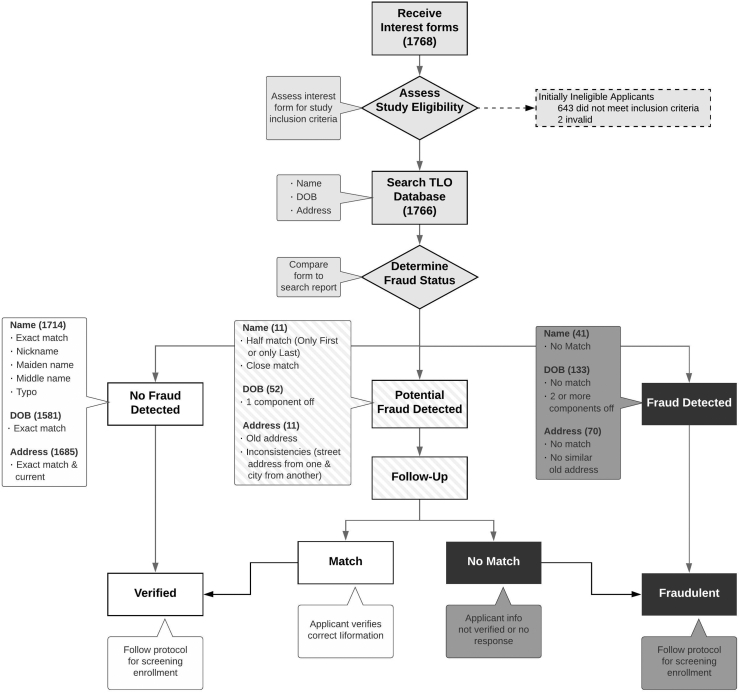
Online studies enable researchers to recruit large, diverse samples, but the nature of these studies provides an opportunity for applicants to misrepresent themselves to increase the likelihood of meeting eligibility criteria for a trial, particularly those that provide financial incentives. This study describes rates of fraudulent applications to an online intervention trial of an Internet intervention for insomnia among older adults (ages ≥55). Applicants were recruited using traditional (e.g., flyers, health providers), online (e.g., Craigslist, Internet searches), and social media (e.g., Facebook) recruitment methods. Applicants first submitted an interest form that included identifying information (name, date of birth, address). This data was then queried against a national database (TransUnion's TLOxp) to determine the application's verification status. Applications were determined to be verified (i.e., information from interest form matched TLOxp report), potentially fraudulent (i.e., potential discrepancy in provided information on interest form versus TLOxp report), or fraudulent (i.e., confirmed discrepancy). Of 1766 total interest forms received, 125 (7.08%) were determined to be fraudulent. Enrollment attempts that were fraudulent were detected among 12.22% of applicants who reported learning of the study through online, 7.04% through social media, 4.58% through traditional, and 4.27% through other methods. Researchers conducting online trials should take precautions, as applicants may provide fraudulent information to gain access to their studies. Reviewing all applications and verifying the identities and eligibility of participants is critical to the integrity of online research trials.
在线研究使研究人员能够招募大量、多样化的样本,但这些研究的性质为申请者提供了一个机会,使其能够歪曲自己以增加符合试验资格标准的可能性,尤其是那些提供经济激励的试验。本研究描述了一项针对老年人(年龄≥55岁)失眠症互联网干预在线试验的欺诈性申请率。申请者通过传统方式(如传单、医疗服务提供者)、在线方式(如克雷格列表网、互联网搜索)和社交媒体(如脸书)招募。申请者首先提交一份兴趣表,其中包括身份识别信息(姓名、出生日期、地址)。然后将这些数据与一个国家数据库(环联公司的TLOxp)进行比对,以确定申请的核实状态。申请被确定为已核实(即兴趣表中的信息与TLOxp报告匹配)、可能欺诈(即兴趣表中提供的信息与TLOxp报告存在潜在差异)或欺诈(即确认存在差异)。在总共收到的1766份兴趣表中,有125份(7.08%)被确定为欺诈。在通过在线方式得知该研究的申请者中,12.22%的人存在欺诈性注册企图;通过社交媒体得知的为7.04%;通过传统方式得知的为4.58%;通过其他方式得知的为4.27%。进行在线试验的研究人员应采取预防措施,因为申请者可能会提供欺诈性信息以参与他们的研究。审查所有申请并核实参与者的身份和资格对于在线研究试验的完整性至关重要。