Namin S, Zhou Y, McGinley E, Beyer K
Institute for Health & Equity, Medical College of Wisconsin, Milwaukee, WI, USA.
Center for Advancing Population Science, Medical College of Wisconsin, Milwaukee, WI, USA.
SSM Popul Health. 2021 May 19;15:100823. doi: 10.1016/j.ssmph.2021.100823. eCollection 2021 Sep.
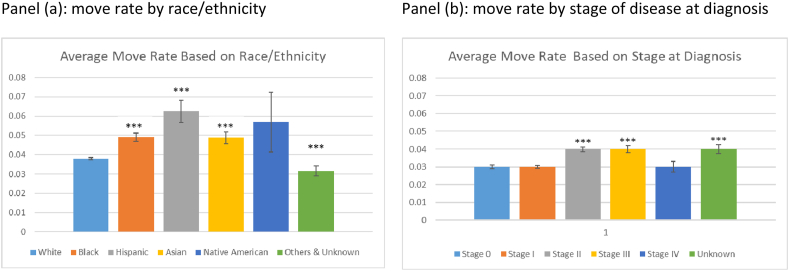
There is a rise in attention to residential history in cancer epidemiology aimed at more effective estimation of social and physical environmental exposures and the influence of place of residence on cancer outcomes. However, in the United States, as in many other countries, residential history data are not readily available. In this paper we explore the feasibility of using the annual Medicare billing ZIP code history available in the SEER-Medicare database to study residential mobility among older cancer survivors in the U.S. In a cohort of women diagnosed with breast cancer between 2007 and 2015, we examine the completeness of the data along with the overall characteristics of residential moves based on race and stage at diagnosis. Findings indicate that residential mobility among older women with breast cancer in the U.S. is limited, but differences by race/ethnicity, stage at diagnosis and before/after diagnosis are statistically significant. And breast cancer survivors from minority groups move more frequently than their non-Hispanic White counterparts. The results also show that move rate slightly, but statistically significantly, increases after diagnosis. We conclude that SEER-Medicare can be utilized to study residential mobility among older cancer survivors. We recommend the creation of sub-cohorts based on specific research questions to account for variability in residential mobility due to very short survival times or a diagnosis shortly after Medicare enrollment. Studying residential history provides the opportunity for assigning socioecological and exposure metrics for future survival studies.
在癌症流行病学中,人们越来越关注居住史,目的是更有效地评估社会和自然环境暴露情况以及居住地对癌症结局的影响。然而,在美国,与许多其他国家一样,居住史数据并不容易获取。在本文中,我们探讨了利用监测、流行病学和最终结果(SEER)-医疗保险数据库中可用的年度医疗保险计费邮政编码历史记录来研究美国老年癌症幸存者居住流动性的可行性。在一个2007年至2015年间被诊断为乳腺癌的女性队列中,我们根据诊断时的种族和分期,研究了数据的完整性以及居住迁移的总体特征。研究结果表明,美国老年乳腺癌女性的居住流动性有限,但按种族/族裔、诊断时的分期以及诊断前后划分存在的差异具有统计学意义。少数群体的乳腺癌幸存者比非西班牙裔白人同行迁移更频繁。结果还表明,诊断后迁移率略有上升,但具有统计学意义。我们得出结论,SEER-医疗保险可用于研究老年癌症幸存者的居住流动性。我们建议根据具体研究问题创建亚队列,以考虑因生存时间极短或医疗保险参保后不久就被诊断而导致的居住流动性差异。研究居住史为未来生存研究分配社会生态和暴露指标提供了机会。