Faculty of Teacher Education Arts and Sports, Western Norway University of Applied Sciences, Sogndal, Norway.
Department of Education and Special Education, University of Gothenburg, Gothenburg, Sweden.
Brain Behav. 2021 Jul;11(7):e02114. doi: 10.1002/brb3.2114. Epub 2021 Jun 6.
Reading disability (RD) is characterized by slow and inaccurate word reading development, commonly reflecting underlying phonological problems. We have previously shown that exposure to white noise acutely improves cognitive performance in children with ADHD. The question addressed here is whether white noise exposure yields positive outcomes also for RD. There are theoretical reasons to expect such a possibility: a) RD and ADHD are two overlapping neurodevelopmental disorders and b) since prior research on white noise benefits has suggested that a central mechanism might be the phenomenon of stochastic resonance, then adding certain kinds of white noise might strengthen the signal-to-noise ratio during phonological processing and phoneme-grapheme mapping.
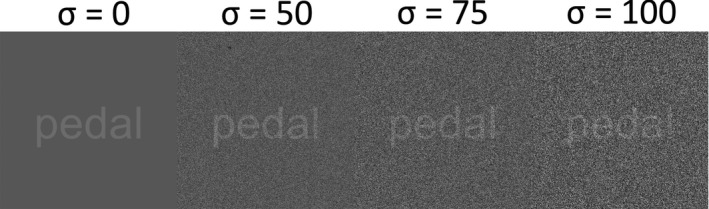
The study was conducted with a group of 30 children with RD and phonological decoding difficulties and two comparison groups: one consisting of skilled readers (n = 22) and another of children with mild orthographic reading problems and age adequate phonological decoding (n = 30). White noise was presented experimentally in visual and auditory modalities, while the children performed tests of single word reading, orthographic word recognition, nonword reading, and memory recall.
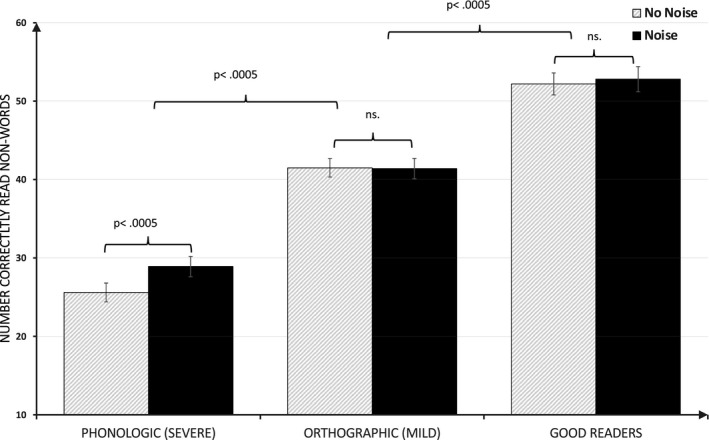
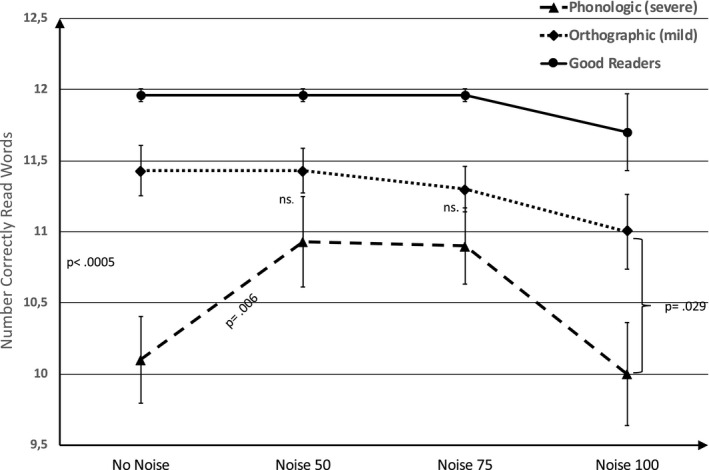
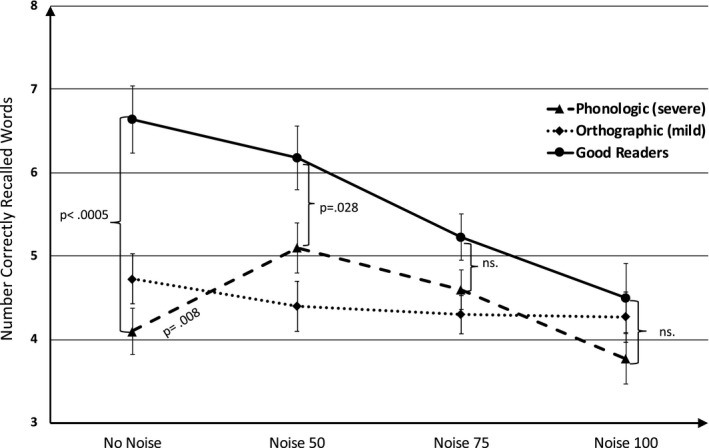
For the first time, we show that visual and auditory white noise exposure improves some reading and memory capacities "on the fly" in children with RD and phonological decoding difficulties. By contrast, the comparison groups displayed either no benefit or a gradual decrease in performance with increasing noise. In interviews, we also found that the white noise exposure was tolerable or even preferred by many children.
These novel findings suggest that poor readers with phonological decoding difficulties may be immediately helped by white noise during reading. Future research is needed to determine the robustness, mechanisms, and long-term practical implications of the white noise benefits in children with reading disabilities.
阅读障碍(RD)的特征是阅读速度缓慢且不准确,通常反映出潜在的语音问题。我们之前已经表明,暴露于白噪声会使 ADHD 儿童的认知表现得到急性改善。这里要解决的问题是,白噪声暴露是否对 RD 也有积极的影响。有理论上的原因可以期待这种可能性:a)RD 和 ADHD 是两种重叠的神经发育障碍;b)由于先前关于白噪声益处的研究表明,一个核心机制可能是随机共振现象,那么添加某些类型的白噪声可能会增强语音处理和语音-字形映射过程中的信噪比。
该研究是在一组 30 名 RD 儿童和语音解码困难的儿童以及两个对照组中进行的:一组由熟练读者组成(n=22),另一组由轻度拼写阅读问题和年龄适当的语音解码的儿童组成(n=30)。在进行单字阅读、正字法词识别、非字阅读和记忆回忆测试的同时,在视觉和听觉模式下进行了白噪声实验。
我们首次表明,在 RD 和语音解码困难的儿童中,视觉和听觉白噪声暴露可“即时”改善一些阅读和记忆能力。相比之下,对照组的表现要么没有受益,要么随着噪声的增加而逐渐下降。在访谈中,我们还发现,许多孩子对白噪声暴露的耐受性较高,甚至更喜欢白噪声暴露。
这些新发现表明,语音解码困难的阅读困难儿童可能会立即受益于阅读时的白噪声。需要进一步的研究来确定阅读障碍儿童的白噪声益处的稳健性、机制和长期实际意义。