Division of Experimental Oncology/Unit of Urology, URI, IRCCS Ospedale San Raffaele, Milan, Italy.
University Vita-Salute San Raffaele, Milan, Italy.
PLoS One. 2021 Jun 7;16(6):e0251608. doi: 10.1371/journal.pone.0251608. eCollection 2021.
To assess the prevalence of isolated teratozoospermia (iTZS) in a cohort of infertile and fertile men; explore the relationship between iTZS, inflammatory parameters and sperm DNA fragmentation index (SDF) in the same cohort.
1824 infertile men and 103 fertile controls. Semen analysis, the neutrophil-to-lymphocyte ratio (NLR) and serum hormones were investigated. DFI was tested in infertile men only. According to 2010 WHO semen analysis, patients were categorized in 3 sub-groups of isolated sperm defects: isolated oligozoospermia (iOZS), isolated asthenozoospermia (iAZS) and iTZS. Descriptive statistics and linear regression models tested the association between clinical variables and inflammatory markers.
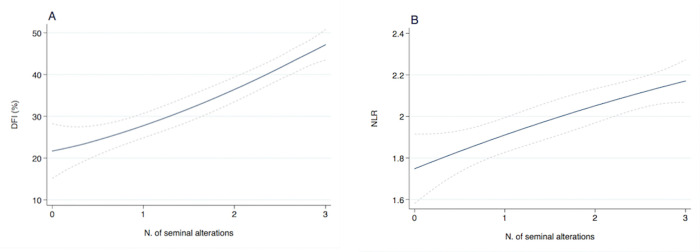
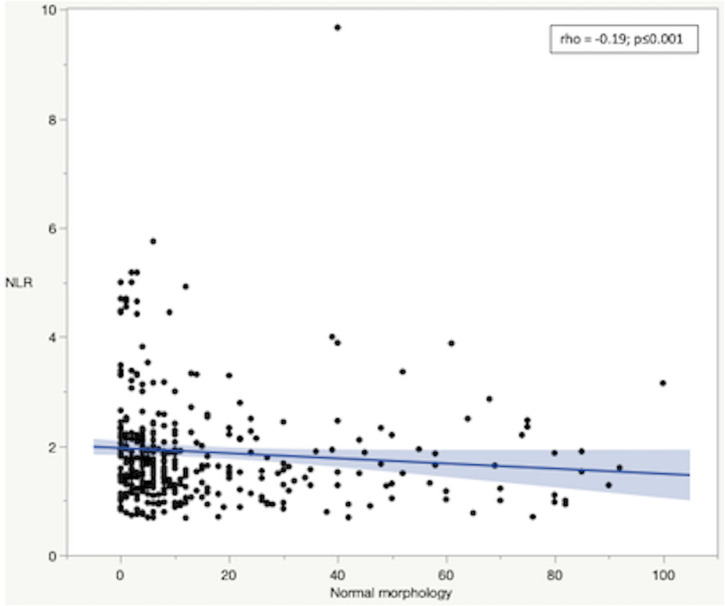
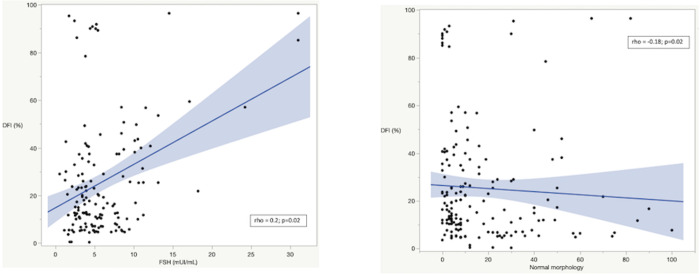
Among infertile men, iAZS, iTZS, and iOZS were found in 13.9%, 11.9% and 4.1% participants, respectively. iTZS was found in 37 (35.9%) fertile men. Infertile men with iTZS had higher NLR values than those with iOZS, iAZS and men with normal semen parameters (all p<0.001). FSH and LH were higher and inhibin B lower in iOZS infertile men compared to all other groups (p≤0.001). Hormonal characteristics were similar between iTZS infertile and fertile men. Similarly, iTZS infertile men had higher SDF than all other groups (all p<0.001). Infertile men with iTZS had higher NLR values than fertile men with iTZS (p<0.01). Linear regression analysis showed that, in infertile men, iTZS was associated with SDF and NLR (all p≤0.01).
iTZS was found in 11.9% of infertile men but it was even more prevalent in fertile controls. Infertile men with iTZS had higher NLR than fertile controls and increased SDF values than infertile participant with iAZS, iOZS, or normal semen parameters. No differences in hormonal characteristics were found between infertile and fertile men with iTZS.
评估不育和生育男性队列中孤立性畸形精子症(iTZS)的流行率;探索同一队列中 iTZS、炎症参数和精子 DNA 碎片化指数(SDF)之间的关系。
共纳入 1824 名不育男性和 103 名生育对照。检测精液分析、中性粒细胞与淋巴细胞比值(NLR)和血清激素。仅在不育男性中检测 DFI。根据 2010 年世界卫生组织精液分析标准,患者被分为 3 个孤立精子缺陷亚组:单纯少精子症(iOZS)、单纯弱精子症(iAZS)和 iTZS。采用描述性统计和线性回归模型检验临床变量与炎症标志物之间的相关性。
在不育男性中,iAZS、iTZS 和 iOZS 分别占 13.9%、11.9%和 4.1%。在 37 名生育男性中发现了 iTZS。与 iOZS、iAZS 和正常精液参数的不育男性相比,iTZS 不育男性的 NLR 值更高(均 p<0.001)。与其他所有组相比,iOZS 不育男性的 FSH 和 LH 更高,抑制素 B 更低(均 p≤0.001)。iTZS 不育和生育男性的激素特征相似。同样,与其他所有组相比,iTZS 不育男性的 SDF 更高(均 p<0.001)。与生育男性相比,iTZS 不育男性的 NLR 值更高(p<0.01)。线性回归分析显示,在不育男性中,iTZS 与 SDF 和 NLR 相关(均 p≤0.01)。
在不育男性中,iTZS 占 11.9%,但在生育对照组中更为常见。与生育对照组相比,iTZS 不育男性的 NLR 值更高,SDF 值也更高,而与 iAZS、iOZS 或正常精液参数的不育男性相比。在 iTZS 不育和生育男性之间未发现激素特征的差异。