School of Medicine and Public Health, University of Newcastle, Newcastle, Australia.
Respiratory Medical Franchise, GSK, Research Triangle Park, NC, USA.
Respir Res. 2021 Jun 7;22(1):171. doi: 10.1186/s12931-021-01746-4.
Comorbidities can complicate the management of severe asthma; therefore, the presence of comorbid conditions or traits often need to be considered when considering treatment options for patients with severe asthma. The aim of this analysis is to investigate the efficacy of mepolizumab in patients with severe eosinophilic asthma and comorbidities.
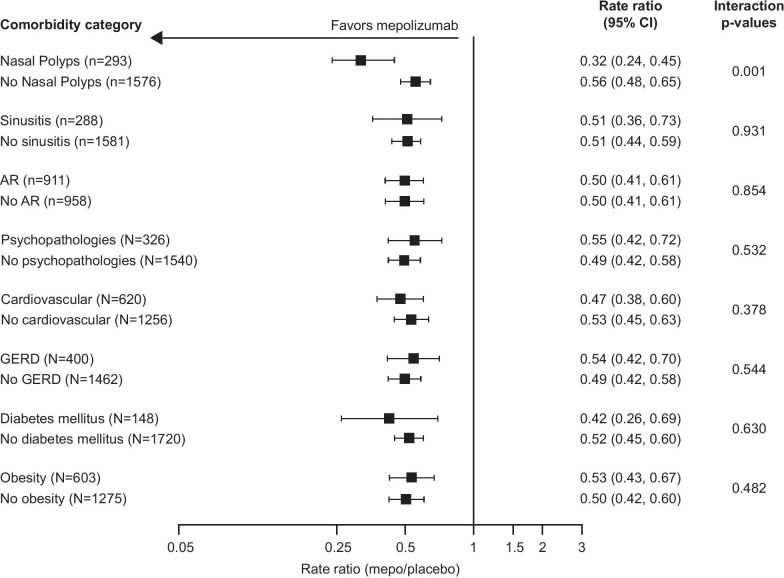
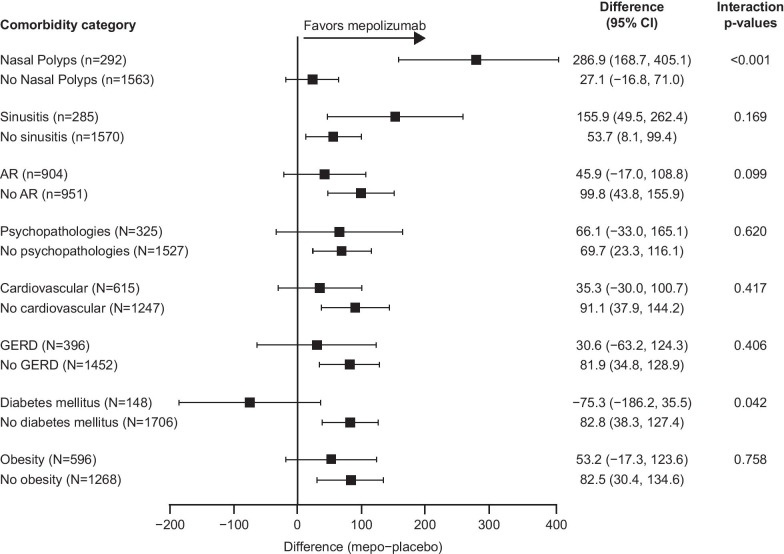
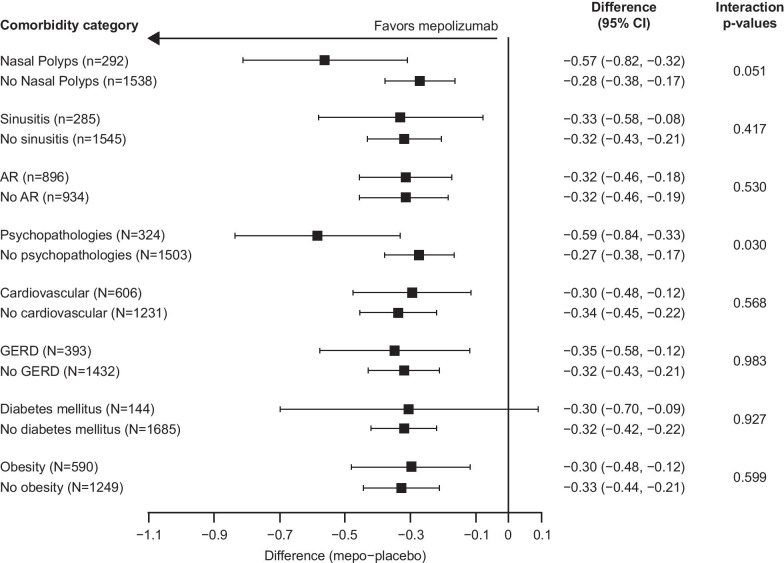
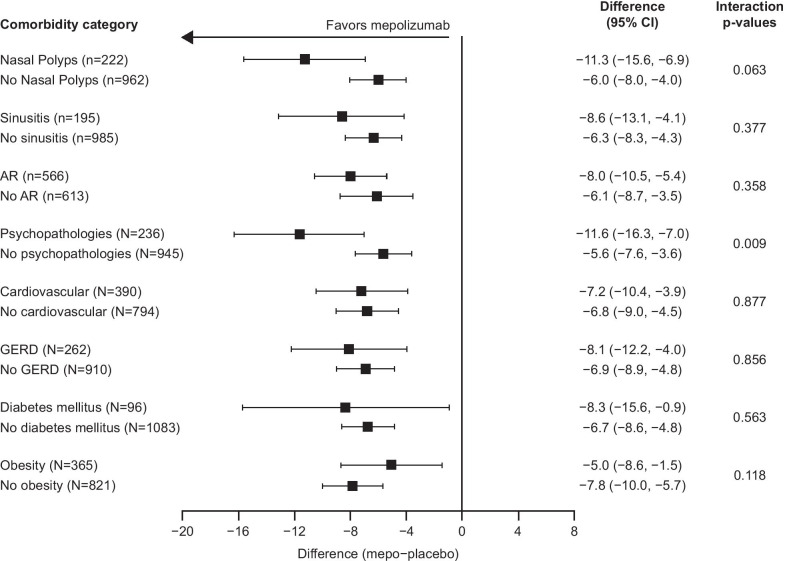
This was a post hoc analysis (GSK ID:209140) of data from the Phase IIb/III studies DREAM, MENSA, SIRIUS, and MUSCA. Patients aged ≥ 12 years with severe eosinophilic asthma were randomized to: mepolizumab 750, 250, or 75 mg intravenously or placebo (DREAM); mepolizumab 75 mg intravenously or 100 mg subcutaneously or placebo (MENSA); or mepolizumab 100 mg subcutaneously or placebo (SIRIUS and MUSCA) every 4 weeks for 24 weeks in SIRIUS and MUSCA, 32 weeks in MENSA or 52 weeks in DREAM. In this analysis the primary endpoint was the annual rate of clinically significant exacerbations; secondary endpoints were Asthma Control Questionnaire-5 score, St George's Respiratory Questionnaire total score, and pre-bronchodilator forced expiratory volume in 1 s at study end. Subgroups were based on comorbidities at baseline.
Overall, 1878 patients received placebo (n = 689) or mepolizumab (n = 1189). Across all comorbidity subgroups mepolizumab reduced the rate of clinically significant exacerbations by 44-68% versus placebo, improved Asthma Control Questionnaire-5 score by 0.27-0.59 points, and improved St George's Respiratory Questionnaire total score by 5.0-11.6 points. Pre-bronchodilator forced expiratory volume in 1 s was improved by 27.1-286.9 mL in all but one comorbidity subgroup, the diabetes mellitus subgroup.
Mepolizumab reduces exacerbations, and improves asthma control, health-related quality of life, and lung function in patients with severe eosinophilic asthma despite comorbid conditions, including upper respiratory conditions, psychopathologies, cardiovascular conditions, gastroesophageal reflux disease, diabetes mellitus, and obesity.
https://clinicaltrials.gov/ DREAM, MEA112997/NCT01000506; MENSA, MEA115588/NCT01691521; SIRIUS, MEA115575/NCT01842607; MUSCA, 200862/NCT02281318.
合并症会使严重哮喘的管理复杂化;因此,在考虑严重哮喘患者的治疗选择时,通常需要考虑合并症或特征的存在。本分析的目的是研究美泊利珠单抗在伴有合并症的严重嗜酸性粒细胞性哮喘患者中的疗效。
这是一项事后分析(GSK 编号:209140),对 IIb/III 期研究 DREAM、MENSA、SIRIUS 和 MUSCA 的数据进行了分析。年龄≥12 岁的严重嗜酸性粒细胞性哮喘患者被随机分配至:美泊利珠单抗 750、250 或 75mg 静脉注射或安慰剂(DREAM);美泊利珠单抗 75mg 静脉注射或 100mg 皮下注射或安慰剂(MENSA);或美泊利珠单抗 100mg 皮下注射或安慰剂(SIRIUS 和 MUSCA),每 4 周一次,共 24 周(SIRIUS 和 MUSCA),32 周(MENSA)或 52 周(DREAM)。在这项分析中,主要终点是临床显著加重的年发生率;次要终点是哮喘控制问卷-5 评分、圣乔治呼吸问卷总分和研究结束时支气管扩张前用力呼气量 1 秒(FEV1)。亚组基于基线时的合并症。
总体而言,1878 名患者接受了安慰剂(n=689)或美泊利珠单抗(n=1189)治疗。在所有合并症亚组中,与安慰剂相比,美泊利珠单抗使临床显著加重的发生率降低了 44-68%,哮喘控制问卷-5 评分提高了 0.27-0.59 分,圣乔治呼吸问卷总分提高了 5.0-11.6 分。除了一个合并症亚组(糖尿病亚组)外,所有亚组的支气管扩张前用力呼气量 1 秒均有改善,改善程度为 27.1-286.9ml。
美泊利珠单抗可减少严重嗜酸性粒细胞性哮喘患者的加重,改善哮喘控制、健康相关生活质量和肺功能,即使存在合并症,包括上呼吸道疾病、精神病理学、心血管疾病、胃食管反流病、糖尿病和肥胖症。
https://clinicaltrials.gov/ DREAM,MEA112997/NCT01000506;MENSA,MEA115588/NCT01691521;SIRIUS,MEA115575/NCT01842607;MUSCA,200862/NCT02281318。