Santos Lívia, Ugun-Klusek Aslihan, Coveney Clare, Boocock David J
Department of Sport Science, Sport, Health and Performance Enhancement Research Centre (SHAPE), School of Science and Technology, Nottingham Trent University, Nottingham, UK.
Department of Biosciences, Centre for Health, Ageing and Understanding Disease (CHAUD), School of Science and Technology, Nottingham Trent University, Nottingham, UK.
NPJ Regen Med. 2021 Jun 7;6(1):32. doi: 10.1038/s41536-021-00141-3.
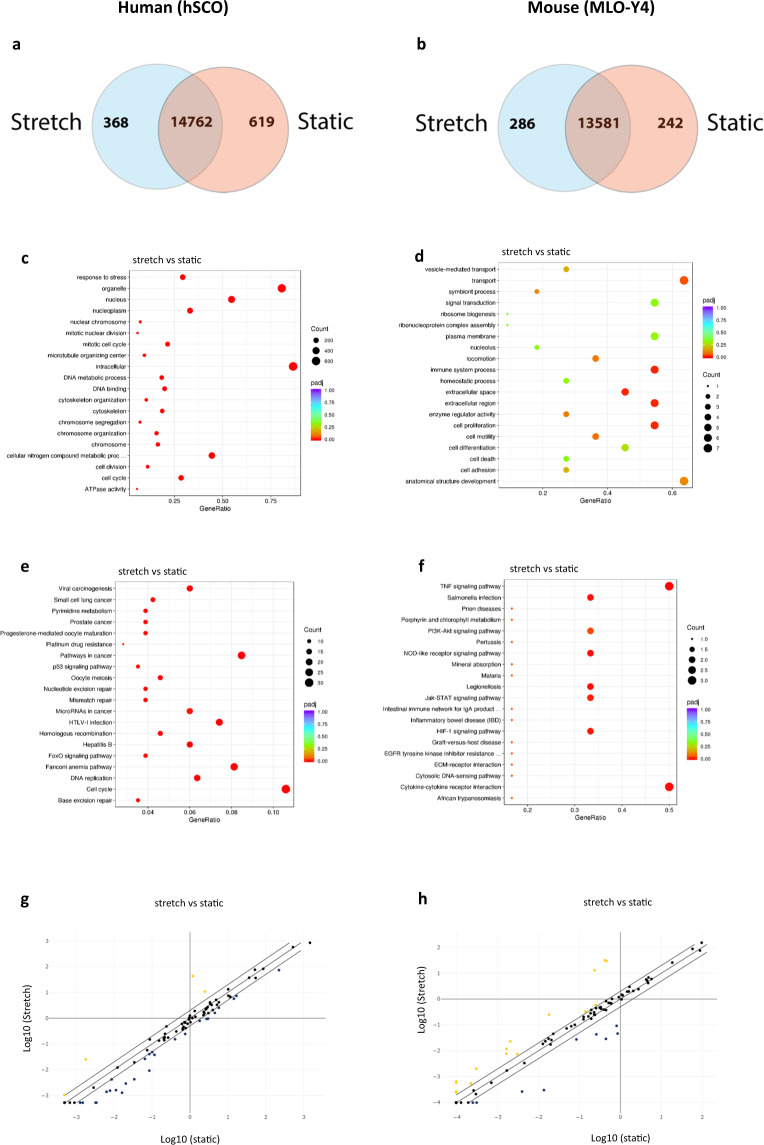
Exercise is a non-pharmacological intervention that can enhance bone regeneration and improve the management of bone conditions like osteoporosis or metastatic bone cancer. Therefore, it is gaining increasing importance in an emerging area of regenerative medicine-regenerative rehabilitation (RR). Osteocytes are mechanosensitive and secretory bone cells that orchestrate bone anabolism and hence postulated to be an attractive target of regenerative exercise interventions. However, the human osteocyte signalling pathways and processes evoked upon exercise remain to be fully identified. Making use of a computer-controlled bioreactor that mimics exercise and the latest omics approaches, RNA sequencing (RNA-seq) and tandem liquid chromatography-mass spectrometry (LC-MS), we mapped the transcriptome and secretome of mechanically stretched human osteocytic cells. We discovered that a single bout of cyclic stretch activated network processes and signalling pathways likely to modulate bone regeneration and cancer. Furthermore, a comparison between the transcriptome and secretome of stretched human and mouse osteocytic cells revealed dissimilar results, despite both species sharing evolutionarily conserved signalling pathways. These findings suggest that osteocytes can be targeted by exercise-driven RR protocols aiming to modulate bone regeneration or metastatic bone cancer.
运动是一种非药物干预措施,可促进骨再生,并改善对骨质疏松症或转移性骨癌等骨骼疾病的治疗。因此,它在再生医学的一个新兴领域——再生康复(RR)中变得越来越重要。骨细胞是机械敏感且具有分泌功能的骨细胞,可协调骨合成代谢,因此被认为是再生运动干预的一个有吸引力的靶点。然而,运动时诱发的人类骨细胞信号通路和过程仍有待充分确定。利用模拟运动的计算机控制生物反应器以及最新的组学方法,即RNA测序(RNA-seq)和串联液相色谱-质谱联用(LC-MS),我们绘制了机械拉伸的人类骨细胞的转录组和分泌组图谱。我们发现,单次循环拉伸激活了可能调节骨再生和癌症的网络过程和信号通路。此外,尽管人类和小鼠骨细胞在进化上共享保守的信号通路,但对拉伸后的人类和小鼠骨细胞的转录组和分泌组进行比较,结果却不尽相同。这些发现表明,旨在调节骨再生或转移性骨癌的运动驱动RR方案可以将骨细胞作为靶点。