Argueta Lissenya B, Lacko Lauretta A, Bram Yaron, Tada Takuya, Carrau Lucia, Zhang Tuo, Uhl Skyler, Lubor Brienne C, Chandar Vasuretha, Gil Cristianel, Zhang Wei, Dodson Brittany, Bastiaans Jeroen, Prabhu Malavika, Salvatore Christine M, Yang Yawei J, Baergen Rebecca N, tenOever Benjamin R, Landau Nathaniel R, Chen Shuibing, Schwartz Robert E, Stuhlmann Heidi
Department of Cell and Developmental Biology, Weill Cornell Medicine, 1300 York Avenue, New York 10065, NY, USA.
Department of Surgery, Weill Cornell Medicine, New York, NY, USA.
bioRxiv. 2021 Jun 17:2021.06.01.446676. doi: 10.1101/2021.06.01.446676.
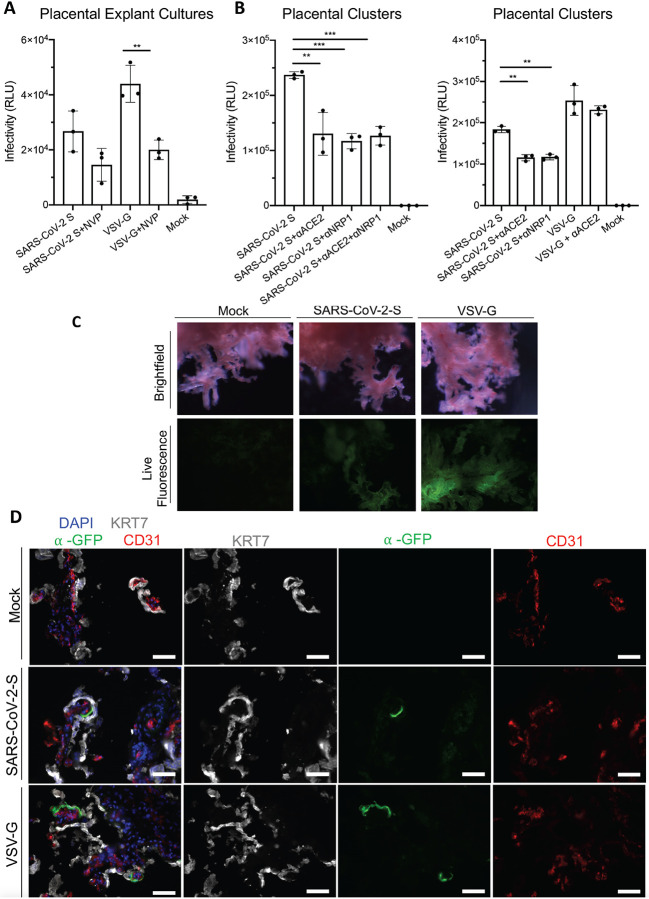
SARS-CoV-2 infection during pregnancy leads to an increased risk of adverse pregnancy outcomes. Although the placenta itself can be a target of virus infection, most neonates are virus free and are born healthy or recover quickly. Here, we investigated the impact of SARS-CoV-2 infection on the placenta from a cohort of women who were infected late during pregnancy and had tested nasal swab positive for SARS-CoV-2 by qRT-PCR at delivery. SARS-CoV-2 genomic and subgenomic RNA was detected in 23 out of 54 placentas. Two placentas with high virus content were obtained from mothers who presented with severe COVID-19 and whose pregnancies resulted in adverse outcomes for the fetuses, including intrauterine fetal demise and a preterm delivered baby still in newborn intensive care. Examination of the placental samples with high virus content showed efficient SARS-CoV-2 infection, using RNA in situ hybridization to detect genomic and replicating viral RNA, and immunohistochemistry to detect SARS-CoV-2 nucleocapsid protein. Infection was restricted to syncytiotrophoblast cells that envelope the fetal chorionic villi and are in direct contact with maternal blood. The infected placentas displayed massive infiltration of maternal immune cells including macrophages into intervillous spaces, potentially contributing to inflammation of the tissue. infection of placental cultures with SARS-CoV-2 or with SARS-CoV-2 spike (S) protein pseudotyped lentivirus targeted mostly syncytiotrophoblast and in rare events endothelial cells. Infection was reduced by using blocking antibodies against ACE2 and against Neuropilin 1, suggesting that SARS-CoV-2 may utilize alternative receptors for entry into placental cells.
孕期感染严重急性呼吸综合征冠状病毒2(SARS-CoV-2)会增加不良妊娠结局的风险。尽管胎盘本身可能是病毒感染的靶点,但大多数新生儿未感染病毒,出生时健康或很快康复。在此,我们对一组妊娠晚期感染SARS-CoV-2且分娩时经定量逆转录聚合酶链反应(qRT-PCR)检测鼻拭子呈阳性的女性的胎盘进行研究,以调查SARS-CoV-2感染对胎盘的影响。在54个胎盘中,有23个检测到SARS-CoV-2基因组和亚基因组RNA。从患有重症冠状病毒病2019(COVID-19)且妊娠导致胎儿出现不良结局(包括宫内胎儿死亡和一名早产婴儿仍在新生儿重症监护室)的母亲处获得了两个病毒含量高的胎盘。对病毒含量高的胎盘样本进行检查发现,使用RNA原位杂交检测基因组和复制中的病毒RNA,以及免疫组织化学检测SARS-CoV-2核衣壳蛋白,显示存在有效的SARS-CoV-2感染。感染局限于包裹胎儿绒毛膜绒毛并与母体血液直接接触的合体滋养层细胞。受感染的胎盘显示母体免疫细胞大量浸润到绒毛间隙,包括巨噬细胞,这可能导致组织炎症。用SARS-CoV-2或SARS-CoV-2刺突(S)蛋白假型慢病毒感染胎盘培养物,主要靶向合体滋养层,偶尔靶向内皮细胞。使用针对血管紧张素转换酶2(ACE2)和针对神经纤毛蛋白1的阻断抗体可减少感染,这表明SARS-CoV-2可能利用替代受体进入胎盘细胞。