Department of Obstetrics, Gynecology and Reproductive Biology, Massachusetts General Hospital, Harvard Medical School, Boston.
Vincent Center for Reproductive Biology, Massachusetts General Hospital, Boston.
JAMA Netw Open. 2020 Dec 1;3(12):e2030455. doi: 10.1001/jamanetworkopen.2020.30455.
Biological data are lacking with respect to risk of vertical transmission and mechanisms of fetoplacental protection in maternal severe acute respiratory syndrome coronavirus 2 (SARS-CoV-2) infection.
To quantify SARS-CoV-2 viral load in maternal and neonatal biofluids, transplacental passage of anti-SARS-CoV-2 antibody, and incidence of fetoplacental infection.
DESIGN, SETTING, AND PARTICIPANTS: This cohort study was conducted among pregnant women presenting for care at 3 tertiary care centers in Boston, Massachusetts. Women with reverse transcription-polymerase chain reaction (RT-PCR) results positive for SARS-CoV-2 were recruited from April 2 to June 13, 2020, and follow-up occurred through July 10, 2020. Contemporaneous participants without SARS-CoV-2 infection were enrolled as a convenience sample from pregnant women with RT-PCR results negative for SARS-CoV-2.
SARS-CoV-2 infection in pregnancy, defined by nasopharyngeal swab RT-PCR.
The main outcomes were SARS-CoV-2 viral load in maternal plasma or respiratory fluids and umbilical cord plasma, quantification of anti-SARS-CoV-2 antibodies in maternal and cord plasma, and presence of SARS-CoV-2 RNA in the placenta.
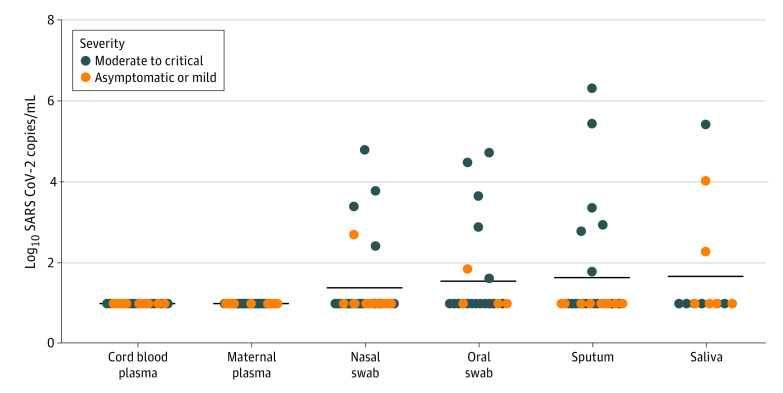
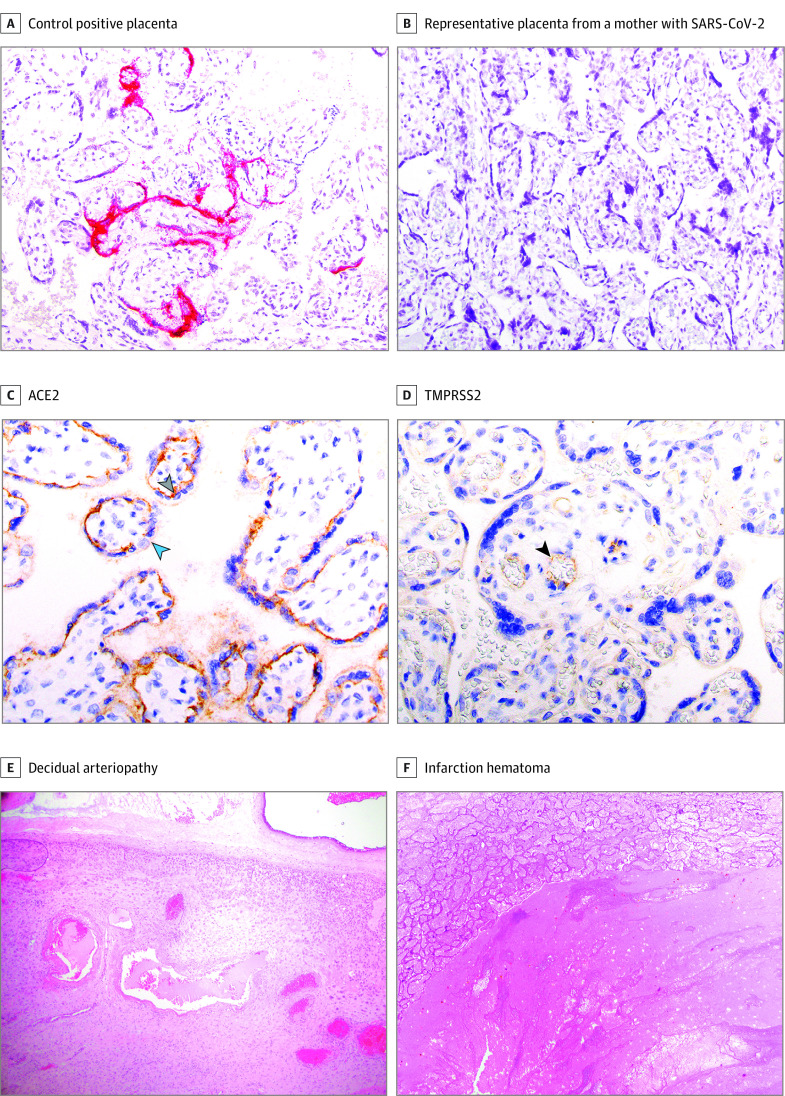
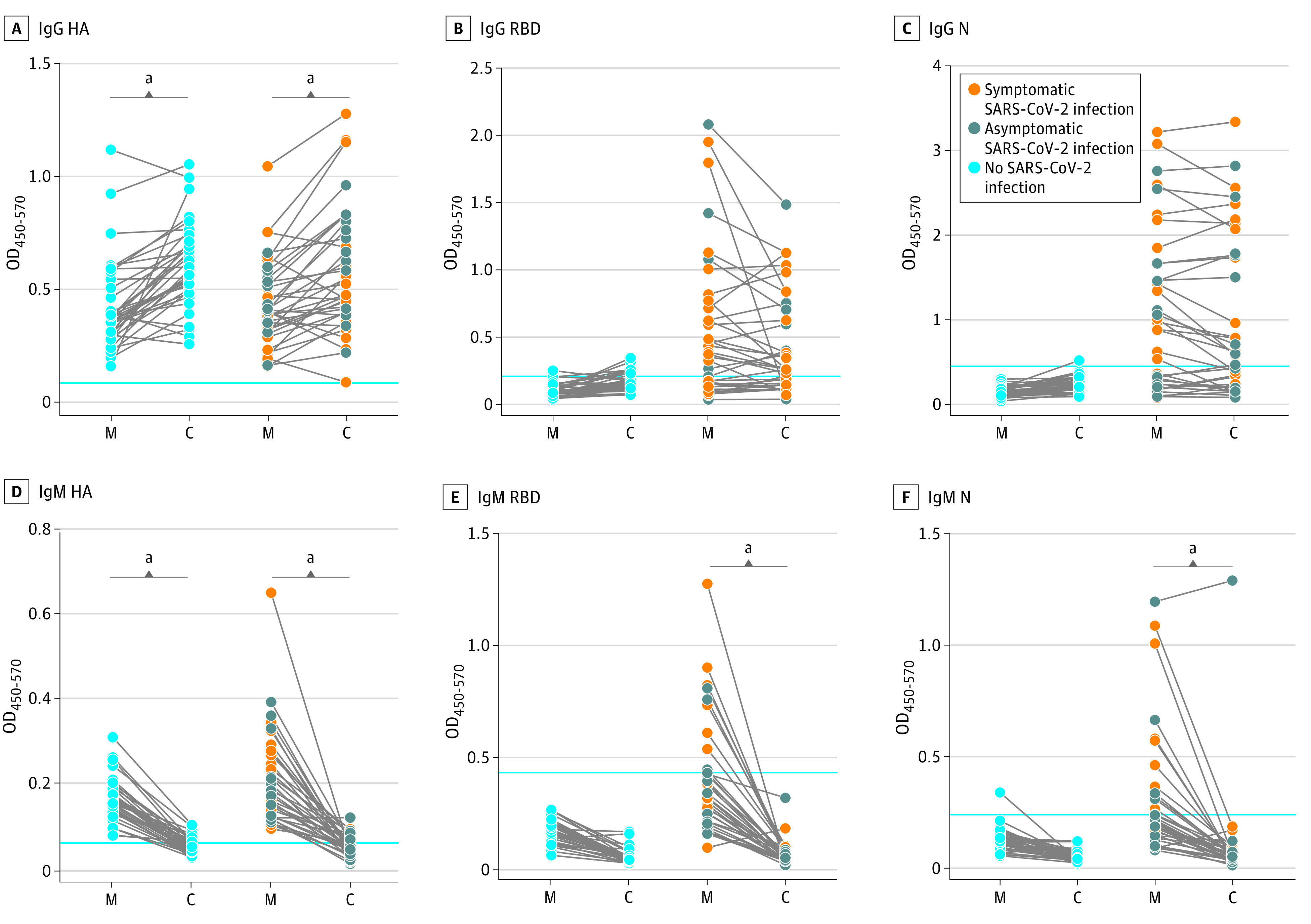
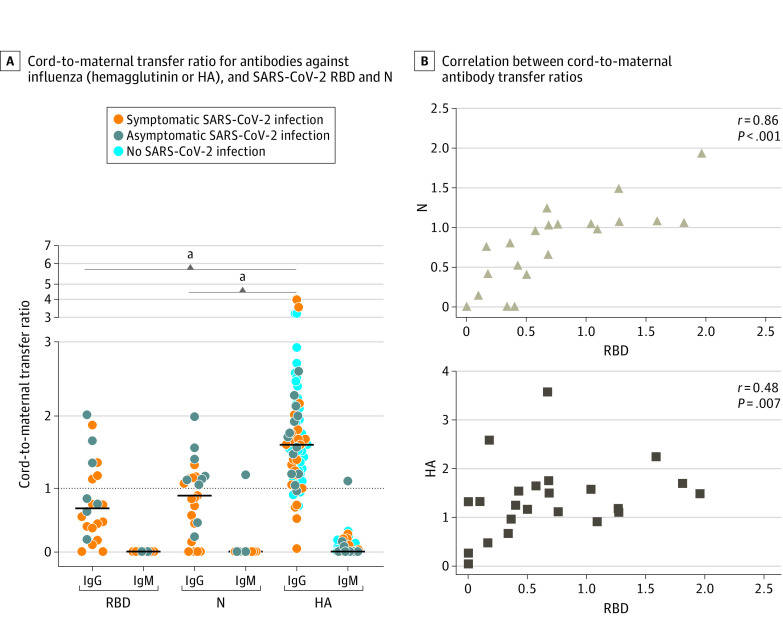
Among 127 pregnant women enrolled, 64 with RT-PCR results positive for SARS-CoV-2 (mean [SD] age, 31.6 [5.6] years) and 63 with RT-PCR results negative for SARS-CoV-2 (mean [SD] age, 33.9 [5.4] years) provided samples for analysis. Of women with SARS-CoV-2 infection, 23 (36%) were asymptomatic, 22 (34%) had mild disease, 7 (11%) had moderate disease, 10 (16%) had severe disease, and 2 (3%) had critical disease. In viral load analyses among 107 women, there was no detectable viremia in maternal or cord blood and no evidence of vertical transmission. Among 77 neonates tested in whom SARS-CoV-2 antibodies were quantified in cord blood, 1 had detectable immunoglobuilin M to nucleocapsid. Among 88 placentas tested, SARS-CoV-2 RNA was not detected in any. In antibody analyses among 37 women with SARS-CoV-2 infection, anti-receptor binding domain immunoglobin G was detected in 24 women (65%) and anti-nucleocapsid was detected in 26 women (70%). Mother-to-neonate transfer of anti-SARS-CoV-2 antibodies was significantly lower than transfer of anti-influenza hemagglutinin A antibodies (mean [SD] cord-to-maternal ratio: anti-receptor binding domain immunoglobin G, 0.72 [0.57]; anti-nucleocapsid, 0.74 [0.44]; anti-influenza, 1.44 [0.80]; P < .001). Nonoverlapping placental expression of SARS-CoV-2 receptors angiotensin-converting enzyme 2 and transmembrane serine protease 2 was noted.
In this cohort study, there was no evidence of placental infection or definitive vertical transmission of SARS-CoV-2. Transplacental transfer of anti-SARS-CoV-2 antibodies was inefficient. Lack of viremia and reduced coexpression and colocalization of placental angiotensin-converting enzyme 2 and transmembrane serine protease 2 may serve as protective mechanisms against vertical transmission.
关于母体严重急性呼吸综合征冠状病毒 2(SARS-CoV-2)感染的垂直传播风险和胎盘中保护机制,生物学数据尚属缺乏。
定量检测母胎生物体液中的 SARS-CoV-2 病毒载量、抗 SARS-CoV-2 抗体的胎盘转导以及胎盘中 SARS-CoV-2 感染的发生率。
设计、地点和参与者:这是一项在马萨诸塞州波士顿的 3 家三级保健中心进行的孕妇队列研究。招募了鼻咽拭子逆转录聚合酶链反应(RT-PCR)结果为 SARS-CoV-2 阳性的孕妇,时间为 2020 年 4 月 2 日至 6 月 13 日,随访截止日期为 2020 年 7 月 10 日。同时招募了 RT-PCR 结果为 SARS-CoV-2 阴性的孕妇作为方便样本,作为没有 SARS-CoV-2 感染的对照。
孕期 SARS-CoV-2 感染,通过鼻咽拭子 RT-PCR 检测。
主要结局为母血浆或呼吸道液和脐带血浆中的 SARS-CoV-2 病毒载量、母血和脐带血中抗 SARS-CoV-2 抗体的定量检测以及胎盘 SARS-CoV-2 RNA 的存在。
在 127 名入组的孕妇中,64 名 RT-PCR 结果为 SARS-CoV-2 阳性(平均[标准差]年龄,31.6[5.6]岁),63 名 RT-PCR 结果为 SARS-CoV-2 阴性(平均[标准差]年龄,33.9[5.4]岁)提供了样本进行分析。在 SARS-CoV-2 感染的孕妇中,23 名(36%)为无症状,22 名(34%)为轻症,7 名(11%)为中度,10 名(16%)为重症,2 名(3%)为危重症。在 107 名孕妇的病毒载量分析中,母血和脐带血中均未检测到病毒血症,也没有垂直传播的证据。在 77 名新生儿的 SARS-CoV-2 抗体检测中,1 名新生儿脐带血中检测到可检测的免疫球蛋白 M 对核衣壳。在 88 个胎盘检测中,均未检测到 SARS-CoV-2 RNA。在 37 名患有 SARS-CoV-2 感染的孕妇的抗体分析中,24 名(65%)孕妇检测到抗受体结合域免疫球蛋白 G,26 名(70%)孕妇检测到抗核衣壳。与抗流感血凝素 A 抗体的转导相比,母体向胎儿的 SARS-CoV-2 抗体转导明显降低(抗受体结合域免疫球蛋白 G,脐带至母体的比值:0.72[0.57];抗核衣壳,0.74[0.44];抗流感,1.44[0.80];P<0.001)。观察到胎盘 SARS-CoV-2 受体血管紧张素转换酶 2 和跨膜丝氨酸蛋白酶 2 的非重叠表达。
在这项队列研究中,没有证据表明胎盘感染或 SARS-CoV-2 的明确垂直传播。SARS-CoV-2 抗体向胎盘的转移效率较低。缺乏病毒血症以及胎盘血管紧张素转换酶 2 和跨膜丝氨酸蛋白酶 2 的共表达和共定位减少,可能是防止垂直传播的保护机制。