Bejleri Jorin, Jirström Elisabeth, Donovan Paul, Williams David J, Pfeiffer Shona
Department of Physiology and Medical Physics, Royal College of Surgeons in Ireland, Dublin, Ireland.
Department of Geriatric & Stroke Medicine, Beaumont Hospital, Royal College of Surgeons in Ireland, Dublin, Ireland.
J Stroke. 2021 May;23(2):162-182. doi: 10.5853/jos.2020.05085. Epub 2021 May 31.
Stroke is the second leading cause of death and disability worldwide and its diagnosis, and assessment of prognosis, remains challenging. There is a need for improved diagnostic and prognostic biomarkers. MicroRNAs (miRNAs) play important roles in the post-transcriptional regulation of gene expression and their secretion and remarkable stability in biofluids highlights their potential as sensitive biomarkers in the diagnosis and prognosis of acute stroke.
We carried out a systematic review to assess current evidence supporting the potential of miRNAs to act as unique diagnostic and prognostic biomarkers in blood samples collected from patients suffering acute stroke within 24 hours of symptoms onset.
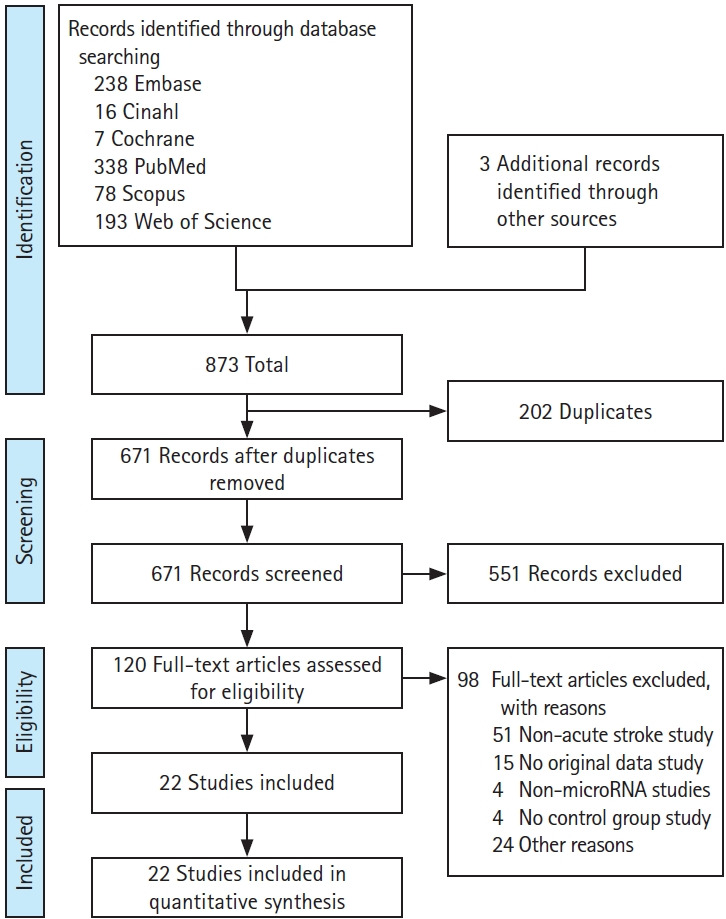
We identified 22 studies eligible for inclusion with 33 dysregulated miRNAs having diagnostic potential in the acute phase of the disease. We identified miR-16, miR-126, and miR-335 as having the highest sensitivity as diagnostic and prognostic biomarkers in acute ischaemic stroke and present original bioinformatic and pathway enrichment analysis of putative miRNA-target interactions.
miRNAs represent unique biomarkers which have a promising future in stroke diagnosis and prognosis. However, there is a need for more standardized and consistent methodology for the accurate interpretation and translation of miRNAs as novel specific and sensitive biomarkers into clinical practice.
中风是全球第二大致死和致残原因,其诊断及预后评估仍具有挑战性。因此需要改进诊断和预后生物标志物。微小RNA(miRNA)在基因表达的转录后调控中发挥重要作用,其在生物流体中的分泌及显著稳定性凸显了它们作为急性中风诊断和预后敏感生物标志物的潜力。
我们进行了一项系统综述,以评估目前支持miRNA作为独特诊断和预后生物标志物潜力的证据,这些证据来自于在症状发作24小时内采集的急性中风患者的血样。
我们确定了22项符合纳入标准的研究,其中33种失调的miRNA在疾病急性期具有诊断潜力。我们确定miR-16、miR-126和miR-335作为急性缺血性中风诊断和预后生物标志物具有最高的敏感性,并展示了对假定的miRNA-靶标相互作用的原始生物信息学和通路富集分析。
miRNA代表了独特的生物标志物,在中风诊断和预后方面有着广阔的前景。然而,需要更标准化和一致的方法来准确解释miRNA,并将其作为新型特异性和敏感生物标志物转化应用于临床实践。