Olindo Stephane, Chausson Nicolas, Signate Aissatou, Mecharles Sylvie, Hennequin Jean-Luc, Saint-Vil Martine, Edimonana-Kaptue Mireille, Jeannin Severine, Landais Anne, Cabre Philippe, Sibon Igor, Smadja Didier, Joux Julien
Stroke Unit, Bordeaux University Hospital, Bordeaux, France.
Neurology Department, Sud-Francilien Hospital, Corbeil-Essonnes, France.
J Stroke. 2021 May;23(2):253-262. doi: 10.5853/jos.2020.05225. Epub 2021 May 31.
Carotid web (CaW) is an intimal variant of fibromuscular dysplasia responsible for ipsilateral cerebral ischemic events (CIE). Symptomatic CaW likely has a high risk of recurrent CIE, but no salient prospective data are available. We aimed to assess recurrence rate and its predictors after a first-ever CIE.
Consecutive Afro-Caribbean patients who had cryptogenic first-ever CIEs (ischemic stroke [IS] or transient ischemic attack [TIA]) associated with ipsilateral CaW were included in this multicenter observational cohort study. The follow-up (January 2008 to March 2019) focused on CIE recurrences. Kaplan-Meier method assessed rates of recurrences and Cox proportional hazards regression analyzed risk factors.
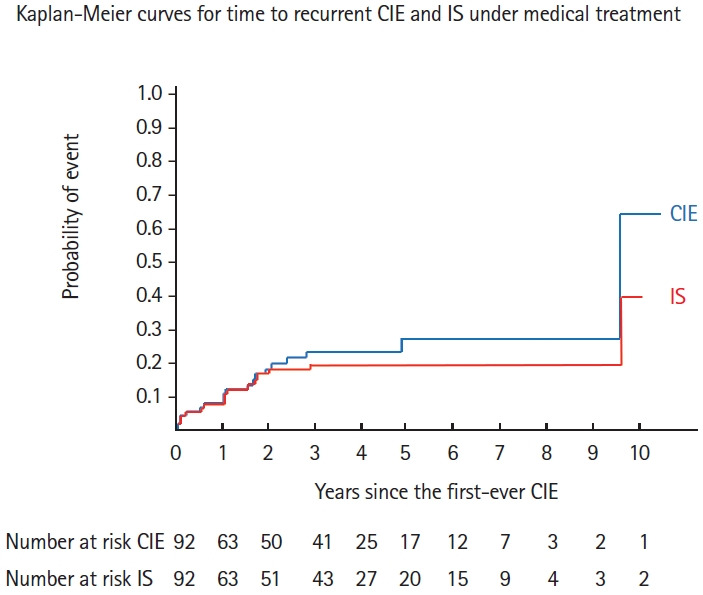
Ninety-two patients (79 first-ever ISs and 13 TIAs; mean age±standard deviation, 49.8±9.9 years; 52 [56.5%] women) were included. During a mean follow-up of 50.5±29.6 months, 19 (20.7%) patients experienced recurrent ipsilateral CIEs (16 ISs and three TIAs). Of 23 patients receiving surgery/stenting treatment, no recurrence occurred after the intervention (median follow-up, 39.8 months [interquartile range, 27.6 to 72.4]). Under medical treatment alone, the annual recurrent CIE rate was 6.9%, and the cumulative rate was 4.4% at 30-day, 10.8% at 1-year, 19.8% at 2-year, 23.2% at 3-year, and 27.3% at 5-year. Presence of silent cerebral infarctions was the only independent risk factor of CIE recurrences (hazard ratio, 6.99; 95% confidence interval, 2.4 to 20.4; P=0.004).
Under medical treatment alone, symptomatic CaW was associated with a high rate of recurrence that reached 27.3% at 5-year. Surgery/stenting seems to be efficient, and randomized control trials are required to confirm the benefit of these interventions.
颈动脉纤维肌性发育不良内膜变异型(颈动脉纤维肌性发育不良内膜变异型)是导致同侧脑缺血事件(CIE)的原因。有症状的颈动脉纤维肌性发育不良内膜变异型可能具有较高的CIE复发风险,但尚无显著的前瞻性数据。我们旨在评估首次CIE后的复发率及其预测因素。
本多中心观察性队列研究纳入了连续的非裔加勒比患者,这些患者首次发生与同侧颈动脉纤维肌性发育不良内膜变异型相关的不明原因CIE(缺血性卒中[IS]或短暂性脑缺血发作[TIA])。随访(2008年1月至2019年3月)重点关注CIE复发情况。采用Kaplan-Meier方法评估复发率,Cox比例风险回归分析危险因素。
纳入92例患者(79例首次发生IS,13例TIA;平均年龄±标准差,49.8±9.9岁;52例[56.5%]为女性)。在平均50.5±29.6个月的随访期间,19例(20.7%)患者发生同侧CIE复发(16例IS和3例TIA)。在23例接受手术/支架治疗的患者中,干预后未发生复发(中位随访时间,39.8个月[四分位间距,27.6至72.4])。仅接受药物治疗时,CIE年复发率为6.9%,30天时累积复发率为4.4%,1年时为10.8%,2年时为19.8%,3年时为可编辑,5年时为27.3%。无症状性脑梗死的存在是CIE复发的唯一独立危险因素(风险比,6.99;95%置信区间,2.4至20.4;P=0.004)。
仅接受药物治疗时,有症状的颈动脉纤维肌性发育不良内膜变异型与较高的复发率相关,5年时复发率达到27.3%。手术/支架治疗似乎有效,需要进行随机对照试验以证实这些干预措施的益处。