Department of Neurology, Brown University, Providence, Rhode Island, USA.
Department of Neurosurgery, Brown University, Providence, Rhode Island, USA.
Ann Clin Transl Neurol. 2024 Sep;11(9):2450-2456. doi: 10.1002/acn3.52161. Epub 2024 Aug 30.
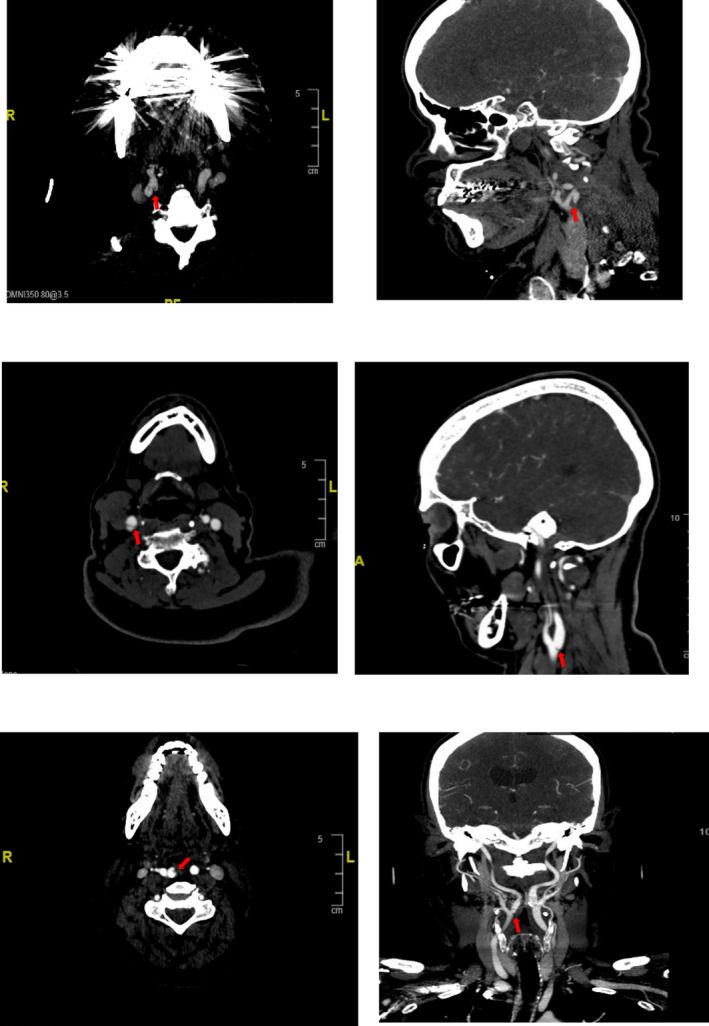
Carotid artery web is a possible cause of ischemic stroke, especially in young patients who lack conventional risk factors. The immediate and long-term outcomes are not well studied. We aimed to determine the association between an ipsilateral carotid web and in-hospital stroke recurrence.
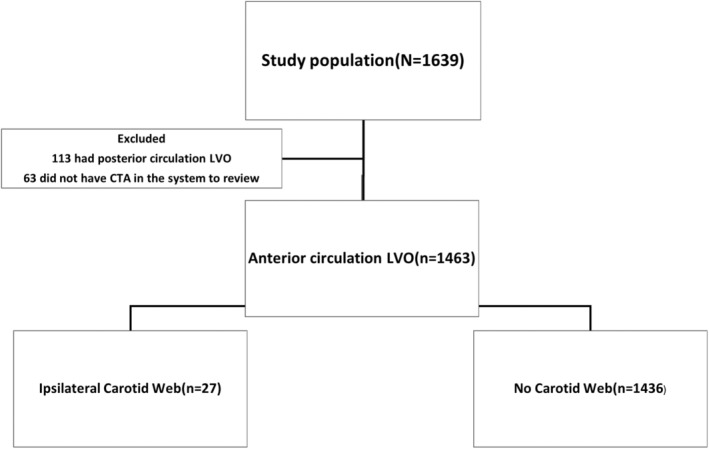
We analyzed data from adult patients admitted with an acute anterior circulation large vessel occlusion at a Comprehensive Stroke Center between July 2015 and March 2023. The primary outcome was in-hospital stroke recurrence and secondary outcome was in-hospital recurrent LVO. Multivariable logistic regression was performed to examine the association between ipsilateral carotid web and recurrent ischemic stroke and recurrent LVO.
Of the 1463 patients with anterior circulation large vessel occlusion, 27 (1.8%) had an ipsilateral carotid artery web. Patients with carotid web were younger (median age (IQR), 60 years (53-67 years) versus 74 years (62-84 years), P < 0.01) and less likely to be Caucasian (60% vs. 80%, p = 0.014). Of the 27 patients with carotid web, 18 (70%) had no identifiable competing stroke mechanism. When compared to patients without ipsilateral carotid web, those with an ipsilateral carotid web had a higher risk of recurrent ischemic stroke (adjusted RR: 4.38, 95% CI: 1.38-13.85) and recurrent ipsilateral large vessel occlusion (adjusted RR: 4.49, 95% CI: 1.41-14.21).
Carotid webs are an under recognized cause of acute large vessel occlusion and are associated with higher risk of early recurrence. Studies are needed to validate our findings and test early revascularization strategies in patients with symptomatic carotid artery webs.
颈动脉壁是缺血性卒中的一个可能原因,尤其是在缺乏传统危险因素的年轻患者中。目前对其即刻和长期预后尚未进行充分研究。本研究旨在确定同侧颈动脉壁与住院期间卒中复发之间的关系。
我们分析了 2015 年 7 月至 2023 年 3 月在综合卒中中心因急性前循环大血管闭塞而入院的成年患者的数据。主要结局为住院期间卒中复发,次要结局为住院期间再次发生大血管闭塞性卒中。采用多变量逻辑回归分析同侧颈动脉壁与复发性缺血性卒中和再次发生大血管闭塞性卒中之间的关系。
在 1463 例前循环大血管闭塞患者中,有 27 例(1.8%)存在同侧颈动脉壁。颈动脉壁患者更年轻(中位数年龄(IQR),60 岁(53-67 岁)与 74 岁(62-84 岁),P<0.01),且更不可能为白种人(60%与 80%,P=0.014)。在 27 例颈动脉壁患者中,18 例(70%)无明确的其他卒中机制。与无同侧颈动脉壁的患者相比,同侧颈动脉壁患者复发性缺血性卒中的风险更高(校正比值比:4.38,95%CI:1.38-13.85)和同侧大血管闭塞的风险更高(校正比值比:4.49,95%CI:1.41-14.21)。
颈动脉壁是急性大血管闭塞的一个未被充分认识的原因,与早期复发的风险增加相关。需要开展研究以验证我们的发现,并测试有症状的颈动脉壁患者的早期血管再通策略。