Department of Pediatric Nephrology, School of Medicine, Tokyo Women's Medical University, 8-1 Kawada-cho, Shinjuku-ku, Tokyo, 162-8666, Japan.
Department of Pediatrics, Yamagata University School of Medicine, Yamagata, Japan.
Sci Rep. 2021 Jun 8;11(1):12008. doi: 10.1038/s41598-021-91520-9.
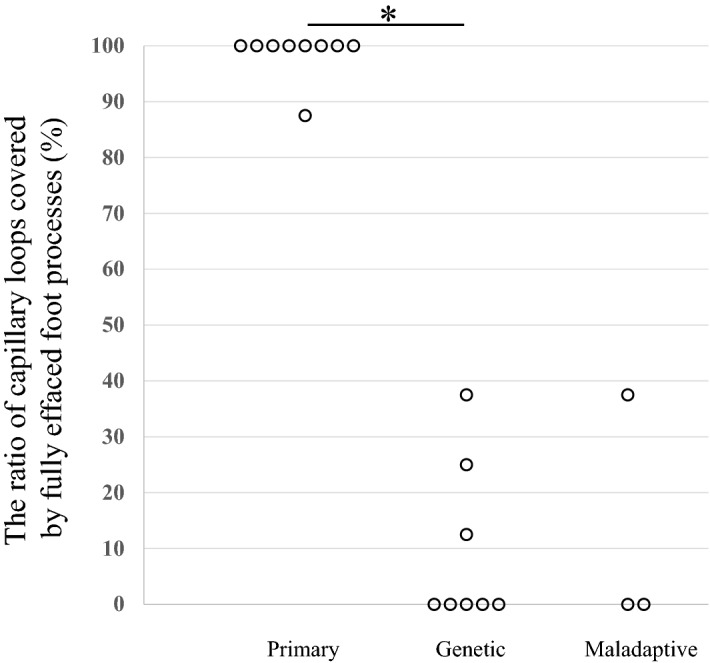
Determining the cause of focal segmental glomerulosclerosis (FSGS) has crucial implications for evaluating the risk of posttransplant recurrence. The degree of foot process effacement (FPE) on electron micrographs (EM) of native kidney biopsies can reportedly differentiate primary FSGS from secondary FSGS. However, no systematic evaluation of FPE in genetic FSGS has been performed. In this study, percentage of FPE and foot process width (FPW) in native kidney biopsies were analyzed in eight genetic FSGS patients and nine primary FSGS patients. All genetic FSGS patients showed segmental FPE up to 38% and FPW below 2000 nm, while all primary FSGS patients showed diffuse FPE above 88% and FPW above 3000 nm. We reviewed the literature which described the degree of FPE in genetic FSGS patients and identified 38 patients with a description of the degree of FPE. The degree of FPE in patients with mutations in the genes encoding proteins associated with slit diaphragm and cytoskeletal proteins was varied, while almost all patients with mutations in other FSGS genes showed segmental FPE. In conclusion, the present study suggests that the degree of FPE in native kidney biopsies may be useful for differentiating some genetic FSGS patients from primary FSGS patients.
确定局灶节段性肾小球硬化症(FSGS)的病因对评估移植后复发的风险具有重要意义。据报道,原发性 FSGS 和继发性 FSGS 可通过对原发性肾脏活检的电子显微镜(EM)上足突融合(FPE)的程度来区分。然而,尚未对遗传 FSGS 中的 FPE 进行系统评估。在这项研究中,对 8 名遗传 FSGS 患者和 9 名原发性 FSGS 患者的原发性肾脏活检中的 FPE 百分比和足突宽度(FPW)进行了分析。所有遗传 FSGS 患者均显示节段性 FPE 达 38%,FPW 低于 2000nm,而所有原发性 FSGS 患者均显示弥漫性 FPE 超过 88%,FPW 超过 3000nm。我们复习了描述遗传 FSGS 患者 FPE 程度的文献,并确定了 38 名描述了 FPE 程度的患者。编码与裂孔隔膜和细胞骨架蛋白相关的蛋白的基因突变患者的 FPE 程度不同,而几乎所有其他 FSGS 基因突变患者均显示节段性 FPE。总之,本研究表明,原发性肾脏活检中的 FPE 程度可能有助于区分一些遗传 FSGS 患者和原发性 FSGS 患者。