Department of Neonatology, Beatrix Children's Hospital, University Medical Center Groningen, University of Groningen, P.O. Box 30.001, 9700, RB, Groningen, the Netherlands.
Department of Neonatology, Wilhelmina Children's Hospital, University Medical Center Utrecht, Utrecht, the Netherlands.
Eur J Pediatr. 2021 Dec;180(12):3491-3497. doi: 10.1007/s00431-021-04139-3. Epub 2021 Jun 9.
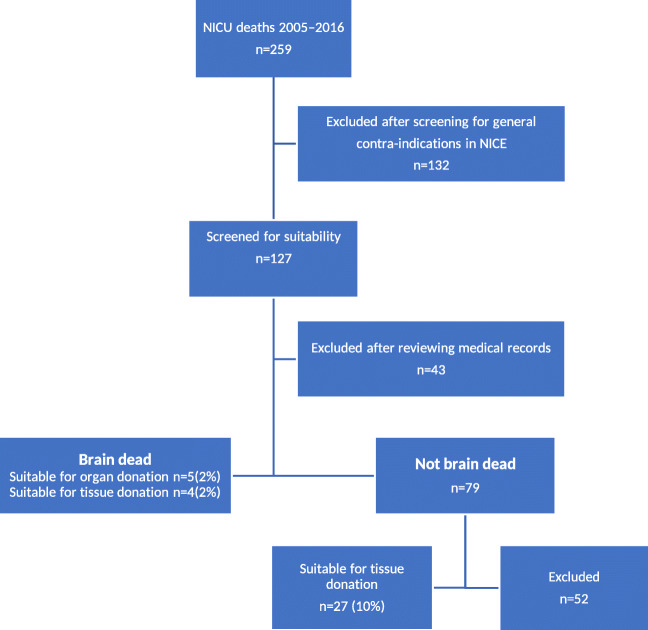
Neonatal organ and tissue donation is not common practice in the Netherlands. At the same time, there is a transplant waiting list for small size-matched organs and tissues. Multiple factors may contribute to low neonatal donation rates, including a lack of awareness of this option. This study provides insight into potential neonatal organ and tissue donors and reports on how many donors were actually reported to the procurement organization. We performed a retrospective analysis of the mortality database and medical records of two largest neonatal intensive care units (NICUs) in the Netherlands. This study reviewed records of neonates with a gestational age >37 weeks and weight >3000g who died in the period from January 1, 2005 through December 31, 2016. During the study period, 259 term-born neonates died in the two NICUs. In total, 132 neonates with general contra-indications for donation were excluded. The medical records of 127 neonates were examined for donation suitability. We identified five neonates with documented brain death who were not recognized as potential organ and/or tissue donors. Of the remaining neonates, 27 were found suitable for tissue donation. One potential tissue donor had been reported to the procurement organization. In three cases, the possibility of donation was brought up by parents.Conclusion: A low proportion (2%) of neonates who died in the NICUs were found suitable for organ donation, and a higher proportion (12%) were found suitable for tissue donation. We suggest that increased awareness concerning the possibility of neonatal donation would likely increase the identification of potential neonatal donors. What is Known: • There is an urgent need for very small organs and tissues from neonatal donors What is New: • A number of neonates who died in the NICU were suitable organ or/and tissue donors but were not recognized as donors. • Knowledge on neonatal donation possibilities is also important for proper counseling of parents who sometimes inquire for the possibility of organ and tissue donation.
新生儿器官和组织捐赠在荷兰并不常见。与此同时,对于匹配的小尺寸器官和组织,存在着移植等待名单。多种因素可能导致新生儿捐赠率低,包括对这种选择缺乏认识。本研究提供了对潜在新生儿器官和组织供体的深入了解,并报告了实际向采购组织报告的供体数量。我们对荷兰两家最大的新生儿重症监护病房(NICU)的死亡率数据库和病历进行了回顾性分析。这项研究回顾了 2005 年 1 月 1 日至 2016 年 12 月 31 日期间在这两个 NICU 中死亡的胎龄>37 周且体重>3000g 的新生儿的记录。在研究期间,这两个 NICU 中有 259 名足月出生的新生儿死亡。总共排除了 132 名有一般捐赠禁忌症的新生儿。检查了 127 名新生儿的病历,以确定其捐赠的适宜性。我们发现了 5 名记录在案的脑死亡但未被确认为潜在器官和/或组织供体的新生儿。在其余的新生儿中,有 27 名被认为适合组织捐赠。一名潜在的组织供体已向采购组织报告。在三种情况下,父母提出了捐赠的可能性。结论:在 NICU 中死亡的新生儿中,只有一小部分(2%)适合器官捐赠,而适合组织捐赠的比例较高(12%)。我们建议,提高对新生儿捐赠可能性的认识,可能会增加对潜在新生儿供体的识别。已知的是:• 非常需要来自新生儿供体的非常小的器官和组织。新的是:• 许多在 NICU 中死亡的新生儿是合适的器官或/和组织供体,但未被确认为供体。• 对新生儿捐赠可能性的了解对于正确咨询有时会询问器官和组织捐赠可能性的父母也很重要。