School of Biological Sciences, The University of Queensland, Brisbane, QLD, 4072, Australia.
School of Earth and Environmental Sciences, The University of Queensland, Brisbane, QLD, 4072, Australia.
Sci Rep. 2021 Jun 9;11(1):12158. doi: 10.1038/s41598-021-91717-y.
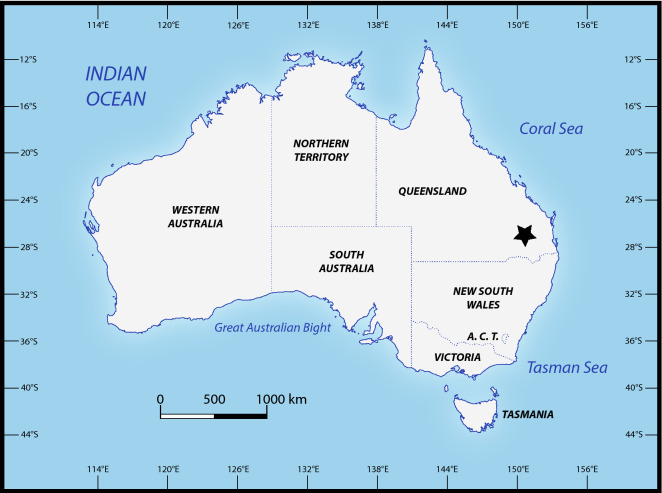
Based on the known fossil record, the majority of crocodylians from the Cenozoic Era of Australia are referred to the extinct clade Mekosuchinae. The only extant crocodylians in Australia are two species of Crocodylus. Hence, the viewpoint that Crocodylus and mekosuchines have been the only crocodylians inhabiting Australia during the Cenozoic has remained largely undisputed. Herein we describe Australia's first tomistomine crocodylian, Gunggamarandu maunala gen. et sp. nov., thus challenging the notion of mekosuchine dominance during most of the Cenozoic. The holotype specimen of Gunggamarandu maunala derives from the Pliocene or Pleistocene of south-eastern Queensland, marking the southern-most global record for Tomistominae. Gunggamarandu maunala is known from a large, incomplete cranium that possesses a unique combination of features that distinguishes it from other crocodylians. Phylogenetic analyses place Gunggamarandu in a basal position within Tomistominae, specifically as a sister taxon to Dollosuchoides from the Eocene of Europe. These results hint at a potential ghost lineage between European and Australian tomistomines going back more than 50 million years. The cranial proportions of the Gunggamarandu maunala holotype specimen indicate it is the largest crocodyliform yet discovered from Australia.
基于已知的化石记录,澳大利亚新生代的大多数鳄类被归入已灭绝的鳄形超目 Mekosuchinae。澳大利亚现存的鳄类只有两种鳄属(Crocodylus)。因此,在新生代期间,鳄属和 Mekosuchinae 一直是唯一栖息在澳大利亚的鳄类这一观点在很大程度上没有受到质疑。本文描述了澳大利亚的第一个似鳄龙科鳄类,Gunggamarandu maunala 属和种,这一发现挑战了在新生代大部分时间里 Mekosuchinae 占主导地位的观点。Gunggamarandu maunala 的正型标本来自昆士兰州东南部的上新世或更新世,这是全球记录最南端的似鳄龙科化石。Gunggamarandu maunala 仅知一个大型的不完整头骨,具有独特的特征组合,使其与其他鳄类区别开来。系统发育分析将 Gunggamarandu 置于似鳄龙科的基部位置,特别是作为欧洲始新世的 Dollosuchoides 的姐妹分类群。这些结果暗示了欧洲和澳大利亚似鳄龙科之间可能存在超过 5000 万年的潜在幽灵谱系。Gunggamarandu maunala 正型标本的头骨比例表明,它是迄今为止在澳大利亚发现的最大的鳄形目动物。