
中国上海 60 岁及以上老年人 23 价肺炎球菌多糖疫苗项目的成本效益分析。
Cost-Effectiveness Analysis of 23-Valent Pneumococcal Polysaccharide Vaccine Program for the Elderly Aged 60 Years or Older in Shanghai, China.
机构信息
Shanghai Municipal Center for Disease Control and Prevention, Shanghai, China.
School of Public Health, Fudan University, Shanghai, China.
出版信息
Front Public Health. 2021 May 24;9:647725. doi: 10.3389/fpubh.2021.647725. eCollection 2021.
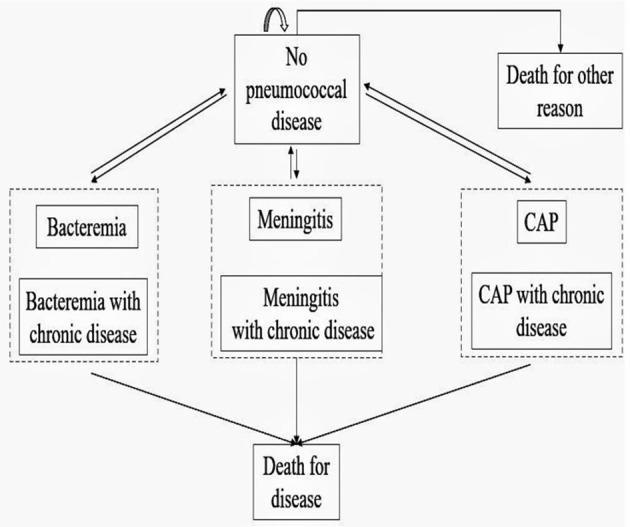
The pneumococcal vaccine has been considered as the most effective measure to prevent pneumococcal diseases. In 2013, Shanghai launched a major public health program to vaccinate people aged 60 years or older with 23-Valent Pneumococcal Polysaccharide Vaccine (PPSV-23) free of charge. By the end of June 2020, a total of 1.56 million old people had been vaccinated free of charge. To evaluate the cost-effectiveness of PPSV-23 vaccination program in Shanghai from the health system perspective. According to the actual number of people aged 60 years or older with PPSV-23 vaccination in Shanghai from 2013 to 2018, a multi-cohort Markov model for life-time was developed to compare health and economic outcomes of vaccinated people vs. if they were not vaccinated for PPSV-23. Cost effectiveness was reported as incremental cost effectiveness ratio (ICER). A 5% discount rate was used for both costs and health outcomes. In addition, one-way sensitivity analysis was used to test the model's robustness. By the end of 2018, a total of 1,091,967 people aged 60 years or older were vaccinated with PPSV-23 in Shanghai, China. Comparing with the unvaccinated circumstances, PPSV-23 vaccination would cost US $19.62 million more and receive an additional 10,321.3 quality-adjusted life-year (QALY). PPSV-23 was associated with the ICER of $190.1 per QALY gained. The Results were sensitive to the variation of vaccine effectiveness against community-acquired pneumonia (CAP), and disease incidence, mortality, and costs of CAP. In all sensitivity analysis, the PPSV-23 was economical. The PPSV-23 vaccination program in Shanghai was cost-effective. With the further development of the project, the administrative costs of the vaccine will be reduced, making it more cost-effective.
肺炎球菌疫苗被认为是预防肺炎球菌疾病最有效的措施。2013 年,上海启动了一项重大公共卫生项目,为 60 岁及以上人群免费接种 23 价肺炎球菌多糖疫苗(PPSV-23)。截至 2020 年 6 月底,共有 156 万人免费接种了疫苗。 从卫生系统角度评估上海 23 价肺炎球菌多糖疫苗(PPSV-23)接种项目的成本效益。 根据上海 2013 年至 2018 年 PPSV-23 接种的实际 60 岁及以上人群数量,建立了终生多队列马尔可夫模型,以比较接种人群与未接种 PPSV-23 人群的健康和经济结果。成本效益以增量成本效益比(ICER)报告。成本和健康结果均采用 5%的贴现率。此外,还进行了单向敏感性分析以检验模型的稳健性。 截至 2018 年底,上海共有 1091967 名 60 岁及以上人群接种了 PPSV-23。与未接种人群相比,PPSV-23 接种将多花费 1962 万美元,但会额外获得 10321.3 个质量调整生命年(QALY)。PPSV-23 的增量成本效益比为 190.1 美元/QALY。结果对疫苗对社区获得性肺炎(CAP)的有效性、CAP 的发病率、死亡率和成本的变化敏感。在所有敏感性分析中,PPSV-23 均具有经济性。 上海的 PPSV-23 疫苗接种项目具有成本效益。随着项目的进一步发展,疫苗的管理成本将会降低,使其更具成本效益。



 Zotero 插件