Jenab Yaser, Hosseinsabet Ali, Vaskelyte Laura, Hosseini Kaveh
Interventional Cardiologist, Tehran Heart Center, Tehran University of Medical Sciences, Tehran, Iran.
Echocardiologist, Tehran Heart Center, Tehran University of Medical Sciences, Tehran, Iran.
Eur Heart J Case Rep. 2021 May 17;5(5):ytab176. doi: 10.1093/ehjcr/ytab176. eCollection 2021 May.
Rupture of sinus of Valsalva (RSV) to right atrium (RA) causes significant left to right shunt, tricuspid regurgitation, and right ventricular failure. If left uncorrected it can lead to biventricular heart failure. Hence, early invasive management is advised. To date, there is no report about platypnoea-orthodeoxia syndrome (POS) after device closure of ruptured sinus of Valsalva.
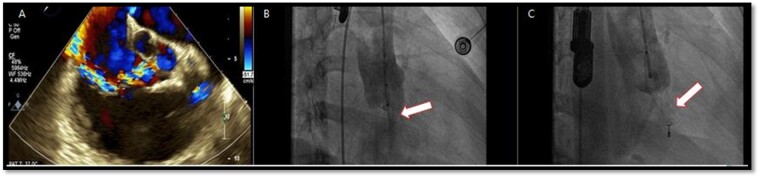
A 50-year-old woman with dyspnoea of exertion and rupture of sinus valsalva to right atrium was referred to our hospital. On admission, chest computed tomography (CT) was normal. After closure of the rupture, she developed orthostatic hypoxemia and frequent cough. A repeat chest CT was suggestive of COVID-19 infection which most probably occurred during the hospitalization. Although COVID-19 was thought to be the only culprit, her symptoms were not solely justified by COVID-19. Transthoracic echocardiography showed patent foramen ovale (PFO) with significant shunt. PFO device closure was performed under intracardiac echocardiography guidance.
Interatrial septum deformation may happen after RSV correction and right to left shunt from PFO may become more significant. POS is an important indication for PFO closure which should be noticed by careful examination. As COVID-19 is the most frequent pathology these days, it may delay other probable diagnosis, and hence detailed history taking and physical examination is mandatory.
瓦氏窦破裂(RSV)至右心房(RA)会导致显著的左向右分流、三尖瓣反流和右心室衰竭。若不纠正,可导致双心室心力衰竭。因此,建议早期进行侵入性治疗。迄今为止,尚无关于经导管封堵瓦氏窦破裂后出现平卧呼吸-直立性低氧血症综合征(POS)的报道。
一名50岁女性,因劳力性呼吸困难及瓦氏窦破裂至右心房而转诊至我院。入院时,胸部计算机断层扫描(CT)正常。破裂封堵后,她出现直立性低氧血症和频繁咳嗽。复查胸部CT提示可能在住院期间感染了新型冠状病毒肺炎(COVID-19)。尽管认为COVID-19是唯一病因,但她的症状不能完全由COVID-19来解释。经胸超声心动图显示卵圆孔未闭(PFO)伴大量分流。在心脏内超声心动图引导下进行了PFO封堵术。
RSV纠正后可能发生房间隔变形,PFO的右向左分流可能会更显著。POS是PFO封堵的重要指征,应通过仔细检查予以注意。由于COVID-19是目前最常见的病理情况,它可能会延误其他可能的诊断,因此必须详细询问病史并进行体格检查。