Division of Pediatric Hematology Oncology, Duke University Medical Center, Durham, North Carolina, USA.
Pediatric Transplant and Cellular Therapy Division, Duke University Medical Center, Durham, North Carolina, USA.
Pediatr Blood Cancer. 2021 Sep;68(9):e29174. doi: 10.1002/pbc.29174. Epub 2021 Jun 9.
Limited English proficiency (LEP) is associated with adverse clinical outcomes. The clinical impact of LEP in hematopoietic stem cell transplant (HSCT) has not been studied. The objectives of this study were to compare HSCT outcomes and health care utilization of Hispanic pediatric patients with and without parental LEP.
We conducted a retrospective review of Hispanic/Latino pediatric patients receiving HSCT at a single institution. Families were identified as LEP or English proficient (EP) based on clinicians' notes, social work documentation, or the signature of a Spanish interpreter on treatment consents.
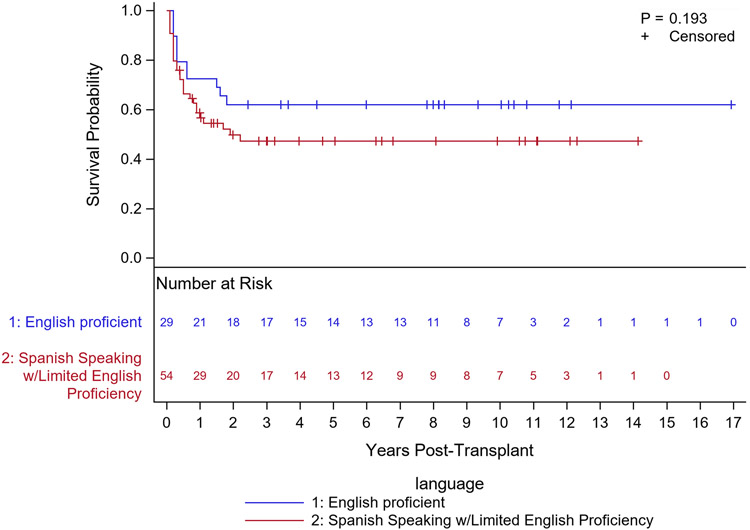
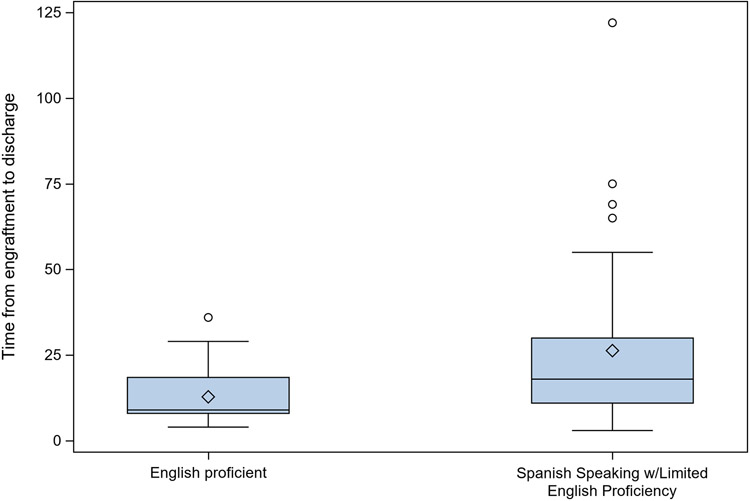
A total of 83 Hispanic/Latino patients were identified with 53 (65.1%) having parental LEP. More patients in the LEP group had a documented financial burden at pretransplant psychosocial evaluation (72.2% vs. 41.4%, p = .009). LEP patients were more likely to have health insurance coverage through government-sponsored Medicaid (76.9% vs. 27.6%, p < .001). LEP patients were hospitalized on average 13 days longer than EP patients, and LEP patients were more likely to have pretransplant cytomegalovirus (CMV) reactivity (67.3%) than EP patients (p = .001). Overall survival was lower in LEP than EP, but was not statistically significant (p = .193). Multivariable Cox modeling suggested a potentially higher risk of death in LEP versus EP (hazard ratio = 1.56, 95% CI: 0.38, 6.23).
Parental LEP in HSCT is associated with prolonged hospitalization and pretransplant CMV reactivity. These factors are associated with posttransplant complications and death. Our results suggest parental LEP is a risk factor for poor HSCT outcomes. Further study is warranted in a larger cohort.
有限的英语水平(LEP)与不良的临床结果相关。 LEP 在造血干细胞移植(HSCT)中的临床影响尚未得到研究。本研究的目的是比较有和没有父母 LEP 的西班牙裔儿科患者的 HSCT 结果和医疗保健利用情况。
我们对一家机构接受 HSCT 的西班牙裔/拉丁裔儿科患者进行了回顾性研究。根据临床医生的笔记、社会工作文件或西班牙语翻译在治疗同意书上的签名,确定家庭为 LEP 或英语熟练(EP)。
共确定了 83 名西班牙裔/拉丁裔患者,其中 53 名(65.1%)父母有 LEP。在移植前心理社会评估中,LEP 组有更多患者有记录的经济负担(72.2%比 41.4%,p=0.009)。LEP 患者更有可能通过政府赞助的医疗补助获得医疗保险(76.9%比 27.6%,p<0.001)。LEP 患者的住院时间平均比 EP 患者长 13 天,LEP 患者比 EP 患者更有可能在移植前出现巨细胞病毒(CMV)反应(67.3%比 40.3%,p=0.001)。LEP 患者的总生存率低于 EP 患者,但无统计学意义(p=0.193)。多变量 Cox 模型表明,LEP 患者死亡的风险高于 EP 患者(风险比=1.56,95%可信区间:0.38, 6.23)。
HSCT 中父母的 LEP 与延长的住院时间和移植前 CMV 反应有关。这些因素与移植后并发症和死亡有关。我们的结果表明,父母的 LEP 是 HSCT 结果不良的一个危险因素。在更大的队列中需要进一步研究。