Department of Emergency Medicine, Cincinnati Children's Hospital and Medical Center (R Zamor, T Byczkowski, L Vaughn, and EM Mahabee-Gittens), Cincinnati, Ohio; Department of Pediatrics, University of Cincinnati College of Medicine (R Zamor, T Byczkowski, L Vaughn, and EM Mahabee-Gittens), Cincinnati, Ohio.
Department of Emergency Medicine, Cincinnati Children's Hospital and Medical Center (R Zamor, T Byczkowski, L Vaughn, and EM Mahabee-Gittens), Cincinnati, Ohio; Department of Pediatrics, University of Cincinnati College of Medicine (R Zamor, T Byczkowski, L Vaughn, and EM Mahabee-Gittens), Cincinnati, Ohio.
Acad Pediatr. 2020 Apr;20(3):356-363. doi: 10.1016/j.acap.2020.01.006. Epub 2020 Jan 22.
Language barriers may influence the management of pediatric emergency department (PED) patients who may not align with evidence-based guidelines from the American Academy of Pediatrics. Our objective was to determine if a family's preferred language of Spanish versus English was associated with differences in management of bronchiolitis in the PED.
We conducted a retrospective study of children ≤2 years old diagnosed with bronchiolitis in a PED over a 7-year period. Rates of PED testing, interventions, and disposition among children whose families' preferred language was Spanish were compared to children whose families' preferred language was English. Primary outcomes were frequencies of chest x-ray and bronchodilator orders. Secondary outcomes were diagnostic testing, medication orders, and disposition. Logistic regression was used to calculate adjusted odds ratios after controlling for age, emergency severity index, prior visit, and nesting within attending physicians.
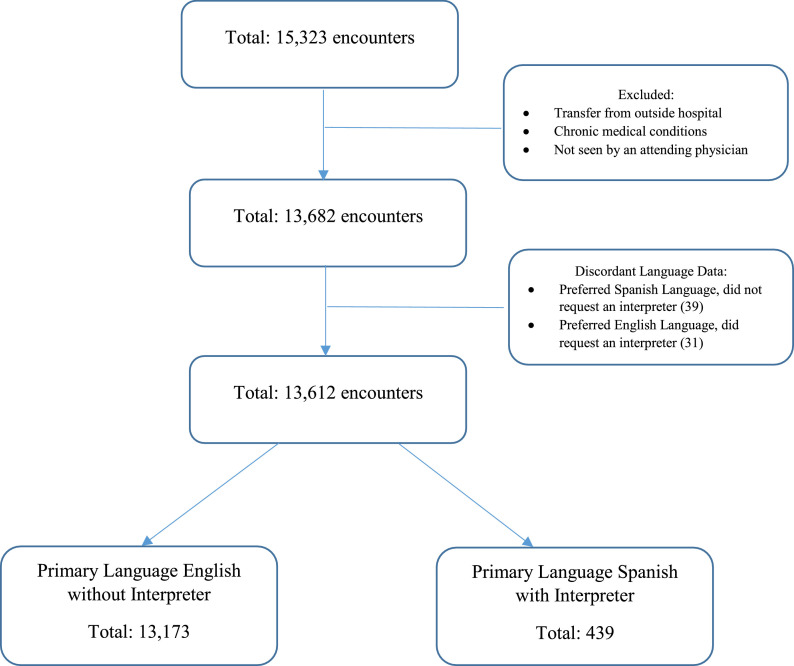
A total of 13,612 encounters were included. Spanish-speaking families were more likely to have chest x-rays (35.8% vs 26.7%, P < .0001; adjusted odds ratio [aOR] 1.5; 95% confidence interval [CI] 1.2-1.9), complete blood counts (8.2% vs 4.9%, P < .005; aOR 1.7; 95% CI 1.2-2.5), and blood cultures ordered (8.1% vs 5.0%, P < .05; aOR 1.7; 95% CI 1.2-2.4). No other differences in bronchodilators, medication orders, or disposition were found between the 2 groups.
Among children diagnosed with bronchiolitis, Spanish-speaking families were more likely to have chest x-rays, complete blood counts, and blood cultures ordered compared to English-speaking families. Further research on how clinical practice guidelines and equity-focused guidelines can impact disparities in diagnostic testing within the PED is warranted.
语言障碍可能会影响到不符合儿科学会循证指南的儿科急诊(PED)患者的治疗。我们的目的是确定患者家庭首选的西班牙语与英语是否与 PED 中毛细支气管炎的治疗存在差异。
我们对 7 年来在 PED 中被诊断为毛细支气管炎的≤2 岁儿童进行了回顾性研究。比较了家庭首选语言为西班牙语的儿童与家庭首选语言为英语的儿童在 PED 检测、干预和处置方面的差异。主要结局指标为胸片和支气管扩张剂的使用情况。次要结局指标为诊断性检查、药物治疗和处置。在控制年龄、紧急情况严重程度指数、既往就诊情况和主治医师分组后,使用逻辑回归计算调整后的比值比。
共纳入 13612 例就诊记录。西班牙语家庭更有可能进行胸片检查(35.8% vs 26.7%,P<0.0001;调整后的比值比[aOR] 1.5;95%置信区间[CI] 1.2-1.9)、更频繁地进行全血细胞计数(8.2% vs 4.9%,P<0.05;aOR 1.7;95% CI 1.2-2.5)和进行血培养(8.1% vs 5.0%,P<0.05;aOR 1.7;95% CI 1.2-2.4)。在支气管扩张剂、药物治疗和处置方面,两组间无其他差异。
在被诊断为毛细支气管炎的儿童中,与英语家庭相比,西班牙语家庭更有可能进行胸片、全血细胞计数和血培养检查。需要进一步研究临床实践指南和以公平为重点的指南如何影响 PED 中诊断性检查的差异。