Department of Psychiatry and Behavioral Health.
Department of Public Health Sciences.
Exp Clin Psychopharmacol. 2022 Dec;30(6):947-958. doi: 10.1037/pha0000488. Epub 2021 Jun 10.
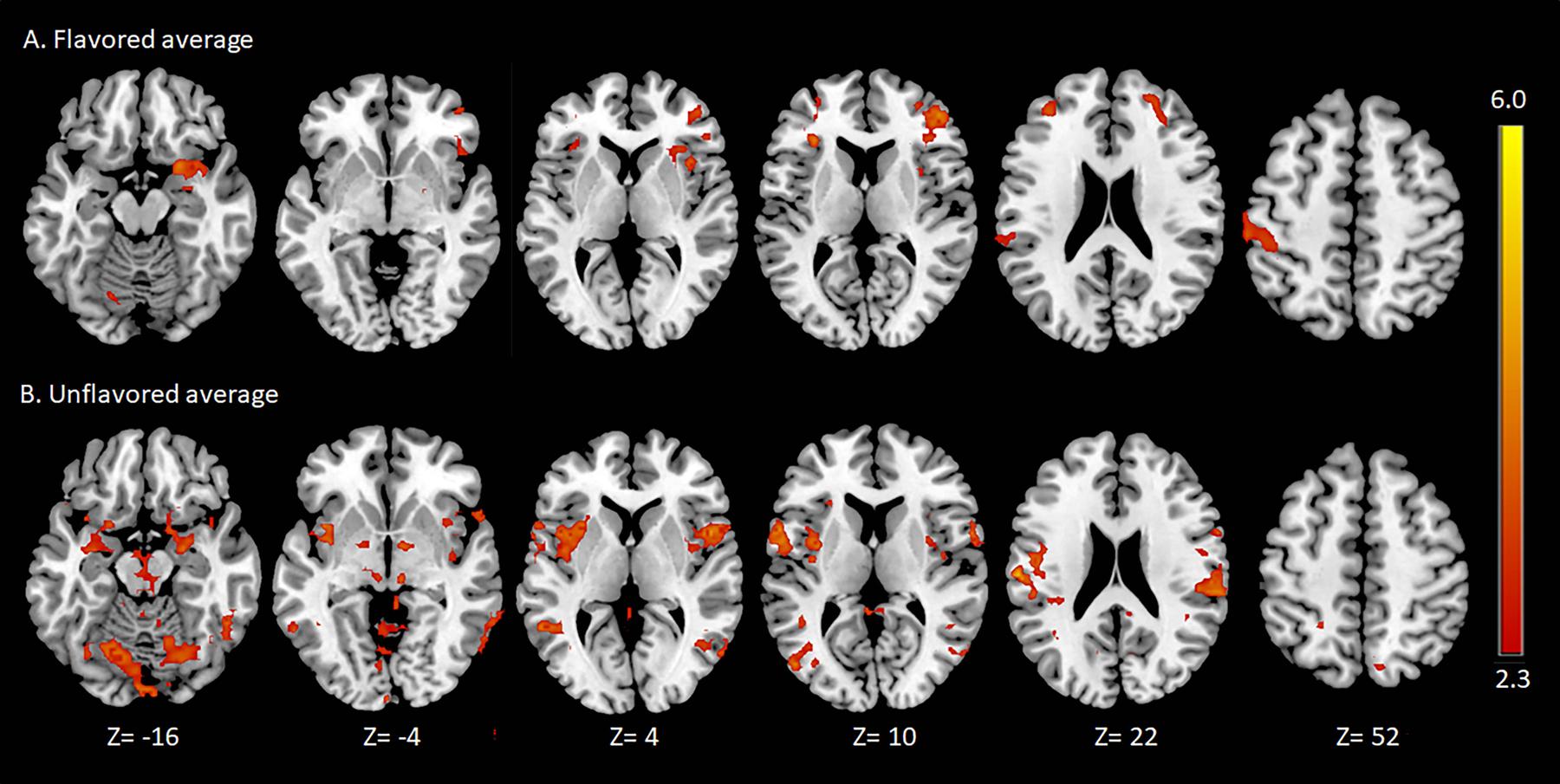
Regulations limiting the sale of flavored e-cigarette products are controversial for their potential to interfere with e-cigarette use as a cessation aid in addition to curbing youth use. Limited research suggests that flavor might enhance the addictive potential of e-cigarettes; however, the acute effects of flavored aerosols on brain function among humans have not been assessed. The present study aimed to isolate and compare the neural substrates of flavored and unflavored e-cigarette aerosols on brain function among nine female daily smokers. Participants inhaled aerosolized e-liquid with 36 mg/mL of nicotine with and without a strawberry-vanilla flavor while undergoing functional magnetic resonance imaging. We used general linear modeling to compare whole-brain mean neural activation and seed-to-voxel task-based functional connectivity between the flavored and unflavored inhalation runs. Contrary to our hypothesis, the flavored aerosol was associated with weaker activation than the unflavored aerosol in the brain stem and bilateral parietal-temporal-occipital region of the cortex. Instead, the flavor engaged taste-related brain regions while suppressing activation of the neural circuits typically engaged during smoking and nicotine administration. Alternatively, functional connectivity between subcortical dopaminergic brain seeds and cortical brain regions involved in motivation and reward salience were stronger during the flavored compared to unflavored aerosol run. The findings suggest that fruity and dessert-flavored e-cigarettes may dampen the reward experience of aerosol inhalation for smokers who initiate e-cigarette use by inhibiting activation of dopaminergic brain circuits. These preliminary findings may have implications for understanding how regulations on flavored e-cigarettes might impact their use as cessation aids. (PsycInfo Database Record (c) 2022 APA, all rights reserved).
限制调味电子烟产品销售的规定颇具争议,因为它们可能会干扰电子烟作为戒烟辅助工具的使用,同时也能遏制青少年使用电子烟。有限的研究表明,口味可能会增强电子烟的成瘾潜力;然而,人类吸食调味气溶胶对大脑功能的急性影响尚未得到评估。本研究旨在在 9 名女性每日吸烟者中,分离和比较调味和非调味电子烟气溶胶对大脑功能的影响。参与者在功能性磁共振成像过程中吸入含有 36 毫克/毫升尼古丁的雾化电子烟液,同时吸入和不吸入草莓香草味。我们使用广义线性模型比较了有和没有调味吸入时大脑的全脑平均神经激活和基于种子的任务功能连接。与我们的假设相反,调味气溶胶在脑干和双侧顶颞枕叶皮层区域的激活强度弱于非调味气溶胶。相反,调味激活了与味觉相关的大脑区域,同时抑制了通常在吸烟和尼古丁给药期间参与的神经回路的激活。或者,在有和没有调味气溶胶吸入时,下丘脑中与多巴胺能相关的脑种子和涉及动机和奖励显著性的皮质脑区之间的功能连接更强。研究结果表明,对于那些通过抑制多巴胺能脑回路的激活而开始使用电子烟的吸烟者来说,水果味和甜点味的电子烟可能会降低气溶胶吸入的奖励体验。这些初步发现可能对理解调味电子烟的规定如何影响它们作为戒烟辅助工具的使用具有重要意义。