Department of Psychiatry, University of Oxford, Oxford, UK.
Oxford Health NHS Foundation Trust, Oxford, UK.
Psychol Med. 2023 Mar;53(4):1185-1195. doi: 10.1017/S0033291721002609. Epub 2021 Jun 11.
When vaccination depends on injection, it is plausible that the blood-injection-injury cluster of fears may contribute to hesitancy. Our primary aim was to estimate in the UK adult population the proportion of COVID-19 vaccine hesitancy explained by blood-injection-injury fears.
In total, 15 014 UK adults, quota sampled to match the population for age, gender, ethnicity, income and region, took part (19 January-5 February 2021) in a non-probability online survey. The Oxford COVID-19 Vaccine Hesitancy Scale assessed intent to be vaccinated. Two scales (Specific Phobia Scale-blood-injection-injury phobia and Medical Fear Survey-injections and blood subscale) assessed blood-injection-injury fears. Four items from these scales were used to create a factor score specifically for injection fears.
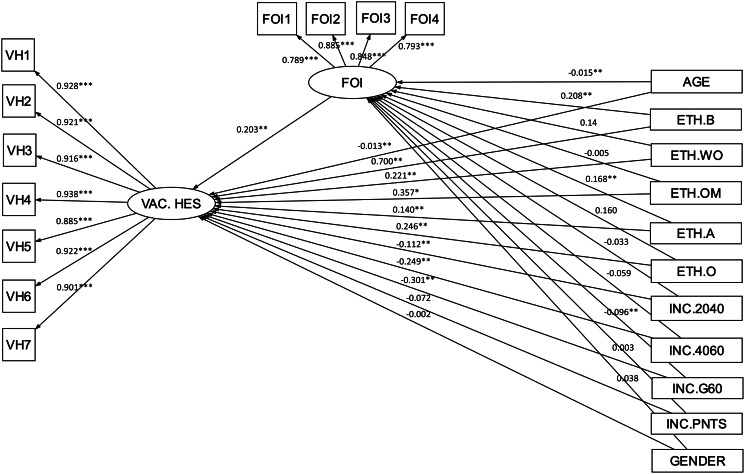
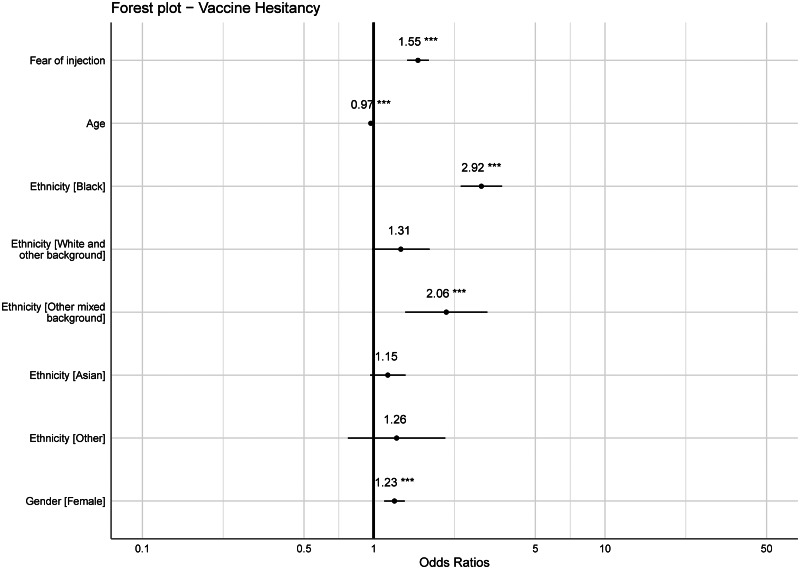
In total, 3927 (26.2%) screened positive for blood-injection-injury phobia. Individuals screening positive (22.0%) were more likely to report COVID-19 vaccine hesitancy compared to individuals screening negative (11.5%), odds ratio = 2.18, 95% confidence interval (CI) 1.97-2.40, < 0.001. The population attributable fraction (PAF) indicated that if blood-injection-injury phobia were absent then this may prevent 11.5% of all instances of vaccine hesitancy, AF = 0.11; 95% CI 0.09-0.14, < 0.001. COVID-19 vaccine hesitancy was associated with higher scores on the Specific Phobia Scale, = 0.22, < 0.001, Medical Fear Survey, = 0.23, = <0.001 and injection fears, = 0.25, < 0.001. Injection fears were higher in youth and in Black and Asian ethnic groups, and explained a small degree of why vaccine hesitancy is higher in these groups.
Across the adult population, blood-injection-injury fears may explain approximately 10% of cases of COVID-19 vaccine hesitancy. Addressing such fears will likely improve the effectiveness of vaccination programmes.
当疫苗接种依赖于注射时,血源性传染病的恐惧可能会导致犹豫。我们的主要目的是估计英国成年人群中,因血源性传染病恐惧而导致的 COVID-19 疫苗犹豫的比例。
共有 15014 名英国成年人参与了这项非概率在线调查(2021 年 1 月 19 日至 2 月 5 日),这些成年人按照年龄、性别、种族、收入和地区进行配额抽样,以匹配人口。牛津 COVID-19 疫苗犹豫量表评估了接种疫苗的意愿。两个量表(特定恐惧症量表-血源性传染病恐惧症和医学恐惧调查-注射和血液子量表)评估了血源性传染病的恐惧。这两个量表的四个项目被用来创建一个专门用于注射恐惧的因子评分。
共有 3927 人(26.2%)筛查出对血源性传染病的恐惧呈阳性。筛查阳性的个体(22.0%)比筛查阴性的个体(11.5%)更有可能报告 COVID-19 疫苗犹豫,比值比=2.18,95%置信区间(CI)1.97-2.40, < 0.001。人群归因分数(PAF)表明,如果不存在血源性传染病的恐惧,那么这可能会阻止所有疫苗犹豫的 11.5%,AF=0.11;95%CI 0.09-0.14, < 0.001。COVID-19 疫苗犹豫与特定恐惧症量表的更高分数相关, =0.22, < 0.001,医学恐惧调查, =0.23, < 0.001,以及注射恐惧, =0.25, < 0.001。年轻人和黑人和亚裔群体的注射恐惧更高,这也解释了为什么这些群体的疫苗犹豫率更高。
在成年人群中,血源性传染病的恐惧可能解释了大约 10%的 COVID-19 疫苗犹豫的病例。解决这些恐惧可能会提高疫苗接种计划的有效性。