Department of Radiation Oncology, Inje University Sanggye Paik Hospital, 1342, Dongil-ro, Nowon-gu, Seoul, Korea.
Proton Therapy Center, National Cancer Center, Goyang, Korea.
Radiat Oncol. 2021 Jun 12;16(1):108. doi: 10.1186/s13014-020-01722-0.
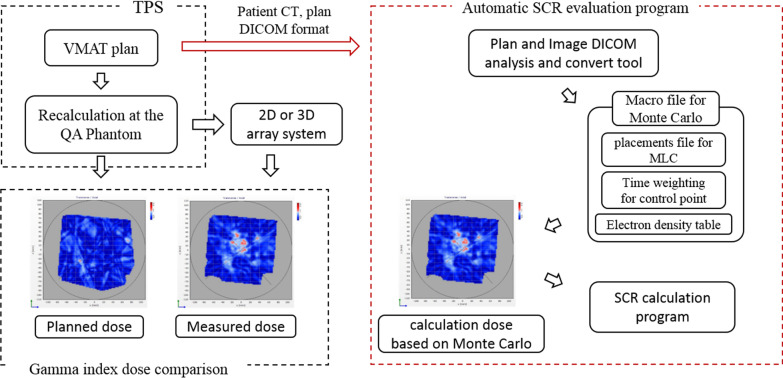
The purpose of this study is to develop a clinical application program that automatically calculates the effect for secondary cancer risk (SCR) of individual patient. The program was designed based on accurate dose calculations using patient computed tomography (CT) data and Monte Carlo engine. Automated patient-specific evaluation program was configured to calculate SCR.
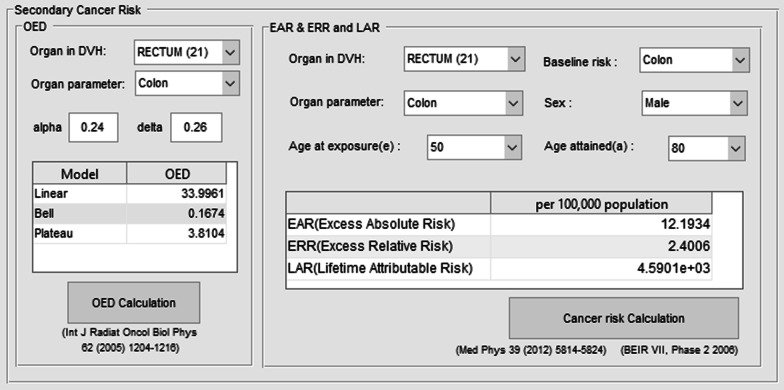
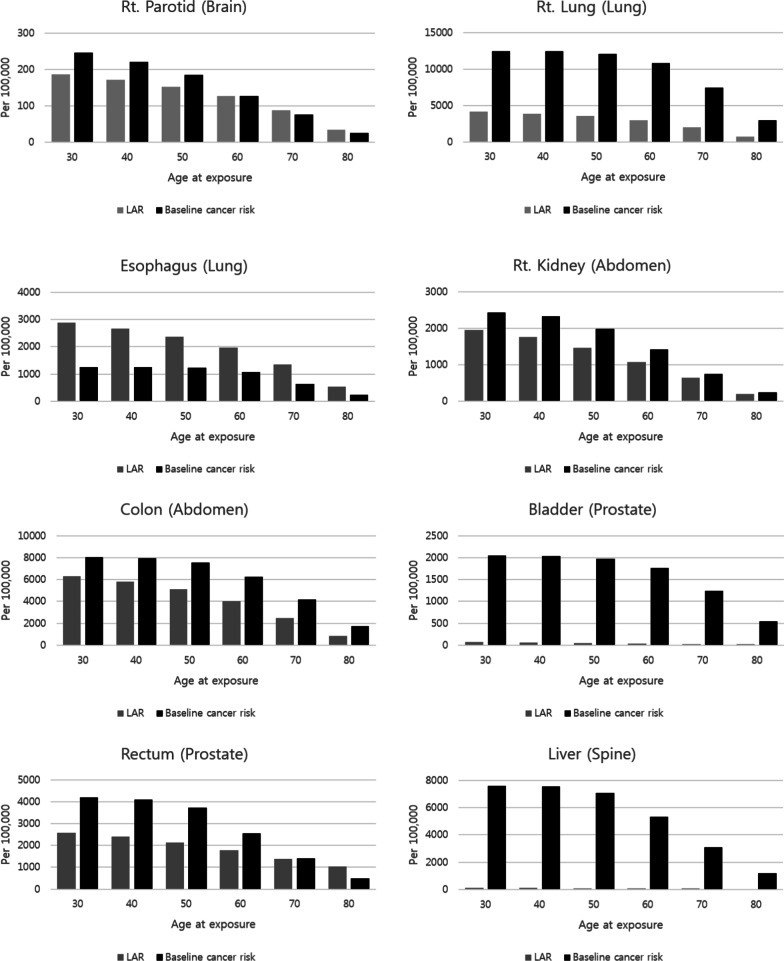
The application program is designed to re-calculate the beam sequence of treatment plan using the Monte Carlo engine and patient CT data, so it is possible to accurately calculate and evaluate scatter and leakage radiation, difficult to calculate in TPS. The Monte Carlo dose calculation system was performed through stoichiometric calibration using patient CT data. The automatic SCR evaluation program in application program created with a MATLAB was set to analyze the results to calculate SCR. The SCR for organ of patient was calculated based on Biological Effects of Ionizing Radiation (BEIR) VII models. The program is designed to sequentially calculate organ equivalent dose (OED), excess absolute risk (EAR), excess relative risk (ERR), and the lifetime attributable risk (LAR) in consideration of 3D dose distribution analysis. In order to confirm the usefulness of the developed clinical application program, the result values from clinical application program were compared with the manual calculation method used in the previous study.
The OED values calculated in program were calculated to be at most approximately 13.3% higher than results in TPS. The SCR result calculated by the developed clinical application program showed a maximum difference of 1.24% compared to the result of the conventional manual calculation method. And it was confirmed that EAR, ERR and LAR values can be easily calculated by changing the biological parameters.
We have developed a patient-specific SCR evaluation program that can be used conveniently in the clinic. The program consists of a Monte Carlo dose calculation system for accurate calculation of scatter and leakage radiation and a patient-specific automatic SCR evaluation program using 3D dose distribution. The clinical application program that improved the disadvantages of the existing process can be used as an index for evaluating a patient treatment plan.
本研究旨在开发一种临床应用程序,可自动计算个体患者的继发癌症风险(SCR)。该程序基于使用患者 CT 数据和蒙特卡罗引擎进行的准确剂量计算而设计。自动配置了患者特定的评估程序以计算 SCR。
该应用程序旨在使用蒙特卡罗引擎和患者 CT 数据重新计算治疗计划的束序列,因此可以准确计算和评估 TPS 中难以计算的散射和漏射线。通过使用患者 CT 数据进行化学计量校准来执行蒙特卡罗剂量计算系统。使用 MATLAB 创建的应用程序中的自动 SCR 评估程序被设置为分析结果以计算 SCR。基于生物效应的电离辐射(BEIR)VII 模型计算患者的 SCR。该程序旨在考虑 3D 剂量分布分析,依次计算器官当量剂量(OED)、超额绝对风险(EAR)、超额相对风险(ERR)和终生归因风险(LAR)。为了确认开发的临床应用程序的有用性,将临床应用程序的结果值与之前研究中使用的手动计算方法进行了比较。
程序中计算的 OED 值最多比 TPS 中的结果高约 13.3%。与传统的手动计算方法相比,开发的临床应用程序计算的 SCR 结果最大差异为 1.24%。并且证实可以通过改变生物学参数轻松计算 EAR、ERR 和 LAR 值。
我们已经开发了一种方便在临床使用的患者特异性 SCR 评估程序。该程序包括用于准确计算散射和漏射线的蒙特卡罗剂量计算系统以及使用 3D 剂量分布的患者特异性自动 SCR 评估程序。改进现有流程缺点的临床应用程序可作为评估患者治疗计划的指标。