Department of Trauma and Reconstructive Surgery, University Hospital RWTH Aachen, Pauwelsstraße 30, 52074, Aachen, Germany.
Department of Orthopaedic Surgery, University Hospital RWTH Aachen, Aachen, Germany.
Arch Orthop Trauma Surg. 2022 Jun;142(6):1275-1281. doi: 10.1007/s00402-021-03989-8. Epub 2021 Jun 13.
Dislocations of the hip joint are a common and clinically relevant complication following total hip arthroplasty (THA). Hip-abduction braces are currently used following operative or non-operative treatment of THA dislocations to prevent re-dislocations. However, the clinical and biomechanical effectiveness of such braces is still controversial.
A total of 30 volunteers were measured during standing and during sitting up and down from a chair task wearing a hip brace set at 70°, 90° or no hip flexion limitation. Range of motion of the hip joint was measured in all directions by an inertial sensor system. Further it has been evaluated if the range of motion would be reduced by the additional use of an arthrodesis cushion.
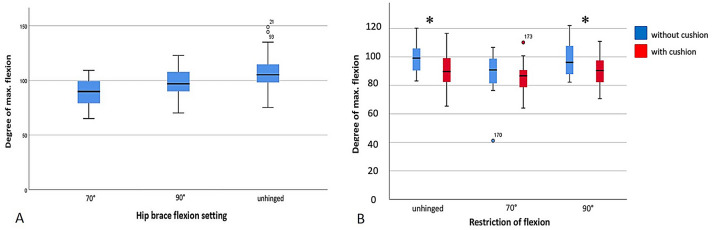
The use of a hip brace set up with flexion limitation did reduce hip ROM in all directions significantly compared to unhinged brace (p < 0.001-0.035). Performing the "sit down and stand-up task" the brace set up at 70° flexion limitation did reduce maximum hip flexion significantly (p = 0.008). However, in most cases the measured hip flexion angles were greater than the settings of the hip brace should have allowed. The additional use of a cushion can further limit hip motion while sitting up and down from a chair.
This study has demonstrated that hip-abduction braces reduce hip range of motion. However, we also found that to achieve a flexion limitation of the hip to 90°, the hip brace should be set at a 70° hip flexion limitation.
髋关节脱位是全髋关节置换术(THA)后一种常见且具有临床意义的并发症。目前,在手术或非手术治疗 THA 脱位后,使用髋关节外展支具来预防再脱位。然而,这种支具的临床和生物力学效果仍然存在争议。
共有 30 名志愿者在佩戴髋关节支具(设置为 70°、90°或无髋关节屈曲限制)站立和从椅子上坐起和坐下时进行测量。通过惯性传感器系统测量髋关节在各个方向的运动范围。进一步评估了在额外使用融合垫的情况下,运动范围是否会减少。
与未铰接支具相比,使用设置有屈曲限制的髋关节支具可显著降低髋关节在各个方向的 ROM(p < 0.001-0.035)。在进行“坐下和站立任务”时,70°屈曲限制的支具可显著降低最大髋关节屈曲(p = 0.008)。然而,在大多数情况下,测量的髋关节屈曲角度大于髋关节支具的设定角度。在从椅子上坐起和坐下时,额外使用垫子可以进一步限制髋关节的运动。
本研究表明,髋关节外展支具可减少髋关节活动范围。然而,我们还发现,要实现髋关节屈曲限制为 90°,髋关节支具应设置为 70°髋关节屈曲限制。