Braun Hans Albert
Neurodynamics Group, Institute of Physiology and Pathophysiology, Philipps University of Marburg, Marburg, Germany.
Front Syst Neurosci. 2021 May 26;15:629436. doi: 10.3389/fnsys.2021.629436. eCollection 2021.
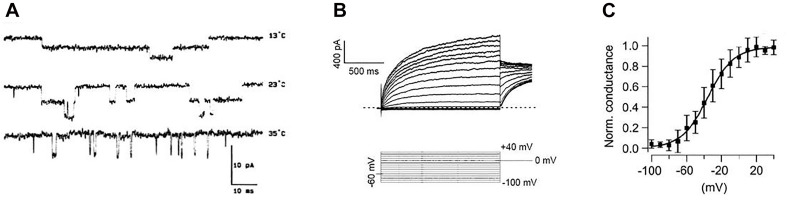
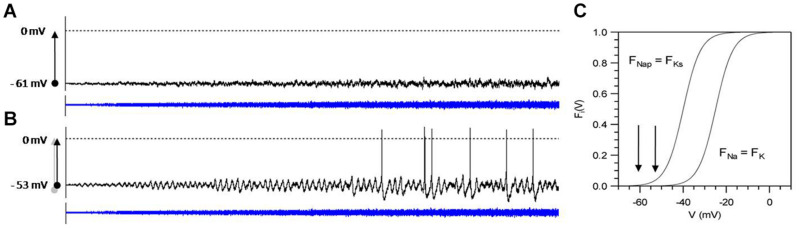
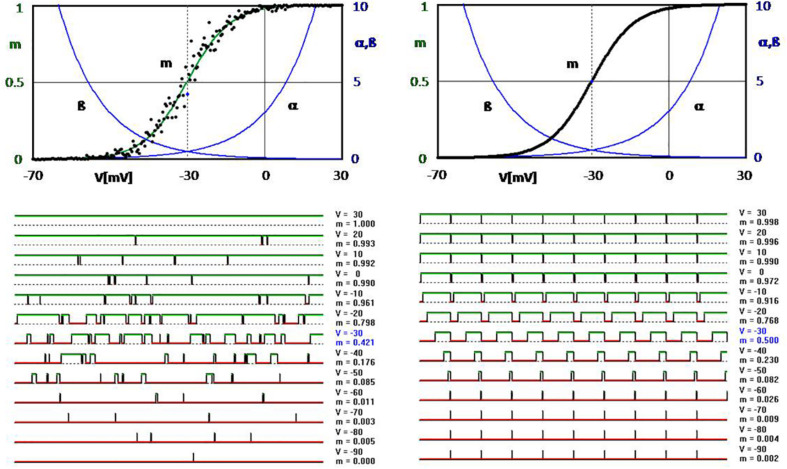
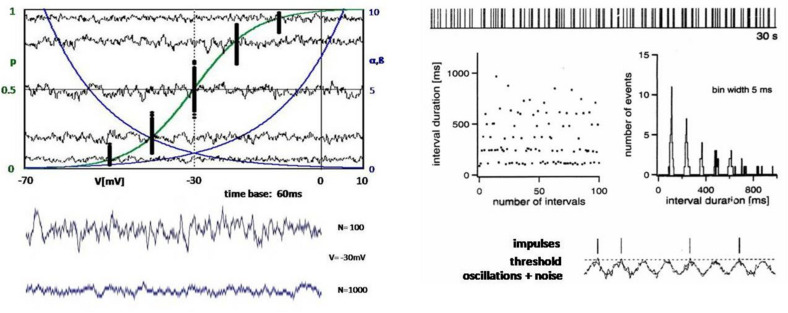
If one accepts that decisions are made by the brain and that neuronal mechanisms obey deterministic physical laws, it is hard to deny what some brain researchers postulate, such as "We do not do what we want, but we want what we do" and "We should stop talking about freedom. Our actions are determined by physical laws." This point of view has been substantially supported by spectacular neurophysiological experiments demonstrating action-related brain activity (readiness potentials, blood oxygen level-dependent signals) occurring up to several seconds before an individual becomes aware of his/her decision to perform the action. This report aims to counter the deterministic argument for the absence of free will by using experimental data, supplemented by computer simulations, to demonstrate that biological systems, specifically brain functions, are built on principle randomness, which is introduced already at the lowest level of neuronal information processing, the opening and closing of ion channels. Switching between open and closed states follows physiological laws but also makes use of randomness, which is apparently introduced by Brownian motion - principally unavoidable under all life-compatible conditions. Ion-channel stochasticity, manifested as noise, function is not smoothed out toward higher functional levels but can even be amplified by appropriate adjustment of the system's non-linearities. Examples shall be given to illustrate how stochasticity can propagate from ion channels to single neuron action potentials to neuronal network dynamics to the interactions between different brain nuclei up to the control of autonomic functions. It is proposed that this intrinsic stochasticity helps to keep the brain in a flexible state to explore diverse alternatives as a prerequisite of free decision-making.
如果有人认同决策是由大脑做出的,且神经元机制遵循确定性的物理定律,那就很难否认一些大脑研究者所提出的观点,比如“我们并非做我们想做的事,而是想我们所做的事”以及“我们应该停止谈论自由。我们的行为由物理定律决定”。这一观点得到了一些引人注目的神经生理学实验的有力支持,这些实验表明,在个体意识到自己要执行某个动作的决定之前,与动作相关的大脑活动(准备电位、血氧水平依赖信号)就已经出现了几秒。本报告旨在通过使用实验数据,并辅以计算机模拟,来反驳关于不存在自由意志的决定论观点,以证明生物系统,特别是大脑功能,是建立在内在随机性基础之上的,这种随机性在神经元信息处理的最低层面,即离子通道的开启和关闭时就已被引入。离子通道在开放和关闭状态之间的切换遵循生理规律,但也利用了随机性,这种随机性显然是由布朗运动引入的——在所有与生命兼容的条件下基本上都是不可避免的。表现为噪声的离子通道随机性,其功能并不会在更高的功能层面被平滑掉,反而可以通过对系统非线性的适当调整而被放大。将给出一些例子来说明随机性是如何从离子通道传播到单个神经元动作电位、神经网络动力学、不同脑核之间的相互作用,直至自主功能的控制。有人提出,这种内在随机性有助于使大脑保持灵活状态,以探索各种可能性,这是自由决策的前提条件。