Cuaton Ginbert Permejo, Caluza Las Johansen Balios, Neo Joshua Francisco Vibar
Division of Environment and Sustainability, The Hong Kong University of Science and Technology, Clear Water Bay, Kowloon, 100025, Hong Kong SAR.
Information Technology and Computer Education Department, Leyte Normal University, Tacloban City, Leyte, 6500, Philippines.
Int J Disaster Risk Reduct. 2021 Jul;61:102367. doi: 10.1016/j.ijdrr.2021.102367. Epub 2021 Jun 6.
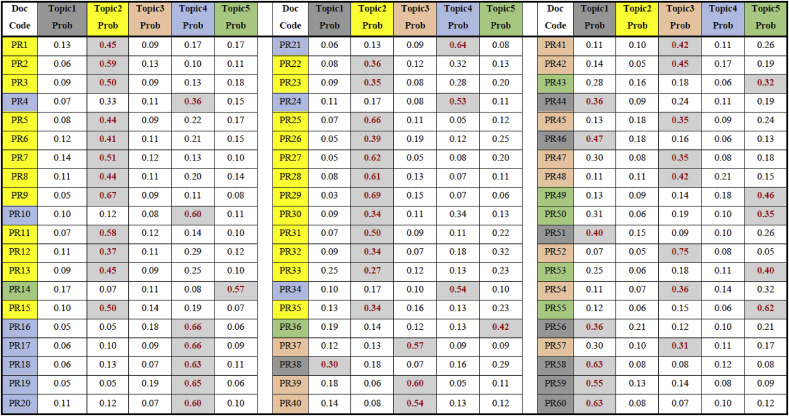
Like many others across the globe, Filipinos continue to suffer from the COVID-19 pandemic. To shed light on how the Philippines initially managed the disease, our paper analyzed the early phase of the government's pandemic response. Using machine learning, we compiled the official press releases issued by the Department of Health from early January to mid-April 2020 where a total of 283,560 datasets amounting to 2.5 megabytes (Mb) were analyzed using the Latent Dirichlet Allocation (LDA) algorithm. Our results revealed five latent themes: the highest effort (40%) centered on "Nationwide Reporting of COVID-19 Status", while "Contact Tracing of Suspected and Infected Individuals" had the least focus at only 11.68%- indicating a lack of priority in this area. Our findings suggest that while the government was ill-prepared in the early phase of the pandemic, it exerted efforts in rearranging its fiscal and operational priorities toward the management of the disease. However, we emphasize that this article should be read and understood with caution. More than a year has already passed since the outbreak in the country and many (in)actions and challenges have adversely impacted its response. These include the Duterte administration's securitization and militarization of pandemic response and its apparent failure to find a balance between the lives and livelihoods of Filipinos, to name a few. We strongly recommend that other scholars study the various aspects of the government's response, i.e., economic, peace and security, agriculture, and business, to assess better how the country responded and continually responds to the pandemic.
和全球许多其他人一样,菲律宾人仍在遭受新冠疫情的折磨。为了阐明菲律宾最初是如何应对这种疾病的,我们的论文分析了政府应对疫情的早期阶段。我们利用机器学习,汇编了卫生部在2020年1月初至4月中旬发布的官方新闻稿,使用潜在狄利克雷分配(LDA)算法对总共283560个数据集(总计2.5兆字节)进行了分析。我们的结果揭示了五个潜在主题:最大力度(40%)集中在“全国范围新冠疫情状况报告”上,而“疑似和感染个体的接触者追踪”关注度最低,仅为11.68%,这表明该领域缺乏优先级。我们的研究结果表明,虽然政府在疫情早期准备不足,但它在重新调整财政和运营优先级以应对疾病管理方面做出了努力。然而,我们强调,阅读和理解本文时应谨慎。自该国疫情爆发以来已经过去了一年多,许多(未采取的)行动和挑战对其应对措施产生了不利影响。其中包括杜特尔特政府将疫情应对安全化和军事化,以及明显未能在菲律宾人的生命和生计之间找到平衡等等。我们强烈建议其他学者研究政府应对措施的各个方面,即经济、和平与安全、农业和商业等,以更好地评估该国如何应对并持续应对疫情。