Qiu Guanghao, Zhang Hanlu, Wang Fuqiang, Zheng Yu, Wang Zihao, Wang Yun
Department of Thoracic Surgery, West China Hospital, Sichuan University, Chengdu, China.
Front Oncol. 2021 May 28;11:625720. doi: 10.3389/fonc.2021.625720. eCollection 2021.
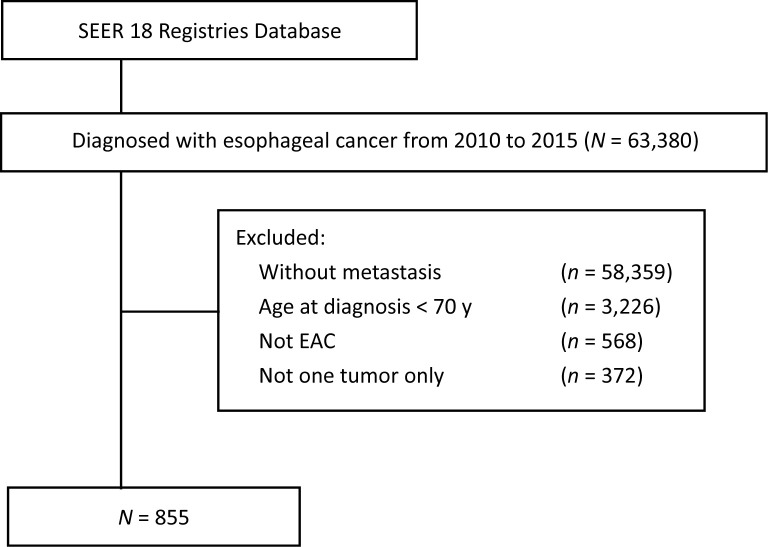
Esophageal adenocarcinoma (EAC) is the most common kind of esophageal cancer. Age at diagnosis of advanced EAC is greater. Studies about practice patterns for elderly EAC patients with distant metastasis (DM) in stage IVB are limited. This retrospective, population-based study was conducted using data from the Surveillance, Epidemiology, and End Results (SEER) to evaluate 855 elderly EAC patients with DM in stage IVB from 2010 to 2015.
855 elderly EAC patients with DM in stage IVB between 2010 and 2015 were included in this study. Univariate and multivariate Cox-regression and Kaplan-Meier analyses were used to assess prognosis. These patients were classified to bone-only, brain-only, lung-only, liver-only, and multiple (patients with two or more organs in metastasis)-site group according to the site of metastasis. Overall survival (OS), cancer-specific survival (CSS), median survival time (MST), and survival rate (SR) were evaluated to analyze the survival outcomes.
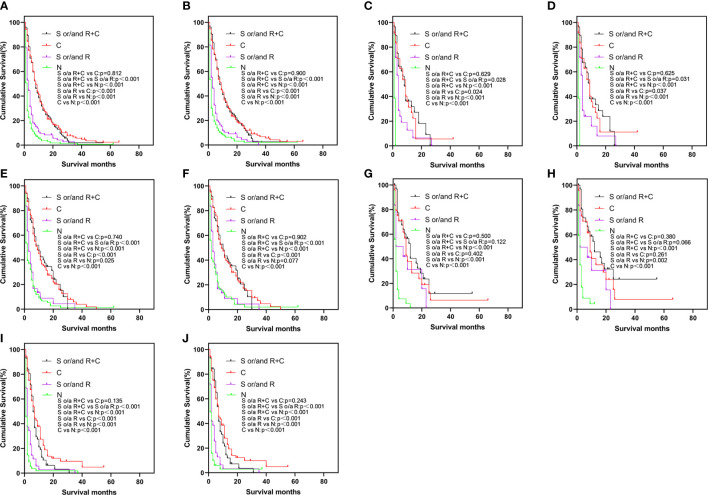
The most common metastasis site was the liver among the single-organ metastasis population, followed by lung, bone, and brain. Compared with the bone-only group, the multiple-site group was associated with worst OS (HR: 1.037, 95% CI: 0.811-1.327, = 0.770) and CSS (HR: 1.052, 95% CI: 0.816-1.357, = 0.695). The multiple-site group also had the lowest MST in the population (MST: 2 months in OS and 3 months in CSS) and SR (6-month SR: 27.1% in OS, 29.9% in CSS, 1-year SR: 10.7% in OS, 12.0% in CSS, 3-year SR: 2.5% in OS, 2.8% in CSS). Compared to untreated patients (N) in the total population, other patients who were treated with surgery (S), radiotherapy (R), and chemotherapy (C) are beneficial for the prognosis (OS and CSS: < 0.001).
This population-based study was conducted to ascertain metastasis patterns and survival outcomes of EAC patients with DM in stage IVB. Elderly patients with multiple-site metastasis exhibited the worst OS and CSS among all the populations, and patients with bone-only metastasis had the worst OS and CSS among single-organ metastasis populations. Active treatment is beneficial for elderly EAC patients with DM in stage IVB, especially chemotherapy. This study also shows that more than one third of the patients had not received any therapy.
食管腺癌(EAC)是最常见的食管癌类型。晚期食管腺癌的诊断年龄较大。关于IVB期伴有远处转移(DM)的老年食管腺癌患者治疗模式的研究有限。本项基于人群的回顾性研究利用监测、流行病学和最终结果(SEER)数据库的数据,对2010年至2015年间855例IVB期伴有DM的老年食管腺癌患者进行评估。
本研究纳入了2010年至2015年间855例IVB期伴有DM的老年食管腺癌患者。采用单因素和多因素Cox回归分析以及Kaplan-Meier分析评估预后。根据转移部位,将这些患者分为仅骨转移、仅脑转移、仅肺转移、仅肝转移和多发转移(转移至两个或更多器官的患者)组。评估总生存期(OS)、癌症特异性生存期(CSS)、中位生存期(MST)和生存率(SR)以分析生存结局。
在单器官转移人群中,最常见的转移部位是肝脏,其次是肺、骨和脑。与仅骨转移组相比,多发转移组的OS(HR:1.037,95%CI:0.811-1.327,P = 0.770)和CSS(HR:1.052,95%CI:0.816-1.357,P = 0.695)最差。多发转移组在该人群中的MST也最低(OS为2个月,CSS为3个月),SR也最低(6个月OS的SR为27.1%,CSS为29.9%;1年OS的SR为10.7%,CSS为12.0%;3年OS的SR为2.5%,CSS为2.8%)。与总体人群中未接受治疗的患者(N)相比,其他接受手术(S)、放疗(R)和化疗(C)治疗的患者预后较好(OS和CSS:P < 0.001)。
本项基于人群的研究旨在确定IVB期伴有DM的食管腺癌患者的转移模式和生存结局。在所有人群中,多发转移的老年患者OS和CSS最差,在单器官转移人群中,仅骨转移的患者OS和CSS最差。积极治疗对IVB期伴有DM的老年食管腺癌患者有益,尤其是化疗。本研究还表明,超过三分之一的患者未接受任何治疗。