Wang Yaoling, Wang Ruiyun, Bai Lijuan, Liu Yun, Liu Lihua, He Linfeng, Qi Benling
Department of Geriatrics, Union Hospital of Tongji Medical College, Huazhong University of Science and Technology, Wuhan, China.
Front Cardiovasc Med. 2021 May 26;8:671885. doi: 10.3389/fcvm.2021.671885. eCollection 2021.
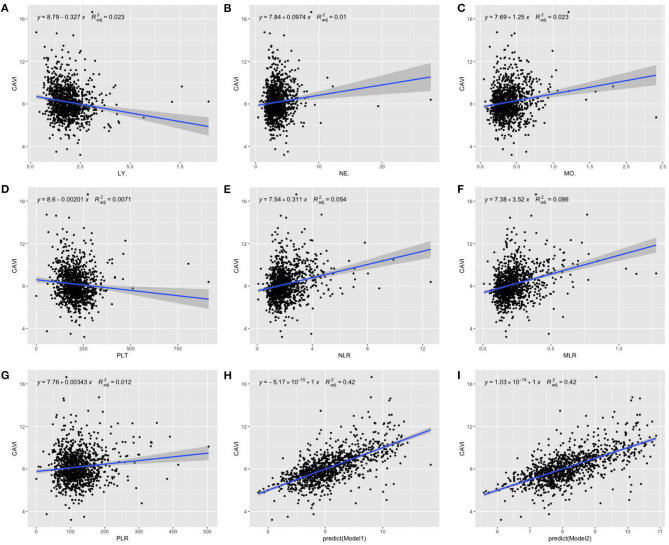
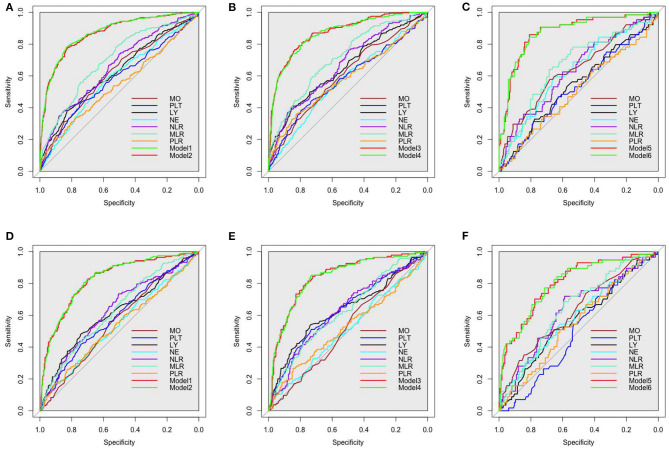
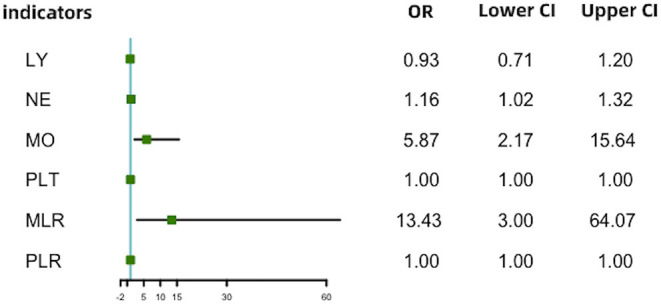
Arterial stiffness was the pathological basis and risk factor of cardiovascular diseases, with chronic inflammation as the core characteristic. We aimed to analyze the association between the arterial stiffness measured by cardio-ankle vascular index (CAVI) and indicators reflecting the inflammation degree, such as count of leukocyte subtypes, platelet, and monocyte-to-lymphocyte ratio (MLR), etc. The data of inpatients from November 2018 to November 2019 and from December 2019 to September 2020 were continuously collected as the training set (1,089 cases) and the validation set (700 cases), respectively. A retrospective analysis of gender subgroups was performed in the training set. The association between inflammatory indicators and CAVI or arterial stiffness by simple linear regression, multiple linear regression, and logistic regression was analyzed. The effectiveness of the inflammation indicators and the CAVI decision models to identify arterial stiffness by receiver operating curve (ROC) in the training and validation set was evaluated. The effect weights of MLR affecting the CAVI were 12.87% in men. MLR was the highest risk factor for arterial stiffness, with the odds ratio (95% confidence interval) of 8.95 (5.04-184.79) in men after adjusting the covariates. A cutpoint MLR of 0.19 had 70% accuracy for identifying arterial stiffness in all participants. The areas under the ROC curve of the CAVI decision models for arterial stiffness were >0.80 in the training set and validation set. The MLR might be a high-risk factor for arterial stiffness and could be considered as a potential indicator to predict arterial stiffness.
动脉僵硬度是心血管疾病的病理基础和危险因素,慢性炎症是其核心特征。我们旨在分析通过心-踝血管指数(CAVI)测量的动脉僵硬度与反映炎症程度的指标之间的关联,如白细胞亚型计数、血小板计数以及单核细胞与淋巴细胞比值(MLR)等。分别连续收集2018年11月至2019年11月以及2019年12月至2020年9月住院患者的数据作为训练集(1089例)和验证集(700例)。在训练集中对性别亚组进行回顾性分析。通过简单线性回归、多元线性回归和逻辑回归分析炎症指标与CAVI或动脉僵硬度之间的关联。在训练集和验证集中通过受试者工作特征曲线(ROC)评估炎症指标和CAVI决策模型识别动脉僵硬度的有效性。在男性中,MLR对CAVI的影响权重为12.87%。MLR是动脉僵硬度的最高风险因素,在调整协变量后,男性的比值比(95%置信区间)为8.95(5.04 - 184.79)。MLR的截断点为0.19时,在所有参与者中识别动脉僵硬度的准确率为70%。在训练集和验证集中,用于动脉僵硬度的CAVI决策模型的ROC曲线下面积均>0.80。MLR可能是动脉僵硬度的高风险因素,可被视为预测动脉僵硬度的潜在指标。