Center of Diabetes, Endocrine and Metabolism, Toho University Sakura Medical Center.
Nagayama Clinic.
J Atheroscler Thromb. 2020 Aug 1;27(8):732-748. doi: 10.5551/jat.RV17043. Epub 2020 Jun 26.
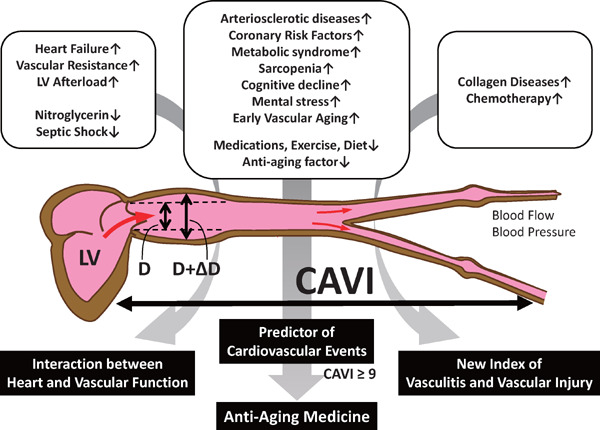
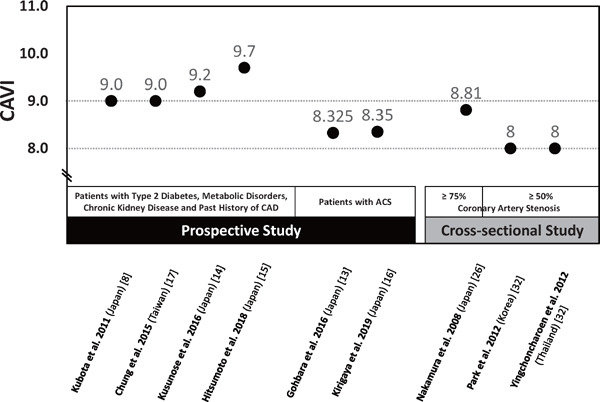
Arterial stiffness is recognized mainly as an indicator of arteriosclerosis and a predictor of cardiovascular events. Cardio-ankle vascular index (CAVI), which reflects arterial stiffness from the origin of the aorta to the ankle, was developed in 2004. An important feature of this index is the independency from blood pressure at the time of measurement. A large volume of clinical evidence obtained using CAVI has been reported. CAVI is high in patients with various atherosclerotic diseases including coronary artery disease and chronic kidney disease. Most coronary risk factors increase CAVI and their improvement reduces CAVI. Many prospective studies have investigated the association between CAVI and future cardiovascular disease (CVD), and proposed CAVI of 9 as the optimal cut-off value for predicting CVD. Research also shows that CAVI reflects afterload and left ventricular diastolic dysfunction in patients with heart failure. Furthermore, relatively acute changes in CAVI are observed under various pathophysiological conditions including mental stress, septic shock and congestive heart failure, and in pharmacological studies. CAVI seems to reflect not only structural stiffness but also functional stiffness involved in acute vascular functions. In 2016, Spronck and colleagues proposed a variant index CAVI, and claimed that CAVI was truly independent of blood pressure while CAVI was not. This argument was settled, and the independence of CAVI from blood pressure was reaffirmed. In this review, we summarize the recently accumulated evidence of CAVI, focusing on the proposed cut-off values for CVD events, and suggest the development of new horizons of vascular function index using CAVI.
动脉僵硬度主要被认为是动脉硬化的指标和心血管事件的预测因子。2004 年开发了反映从主动脉起源到脚踝的动脉僵硬度的心血管踝臂指数(CAVI)。该指数的一个重要特征是测量时独立于血压。已经报道了使用 CAVI 获得的大量临床证据。CAVI 在包括冠状动脉疾病和慢性肾病在内的各种动脉粥样硬化疾病患者中较高。大多数冠状动脉危险因素会增加 CAVI,而改善这些危险因素会降低 CAVI。许多前瞻性研究调查了 CAVI 与未来心血管疾病(CVD)之间的关系,并提出 CAVI 为 9 作为预测 CVD 的最佳截断值。研究还表明,CAVI 反映了心力衰竭患者的后负荷和左心室舒张功能障碍。此外,在各种病理生理条件下,包括精神应激、感染性休克和充血性心力衰竭,以及在药理学研究中,观察到 CAVI 的相对急性变化。CAVI 似乎不仅反映了结构僵硬,还反映了涉及急性血管功能的功能僵硬。2016 年,Spronck 及其同事提出了一种变体指数 CAVI,并声称 CAVI 在 CAVI 不受血压影响的情况下是真正独立于血压的。这一论点得到了解决,CAVI 不受血压的独立性得到了再次确认。在这篇综述中,我们总结了最近积累的 CAVI 证据,重点介绍了 CVD 事件的建议截断值,并提出了使用 CAVI 开发新的血管功能指数的新前景。