Franco Flávia P, Túler Amanda C, Gallan Diego Z, Gonçalves Felipe G, Favaris Arodí P, Peñaflor Maria Fernanda G V, Leal Walter S, Moura Daniel S, Bento José Maurício S, Silva-Filho Marcio C
Departamento de Genética, Escola Superior de Agricultura Luiz de Queiroz, Universidade de São Paulo, Piracicaba, SP, Brazil.
Departamento de Entomologia e Acarologia, Escola Superior de Agricultura Luiz de Queiroz, Universidade de São Paulo, Piracicaba, SP, Brazil.
ISME J. 2021 Dec;15(12):3522-3533. doi: 10.1038/s41396-021-01010-z. Epub 2021 Jun 14.
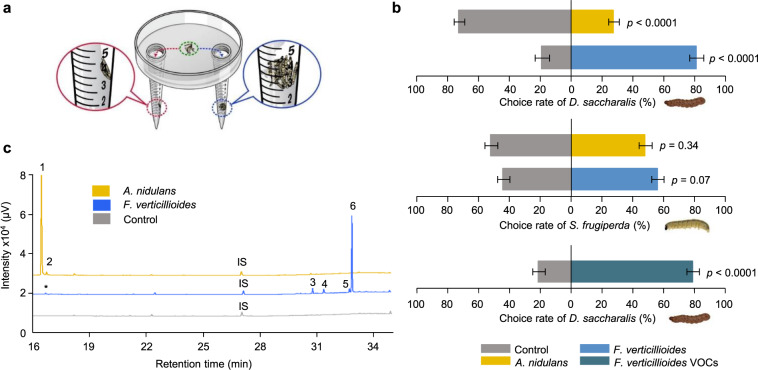
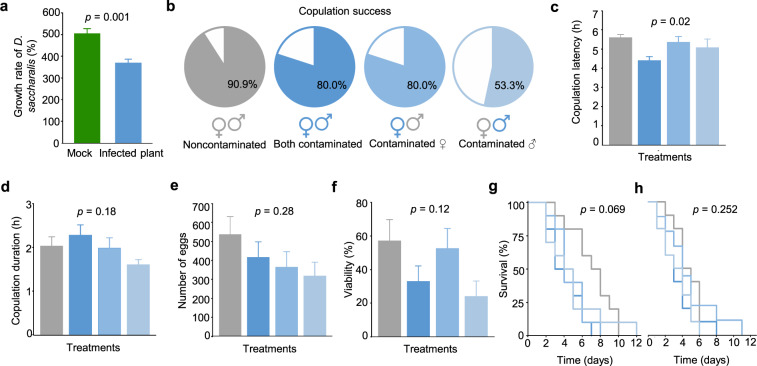
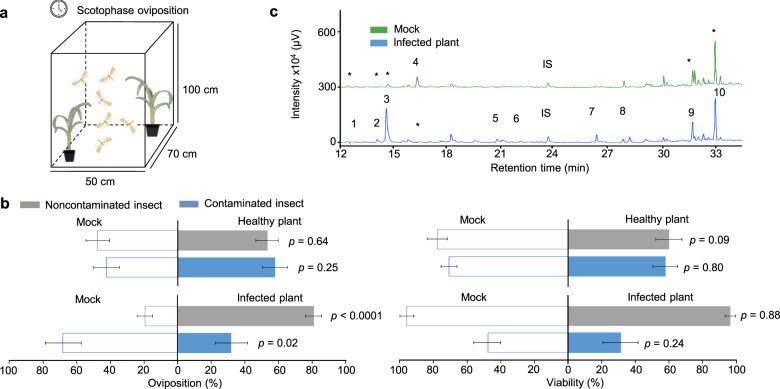
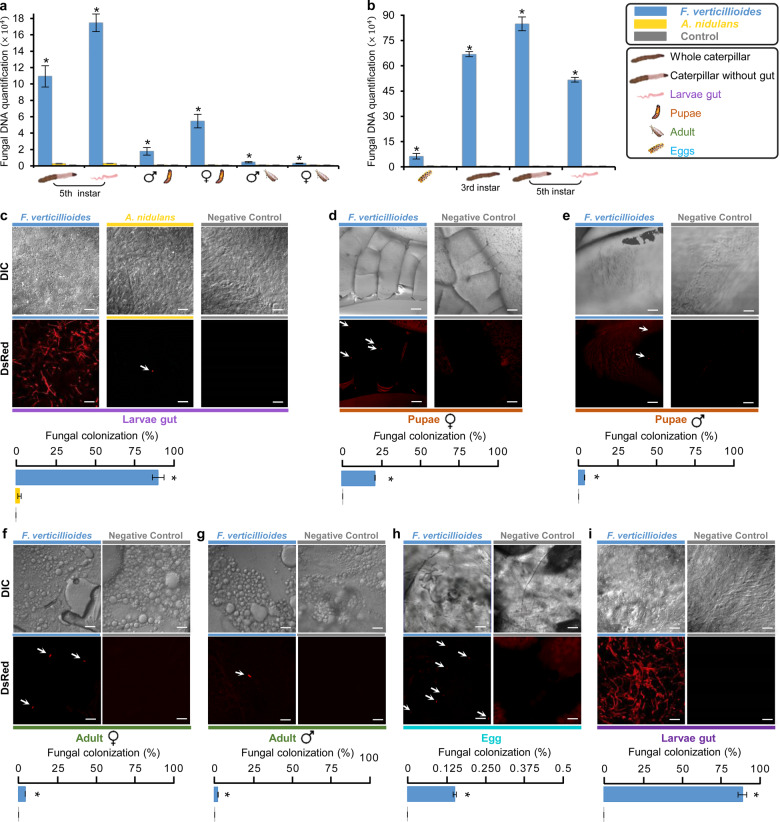
Vector-borne plant pathogens often change host traits to manipulate vector behavior in a way that favors their spread. By contrast, infection by opportunistic fungi does not depend on vectors, although damage caused by an herbivore may facilitate infection. Manipulation of hosts and vectors, such as insect herbivores, has not been demonstrated in interactions with fungal pathogens. Herein, we establish a new paradigm for the plant-insect-fungus association in sugarcane. It has long been assumed that Fusarium verticillioides is an opportunistic fungus, where it takes advantage of the openings left by Diatraea saccharalis caterpillar attack to infect the plant. In this work, we show that volatile emissions from F. verticillioides attract D. saccharalis caterpillars. Once they become adults, the fungus is transmitted vertically to their offspring, which continues the cycle by inoculating the fungus into healthy plants. Females not carrying the fungus prefer to lay their eggs on fungus-infected plants than mock plants, while females carrying the fungus prefer to lay their eggs on mock plants than fungus-infected plants. Even though the fungus impacts D. saccharalis sex behavior, larval weight and reproduction rate, most individuals complete their development. Our data demonstrate that the fungus manipulates both the host plant and insect herbivore across life cycle to promote its infection and dissemination.
媒介传播的植物病原体常常改变宿主的性状,以一种有利于其传播的方式操纵媒介的行为。相比之下,机会性真菌的感染并不依赖于媒介,尽管食草动物造成的损害可能会促进感染。在与真菌病原体的相互作用中,尚未证明存在对宿主和媒介(如昆虫食草动物)的操纵。在此,我们建立了甘蔗中植物-昆虫-真菌关联的新范式。长期以来,人们一直认为轮枝镰孢菌是一种机会性真菌,它利用甘蔗二点螟幼虫攻击留下的伤口来感染植物。在这项研究中,我们发现轮枝镰孢菌释放的挥发性物质会吸引甘蔗二点螟幼虫。幼虫成虫后,真菌会垂直传播给它们的后代,而后代通过将真菌接种到健康植物中延续这个循环。未携带真菌的雌虫更喜欢在感染真菌的植物上而非模拟植物上产卵,而携带真菌的雌虫则更喜欢在模拟植物上而非感染真菌的植物上产卵。尽管真菌会影响甘蔗二点螟的性行为、幼虫体重和繁殖率,但大多数个体仍能完成发育。我们的数据表明,这种真菌在整个生命周期中操纵宿主植物和昆虫食草动物,以促进其感染和传播。