Wallace Bruce, van Roode Thea, Pagan Flora, Hore Dennis, Pauly Bernadette
Canadian Institute for Substance Use Research, University of Victoria, PO Box 1700, STN CSC, Victoria, BC, Canada.
School of Social Work, University of Victoria, PO Box 1700, STN CSC, Victoria, BC, Canada.
BMC Public Health. 2021 Jun 16;21(1):1156. doi: 10.1186/s12889-021-11243-4.
As drug checking becomes more integrated within public health responses to the overdose crisis, and potentially more institutionalized, there is value in critically questioning the impacts of drug checking as a harm reduction response.
As part of a pilot project to implement community drug checking in Victoria, BC, Canada, in-depth interviews (N = 27) were held with people who use or have used substances, family or friends of people who use substances, and/or people who make or distribute substances. Critical harm reduction and social justice perspectives and a socioecological model guided our analysis to understand the potential role of drug checking within the overdose crisis, from the perspective of prospective service users.
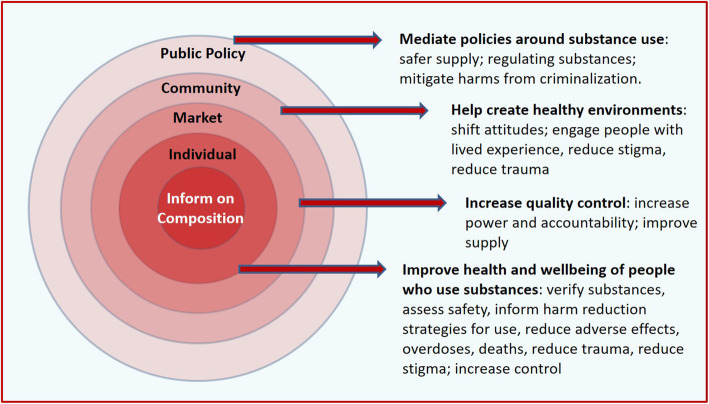
Participants provided insight into who might benefit from community drug checking and potential benefits. They indicated drug checking addresses a "shared need" that could benefit people who use substances, people who care for people who use substances, and people who sell substances. Using a socioecological model, we identified four overarching themes corresponding to benefits at each level: "drug checking to improve health and wellbeing of people who use substances", "drug checking to increase quality control in an unregulated market", "drug checking to create healthier environments", and "drug checking to mediate policies around substance use".
Drug checking requires a universal approach to meet the needs of diverse populations who use substances, and must not be focused on abstinence based outcomes. As a harm reduction response, community drug checking has potential impacts beyond the individual level. These include increasing power and accountability within the illicit drug market, improving the health of communities, supporting safer supply initiatives and regulation of substances, and mitigating harms of criminalization. Evaluation of drug checking should consider potential impacts that extend beyond individual behaviour change and recognize lived realities and structural conditions.
随着药物检测在应对过量用药危机的公共卫生措施中变得更加一体化,并且可能更加制度化,审慎质疑药物检测作为一种减少伤害措施所产生的影响具有重要意义。
作为在加拿大不列颠哥伦比亚省维多利亚市实施社区药物检测试点项目的一部分,我们对使用或曾使用过毒品的人、吸毒者的家人或朋友以及/或者制造或分销毒品的人进行了深入访谈(N = 27)。减少伤害和社会正义的批判性视角以及社会生态模型指导我们进行分析,以便从前瞻性服务使用者的角度了解药物检测在过量用药危机中的潜在作用。
参与者深入探讨了谁可能从社区药物检测中受益以及潜在的益处。他们指出,药物检测满足了一种“共同需求”,这可能使吸毒者、照顾吸毒者的人以及贩毒者都受益。运用社会生态模型,我们确定了四个总体主题,分别对应每个层面的益处:“药物检测以改善吸毒者的健康和福祉”、“药物检测以提高无监管市场的质量控制”、“药物检测以创造更健康的环境”以及“药物检测以协调围绕药物使用的政策”。
药物检测需要一种通用方法来满足不同吸毒人群的需求,且绝不能专注于基于戒毒的结果。作为一种减少伤害的措施,社区药物检测的潜在影响超出了个人层面。这些影响包括增强非法毒品市场的权力和问责制、改善社区健康、支持更安全的供应举措和药物监管以及减轻刑事定罪的危害。对药物检测的评估应考虑到超出个人行为改变的潜在影响,并认识到实际生活情况和结构条件。