Division of Cardiology, Department of Internal Medicine, Korea University Anam Hospital, Korea University College of Medicine, 73 Goryeodae-ro, Seongbuk-gu, Seoul, 02841, Republic of Korea.
Department of Statistics and Actuarial Science, Soongsil University, Seoul, Republic of Korea.
Sci Rep. 2021 Jun 16;11(1):12698. doi: 10.1038/s41598-021-92088-0.
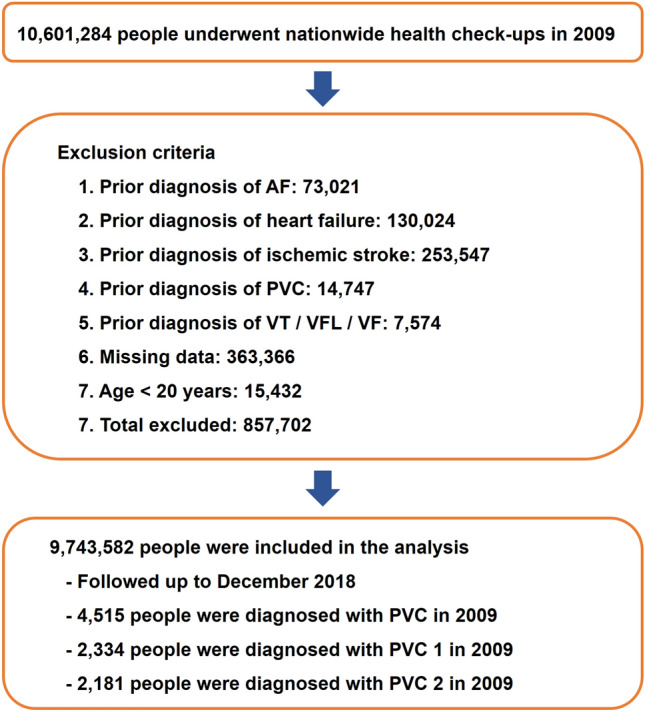
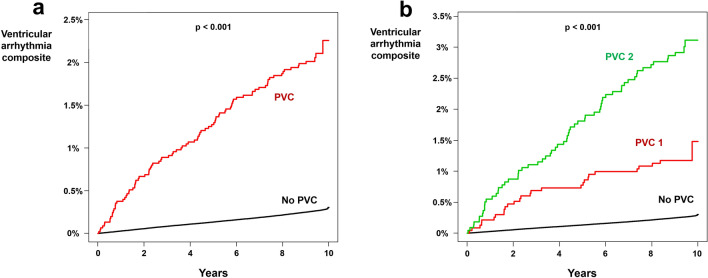
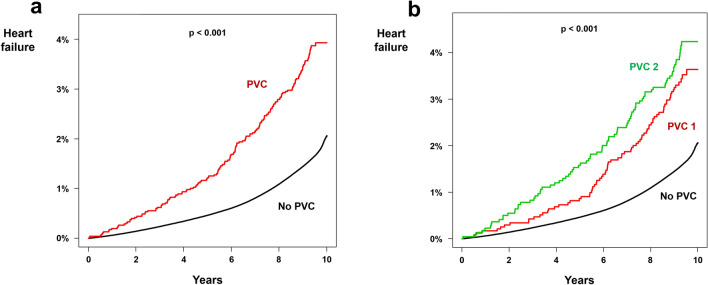
Premature ventricular contraction (PVC), a common arrhythmia affecting 1-2% of the general population, has been considered to have a benign clinical course. However, people with PVC often develop heart failure and ventricular arrhythmias such as ventricular tachycardia. We aimed to clarify the risk of heart failure and lethal ventricular arrhythmias in people with PVC. The Korean National Health Insurance Service database was used for this study. People who underwent nationwide health check-ups in 2009 were enrolled in this study and clinical follow-up data until December 2018 were analyzed. Newly diagnosed PVC in 2009 (≥ 1 inpatient or outpatient claim) were identified and cumulative incidence of heart failure (≥ 1 inpatient claim) and ventricular arrhythmias (≥ 1 inpatient or outpatient claim) were compared. A total of 4515 people were first diagnosed with PVC in 2009 among 9,743,582 people without prior history of PVC, heart failure, or ventricular arrhythmias. People with newly diagnosed PVC in 2009 had a significantly higher incidence of heart failure compared to those without PVC [adjusted hazard ratio (HR) 1.371; 95% confidence interval (CI) 1.177-1.598; p < 0.001]. Significant interaction was observed between age and PVC with young age people at greater risk of developing heart failure for having PVC. The incidence of ventricular arrhythmia was also significantly increased in people with PVC (HR 5.588; 95% CI 4.553-6.859; p < 0.001). Age and chronic kidney disease had significant interactions with PVC. In conclusion, the incidence of heart failure and ventricular arrhythmia was significantly increased in people with PVC. Outpatient follow-up of people with PVC can be helpful to detect early signs of heart failure or advanced forms of ventricular arrhythmia.
室性期前收缩(PVC)是一种常见的心律失常,影响 1-2%的普通人群,被认为具有良性的临床过程。然而,患有 PVC 的人常常会发展为心力衰竭和室性心动过速等室性心律失常。我们旨在阐明 PVC 患者发生心力衰竭和致命性室性心律失常的风险。本研究使用了韩国国家健康保险服务数据库。本研究纳入了 2009 年接受全国健康检查的人群,并分析了截至 2018 年 12 月的临床随访数据。2009 年新诊断为 PVC(≥1 次住院或门诊就诊),比较心力衰竭(≥1 次住院就诊)和室性心律失常(≥1 次住院或门诊就诊)的累积发生率。在没有 PVC、心力衰竭或室性心律失常既往史的 9743582 人中,共有 4515 人在 2009 年首次诊断为 PVC。与无 PVC 者相比,2009 年新诊断为 PVC 的患者心力衰竭的发生率显著更高[校正后的危险比(HR)1.371;95%置信区间(CI)1.177-1.598;p<0.001]。年龄和 PVC 之间存在显著的交互作用,年轻患者发生心力衰竭的风险更高。患有 PVC 的患者室性心律失常的发生率也显著增加(HR 5.588;95%CI 4.553-6.859;p<0.001)。年龄和慢性肾脏病与 PVC 之间存在显著的交互作用。总之,PVC 患者心力衰竭和室性心律失常的发生率显著增加。对 PVC 患者进行门诊随访有助于发现心力衰竭或更严重形式的室性心律失常的早期迹象。