College of Mechanical and Electronic Engineering, Nanjing Forestry University, Nanjing, People's Republic of China.
PLoS One. 2021 Jun 17;16(6):e0253311. doi: 10.1371/journal.pone.0253311. eCollection 2021.
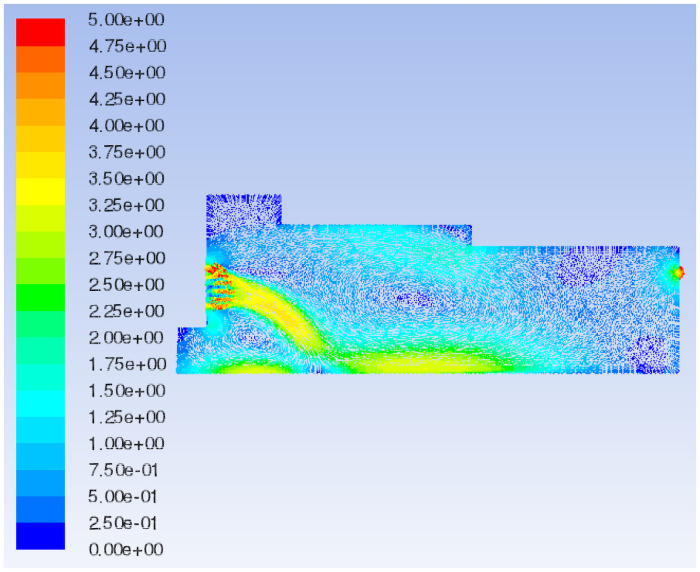
Particleboards are widely used in the artificial board market, which can be constructed from a variety of raw materials and require small amounts of energy to be produced. In the particleboard production process, forming machines play an important role as the key equipment for achieving continuous production. In recent years, airflow forming machines have received increasing attention in particleboard production lines because of their strong separation ability and low price. However, the internal flow field is complex and difficult to control, which affects the surface quality and strength of the particleboard. The most pressing technical difficulty is controlling the flow field characteristics of the airflow paver. At present, the research on this subject is conducted primarily through repeated experiments, which entail long research periods and high processing costs. To reduce human and financial costs, in this study, Computational Fluid Dynamics (CFD) is employed to investigate the flow field and the gas-solid two-phase flow field coupled with particle movement of an airflow forming machine. The accuracy of the calculation model is verified by comparing characteristic point velocities obtained from experimental analysis and a simulation. The simulation results show that in practical production, the frequency of a negative pressure fan should be greater than 27 Hz. It is necessary to set the shoulder properly, and the slab smoothness can be improved by moving the shoulder back on the premise of meeting the strength requirements of the box. The distance between the shoulders of the box body should be less than 2570 mm, and particles with uniform diameter should be added to the paving box to reduce the turbulence effect, improve the quality of particle forming and provide actual particleboard production with a solid theoretical foundation.
刨花板在人造板市场中得到广泛应用,可以用各种原材料制成,并且生产所需能源较少。在刨花板生产过程中,成型机作为实现连续生产的关键设备,起着重要作用。近年来,气流铺装机在刨花板生产线中受到越来越多的关注,因为其具有较强的分离能力和较低的价格。然而,内部流场复杂,难以控制,这会影响刨花板的表面质量和强度。最紧迫的技术难题是控制气流铺装机的流场特性。目前,对这一主题的研究主要通过反复试验进行,这需要较长的研究周期和较高的加工成本。为了降低人力和财务成本,在本研究中,采用计算流体动力学(CFD)研究气流成型机的流场和与颗粒运动相耦合的气固两相流场。通过将实验分析和模拟得到的特征点速度进行比较,验证了计算模型的准确性。模拟结果表明,在实际生产中,负压风机的频率应大于 27 Hz。有必要适当地设置肩部,在满足箱体强度要求的前提下,将肩部向后移动可以提高板坯的平整度。箱体肩部之间的距离应小于 2570mm,并在铺装机中添加直径均匀的颗粒,以减少紊流效应,提高颗粒成型质量,为实际的刨花板生产提供坚实的理论基础。