Alvarez-Alvarez Belén, García-Seara Javier, Martínez-Sande Jose L, Rodríguez-Mañero Moisés, Fernández López Xesús A, González-Melchor Laila, Iglesias-Alvarez Diego, Gude Francisco, Díaz-Louzao Carla, González-Juanatey José R
Cardiology Department Clinical University Hospital of Santiago de Compostela Santiago de Compostela Spain.
Arrhythmia Unit Clinical University Hospital of Santiago de Compostela Santiago de Compostela Spain.
J Arrhythm. 2021 Mar 21;37(3):653-659. doi: 10.1002/joa3.12527. eCollection 2021 Jun.
The benefit of cardiac resynchronization therapy (CRT) in heart failure (HF) patients with reduced left ventricular ejection fraction (LVEF) have been observed in the first year. However, there are few data on long-term follow-up and the effect of changes of LVEF on mortality. This study aimed to assess the LV remodeling after CRT implantation and the probable effect of changes in LVEF with repeated measures on mortality over time in a real-world registry.
Among our cohort of 328 consecutive CRT patients, mixed model effect analysis have been made to describe the temporal evolution of LVEF and LVESV changes over time up with several explanatory variables. Besides, the effect of LVEF along time on the probability of mortality was evaluated using joint modeling for longitudinal and survival data.
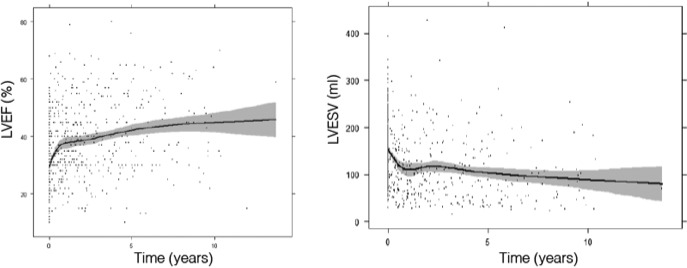
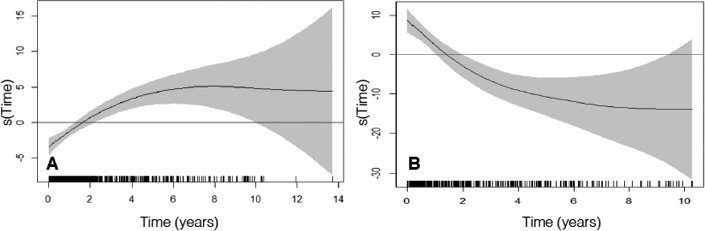
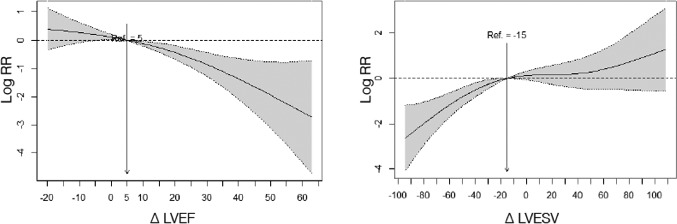
The study population included 328 patients (253 men; 70.2 ± 9.5 years) in 4.2 (2.9) years follow-up. There was an increase in LVEF of 11% and a reduction in LVESV of 42 mL during the first year. These changes are more important during the first year, but slight changes remain during the follow-up. The largest reduction in LVESV occurred in patients with left bundle branch block (LBBB) and the smallest reduction in patients with NYHA IV. The smallest increase in LVEF was an ischemic etiology, longer QRS, and LV electrode in a nonlateral vein. Besides, the results showed that the LVEF profiles taken during follow-up after CRT were associated with changes in the risk of death.
Reverse remodeling of the left ventricle is observed especially during the first year, but it seems to be maintained later after CRT implantation in a contemporary cohort of patients. Longitudinal measurements could give us additional information at predicting the individual mortality risk after adjusting by age and sex compared to a single LVEF measurement after CRT.
心脏再同步治疗(CRT)对左心室射血分数(LVEF)降低的心力衰竭(HF)患者的益处已在第一年得到观察。然而,关于长期随访以及LVEF变化对死亡率影响的数据较少。本研究旨在评估CRT植入后的左心室重构以及LVEF变化与重复测量对现实世界注册研究中随时间推移死亡率的可能影响。
在我们连续的328例CRT患者队列中,采用混合模型效应分析来描述LVEF和左心室收缩末期容积(LVESV)随时间的变化以及几个解释变量。此外,使用纵向和生存数据的联合模型评估LVEF随时间对死亡概率的影响。
研究人群包括328例患者(253例男性;年龄70.2±9.5岁),随访4.2(2.9)年。第一年LVEF增加11%,LVESV减少42 mL。这些变化在第一年更为显著,但随访期间仍有轻微变化。LVESV减少最大的发生在左束支传导阻滞(LBBB)患者中,NYHA IV级患者减少最小。LVEF增加最小的是缺血性病因、QRS波较长以及左心室电极位于非侧支静脉的患者。此外,结果表明CRT术后随访期间的LVEF变化与死亡风险变化相关。
尤其是在第一年观察到左心室逆向重构,但在当代患者队列中CRT植入后似乎后期仍能维持。与CRT术后单次LVEF测量相比,纵向测量在按年龄和性别调整后预测个体死亡风险时能为我们提供更多信息。