Okuyama Kohei, Hayashida Saki, Rokutanda Satoshi, Kawakita Akiko, Soutome Sakiko, Sawada Shunsuke, Yanamoto Souichi, Kojima Yuka, Umeda Masahiro
Department of Oral and Maxillofacial Surgery, Graduate School of Medical and Dental Sciences, Tokyo Medical and Dental University, Tokyo, Japan.
Department of Clinical Oral Oncology, Nagasaki University Graduate School of Biomedical Sciences, Nagasaki, Japan.
J Dent Sci. 2021 Jul;16(3):885-890. doi: 10.1016/j.jds.2020.12.007. Epub 2020 Dec 31.
BACKGROUND/PURPOSE: Because the anatomy and the nature of the bone tissue between the mandible and maxilla are largely different, more site-specific studies are required to improve the healing rate on medication-related osteonecrosis of the jaw (MRONJ). The present study assessed maxillary MRONJ that was treated by surgery to understand its clinical characteristics, and to identify critical factors that influenced outcomes.
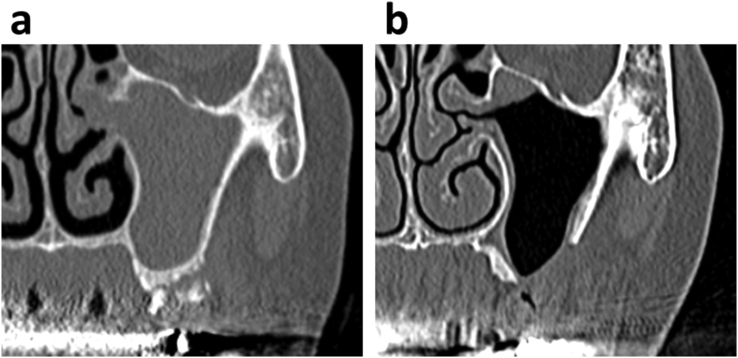
The medical records of 54 patients with maxillary MRONJ who underwent surgery were retrospectively reviewed. Variables related to the prognosis of MRONJ were extracted from the medical records and imaging, and were statistically analyzed. We also evaluated the concomitant maxillary sinusitis (MS) after the surgical treatment of MRONJ, based on CT evaluation and change of symptoms.
The healing rate of surgery for maxillary MRONJ was 85.2%, which suggested that surgical treatment is an effective strategy for treating maxillary MRONJ. Multivariate analysis revealed that postoperative residual necrotic bone was a poor prognosticator for maxillary MRONJ. Among 10 patients who did not obtain healing of MS postoperatively, 8 patients showed an improvement.
Our results indicate that surgical treatment is an appropriate strategy for maxillary MRONJ and complete resection of necrotic bone (i.e., extensive surgery) is needed to obtain complete healing of maxillary MRONJ. Concomitant MS tends to be healed or improved clinically in combination with the healing of maxillary MRONJ.
背景/目的:由于下颌骨和上颌骨之间骨组织的解剖结构和性质差异很大,需要更多针对特定部位的研究来提高颌骨药物性骨坏死(MRONJ)的愈合率。本研究评估了接受手术治疗的上颌骨MRONJ,以了解其临床特征,并确定影响治疗结果的关键因素。
回顾性分析54例接受手术治疗的上颌骨MRONJ患者的病历。从病历和影像学资料中提取与MRONJ预后相关的变量,并进行统计学分析。我们还根据CT评估和症状变化,评估了MRONJ手术治疗后的上颌窦炎(MS)情况。
上颌骨MRONJ的手术愈合率为85.2%,这表明手术治疗是治疗上颌骨MRONJ的有效策略。多因素分析显示,术后残留坏死骨是上颌骨MRONJ预后不良的指标。在术后MS未愈合的10例患者中,8例有改善。
我们的结果表明,手术治疗是上颌骨MRONJ的合适策略,需要彻底切除坏死骨(即广泛手术)以实现上颌骨MRONJ的完全愈合。伴随的MS往往会随着上颌骨MRONJ的愈合而在临床上愈合或改善。