
早期青春期接触抗生素会导致成年雄性小鼠的线粒体和行为缺陷。
Early-adolescent antibiotic exposure results in mitochondrial and behavioral deficits in adult male mice.
机构信息
Department of Medical Imaging, Anatomy, Radboud University Medical Center, Donders Institute for Brain, Cognition & Behaviour, Centre for Medical Neuroscience, Preclinical Imaging Centre PRIME, Nijmegen, The Netherlands.
Department of Clinical Genomics, Mayo Clinic, 200 First St. SW, Rochester, MN, USA.
出版信息
Sci Rep. 2021 Jun 18;11(1):12875. doi: 10.1038/s41598-021-92203-1.
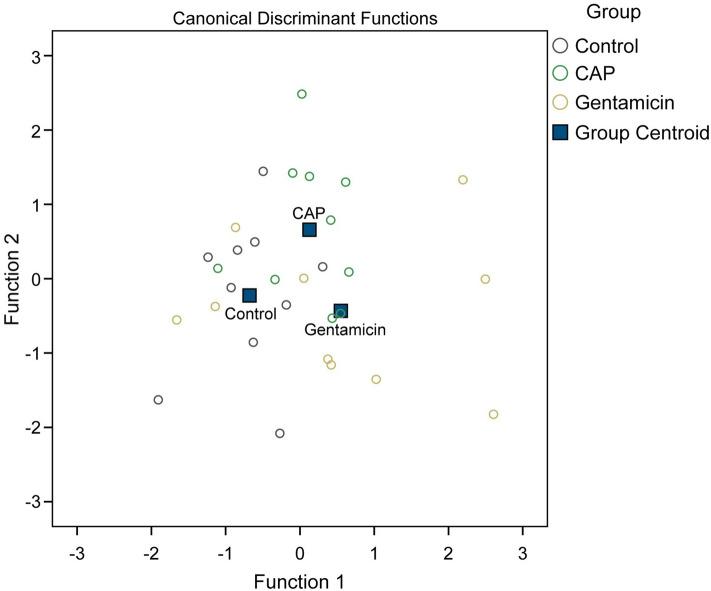
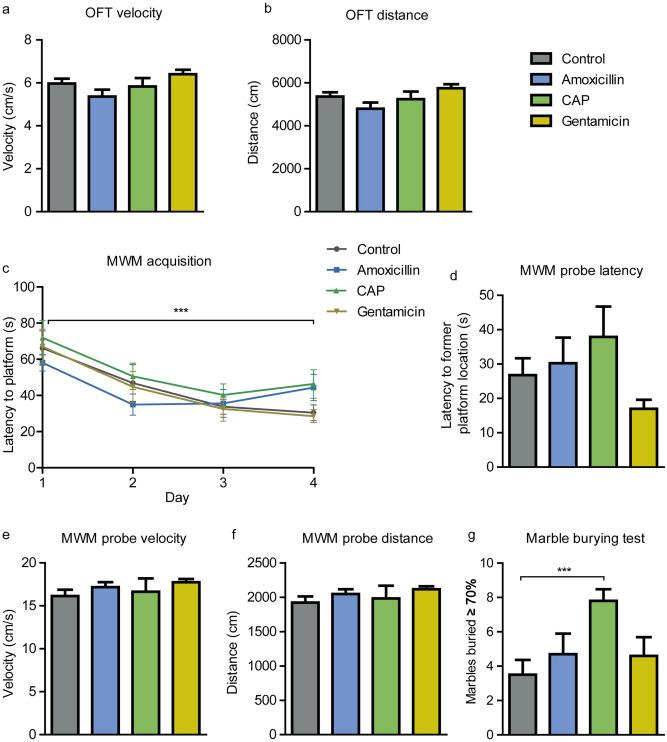
Exposure to antibiotic treatment has been associated with increased vulnerability to various psychiatric disorders. However, a research gap exists in understanding how adolescent antibiotic therapy affects behavior and cognition. Many antibiotics that target bacterial translation may also affect mitochondrial translation resulting in impaired mitochondrial function. The brain is one of the most metabolically active organs, and hence is the most vulnerable to impaired mitochondrial function. We hypothesized that exposure to antibiotics during early adolescence would directly affect brain mitochondrial function, and result in altered behavior and cognition. We administered amoxicillin, chloramphenicol, or gentamicin in the drinking water to young adolescent male wild-type mice. Next, we assayed mitochondrial oxidative phosphorylation complex activities in the cerebral cortex, performed behavioral screening and targeted mass spectrometry-based acylcarnitine profiling in the cerebral cortex. We found that mice exposed to chloramphenicol showed increased repetitive and compulsive-like behavior in the marble burying test, an accurate and sensitive assay of anxiety, concomitant with decreased mitochondrial complex IV activity. Our results suggest that only adolescent chloramphenicol exposure leads to impaired brain mitochondrial complex IV function, and could therefore be a candidate driver event for increased anxiety-like and repetitive, compulsive-like behaviors.
接触抗生素治疗与各种精神疾病的易感性增加有关。然而,对于了解青少年抗生素治疗如何影响行为和认知,仍存在研究空白。许多靶向细菌翻译的抗生素也可能影响线粒体翻译,导致线粒体功能受损。大脑是新陈代谢最活跃的器官之一,因此最容易受到线粒体功能受损的影响。我们假设在青少年早期接触抗生素会直接影响大脑线粒体功能,并导致行为和认知改变。我们在饮用水中给年轻的青春期雄性野生型小鼠施用阿莫西林、氯霉素或庆大霉素。接下来,我们测定了大脑皮层中线粒体氧化磷酸化复合物的活性,进行了行为筛选,并在大脑皮层进行了基于靶向质谱的酰基辅酶 A 谱分析。我们发现,暴露于氯霉素的小鼠在大理石掩埋试验中表现出重复和强迫样行为增加,这是一种焦虑的准确和敏感的检测方法,同时伴有线粒体复合物 IV 活性降低。我们的结果表明,只有青春期氯霉素暴露会导致大脑线粒体复合物 IV 功能受损,因此可能是增加焦虑样和重复强迫样行为的候选驱动事件。




 Zotero 插件