Department of Surgery, Samsung Medical Center, Sungkyunkwan University School of Medicine, 50 Irwon-dong, Gangnam-gu, Seoul, 135-710, Korea.
Statistics and Data Center, Research Institute for Future Medicine, Samsung Medical Center, Seoul, Korea.
Sci Rep. 2021 Jun 18;11(1):12909. doi: 10.1038/s41598-021-92298-6.
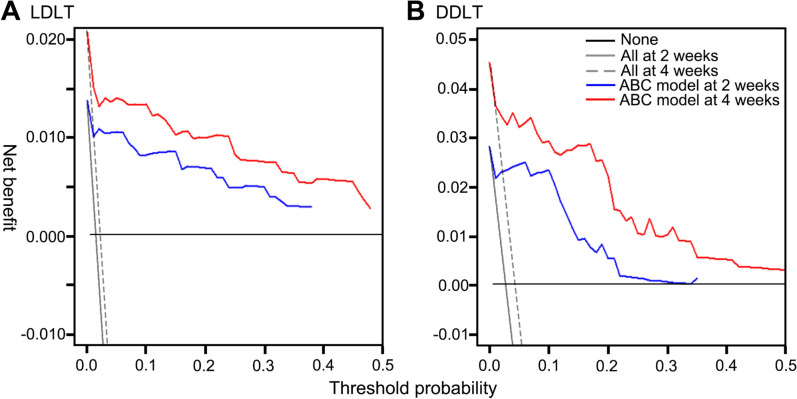
This study was designed to build models predicting early graft failure after liver transplantation. Cox regression model for predicting early graft failure after liver transplantation using post-transplantation aspartate aminotransferase, total bilirubin, and international normalized ratio of prothrombin time was constructed based on data from both living donor (n = 1153) and deceased donor (n = 359) liver transplantation performed during 2004 to 2018. The model was compared with Model for Early Allograft Function Scoring (MEAF) and early allograft dysfunction (EAD) with their C-index and time-dependent area-under-curve (AUC). The C-index of the model for living donor (0.73, CI = 0.67-0.79) was significantly higher compared to those of both MEAF (0.69, P = 0.03) and EAD (0.66, P = 0.001) while C-index for deceased donor (0.74, CI = 0.65-0.83) was only significantly higher compared to C-index of EAD. (0.66, P = 0.002) Time-dependent AUC at 2 weeks of living donor (0.96, CI = 0.91-1.00) and deceased donor (0.98, CI = 0.96-1.00) were significantly higher compared to those of EAD. (both 0.83, P < 0.001 for living donor and deceased donor) Time-dependent AUC at 4 weeks of living donor (0.93, CI = 0.86-0.99) was significantly higher compared to those of both MEAF (0.87, P = 0.02) and EAD. (0.84, P = 0.02) Time-dependent AUC at 4 weeks of deceased donor (0.94, CI = 0.89-1.00) was significantly higher compared to both MEAF (0.82, P = 0.02) and EAD. (0.81, P < 0.001). The prediction model for early graft failure after liver transplantation showed high predictability and validity with higher predictability compared to traditional models for both living donor and deceased donor liver transplantation.
本研究旨在建立预测肝移植后早期移植物失功的模型。我们基于 2004 年至 2018 年期间行活体供肝(n=1153)和尸体供肝(n=359)肝移植患者的术后天门冬氨酸氨基转移酶、总胆红素和凝血酶原时间国际标准化比值数据,构建了预测肝移植后早期移植物失功的 Cox 回归模型。我们比较了该模型与早期移植物功能评分(MEAF)和早期移植物功能障碍(EAD)的 C 指数和时间依赖性曲线下面积(AUC)。活体供肝模型的 C 指数(0.73,95%CI:0.67-0.79)显著高于 MEAF(0.69,P=0.03)和 EAD(0.66,P=0.001),而尸体供肝模型的 C 指数(0.74,95%CI:0.65-0.83)仅显著高于 EAD 的 C 指数(0.66,P=0.002)。活体供肝和尸体供肝移植术后 2 周的时间依赖性 AUC(0.96,95%CI:0.91-1.00 和 0.98,95%CI:0.96-1.00)显著高于 EAD(均为 0.83,P<0.001)。活体供肝移植术后 4 周的时间依赖性 AUC(0.93,95%CI:0.86-0.99)显著高于 MEAF(0.87,P=0.02)和 EAD(0.84,P=0.02)。尸体供肝移植术后 4 周的时间依赖性 AUC(0.94,95%CI:0.89-1.00)显著高于 MEAF(0.82,P=0.02)和 EAD(0.81,P<0.001)。肝移植后早期移植物失功预测模型具有较高的预测能力和准确性,与活体供肝和尸体供肝肝移植的传统模型相比,具有更高的预测能力。