• 文献检索
  • 文档翻译
  • 深度研究
  • 学术资讯
  • Suppr Zotero 插件Zotero 插件
  • 邀请有礼
  • 套餐&价格
  • 历史记录
应用&插件
Suppr Zotero 插件Zotero 插件浏览器插件Mac 客户端Windows 客户端微信小程序
定价
高级版会员购买积分包购买API积分包
服务
文献检索文档翻译深度研究API 文档MCP 服务
关于我们
关于 Suppr公司介绍联系我们用户协议隐私条款
关注我们

Suppr 超能文献

核心技术专利:CN118964589B侵权必究
粤ICP备2023148730 号-1Suppr @ 2026

文献检索

告别复杂PubMed语法,用中文像聊天一样搜索,搜遍4000万医学文献。AI智能推荐,让科研检索更轻松。

立即免费搜索

文件翻译

保留排版,准确专业,支持PDF/Word/PPT等文件格式,支持 12+语言互译。

免费翻译文档

深度研究

AI帮你快速写综述,25分钟生成高质量综述,智能提取关键信息,辅助科研写作。

立即免费体验

1957-2020 年印度基孔肯雅热与非人灵长类动物死亡的回顾性研究。

Retrospective Study of Kyasanur Forest Disease and Deaths among Nonhuman Primates, India, 1957-2020.

出版信息

Emerg Infect Dis. 2021 Jul;27(7):1969-1973. doi: 10.3201/eid2707.210463.

DOI:10.3201/eid2707.210463
PMID:34152964
原文链接:https://pmc.ncbi.nlm.nih.gov/articles/PMC8237885/
Abstract

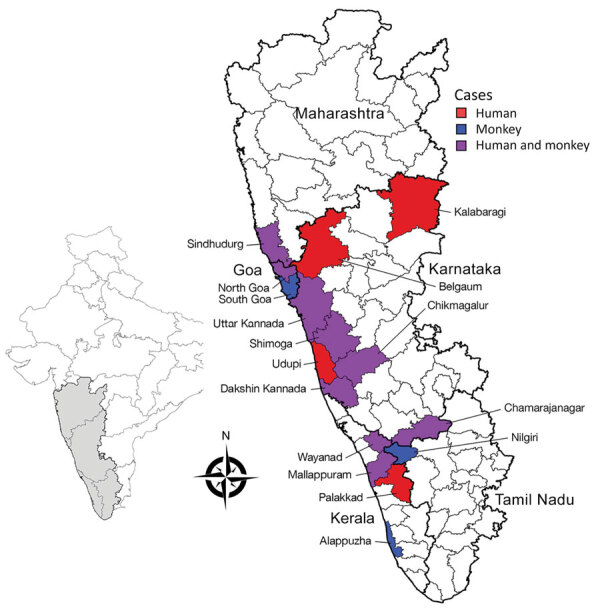
Kyasanur Forest disease (KFD) is a tickborne hemorrhagic disease affecting primates along the Western Ghats mountain range in India. Our retrospective study indicated that >3,314 monkey deaths attributed to KFD were reported in KFD-endemic states in India during 1957-2020. These data can help guide surveillance to protect animal and human health.

摘要

基孔肯雅热(KFD)是一种由蜱传播的出血性疾病,影响印度西高止山脉沿线的灵长类动物。我们的回顾性研究表明,1957 年至 2020 年间,在印度基孔肯雅热流行的各州,有超过 3314 只猴子死于基孔肯雅热。这些数据有助于指导监测工作,以保护动物和人类的健康。
https://cdn.ncbi.nlm.nih.gov/pmc/blobs/0290/8237885/7a41e6869f53/21-0463-F2.jpg
https://cdn.ncbi.nlm.nih.gov/pmc/blobs/0290/8237885/d3fd767d10ad/21-0463-F1.jpg
https://cdn.ncbi.nlm.nih.gov/pmc/blobs/0290/8237885/7a41e6869f53/21-0463-F2.jpg
https://cdn.ncbi.nlm.nih.gov/pmc/blobs/0290/8237885/d3fd767d10ad/21-0463-F1.jpg
https://cdn.ncbi.nlm.nih.gov/pmc/blobs/0290/8237885/7a41e6869f53/21-0463-F2.jpg

相似文献

1
Retrospective Study of Kyasanur Forest Disease and Deaths among Nonhuman Primates, India, 1957-2020.1957-2020 年印度基孔肯雅热与非人灵长类动物死亡的回顾性研究。
Emerg Infect Dis. 2021 Jul;27(7):1969-1973. doi: 10.3201/eid2707.210463.
2
Prevalence and spatial distribution of Ixodid tick populations in the forest fringes of Western Ghats reported with human cases of Kyasanur forest disease and monkey deaths in South India.在印度南部西高止山脉森林边缘地区,与基孔肯雅森林病人类病例和猴子死亡情况相关报告的硬蜱种群患病率及空间分布。
Exp Appl Acarol. 2018 May;75(1):135-142. doi: 10.1007/s10493-018-0223-5. Epub 2018 Mar 28.
3
Kyasanur Forest Disease (KFD): Rare Disease of Zoonotic Origin.基孔肯雅热森林病(KFD):一种罕见的人畜共患病源性疾病。
J Nepal Health Res Counc. 2016 Sep;14(34):214-218.
4
On the transmission pattern of Kyasanur Forest disease (KFD) in India.关于印度基孔肯雅森林病(KFD)的传播模式
Infect Dis Poverty. 2015 Aug 19;4:37. doi: 10.1186/s40249-015-0066-9.
5
An outbreak of Kyasanur forest disease in the Wayanad and Malappuram districts of Kerala, India.印度喀拉拉邦韦亚纳德和马拉普拉姆地区发生基孔肯雅森林病疫情。
Ticks Tick Borne Dis. 2017 Jan;8(1):25-30. doi: 10.1016/j.ttbdis.2016.09.010. Epub 2016 Sep 21.
6
Species distribution and ecological suitability analysis for potential tick vectors of Kyasanur forest disease in the Western Ghats of Kerala.喀拉拉邦西高止山脉基萨努尔森林病潜在蜱媒的物种分布和生态适宜性分析。
Med Vet Entomol. 2022 Mar;36(1):38-42. doi: 10.1111/mve.12549. Epub 2021 Sep 23.
7
Kyasanur Forest Disease in India: innovative options for intervention.印度基孔肯雅热:干预的创新选择。
Hum Vaccin Immunother. 2019;15(10):2243-2248. doi: 10.1080/21645515.2019.1602431. Epub 2019 May 7.
8
Forest loss shapes the landscape suitability of Kyasanur Forest disease in the biodiversity hotspots of the Western Ghats, India.森林砍伐塑造了印度西高止山脉生物多样性热点地区基萨努尔森林病的景观适宜性。
Int J Epidemiol. 2019 Dec 1;48(6):1804-1814. doi: 10.1093/ije/dyz232.
9
Epidemiology, Pathogenesis, and Control of a Tick-Borne Disease- Kyasanur Forest Disease: Current Status and Future Directions.蜱传疾病-基孔肯雅热的流行病学、发病机制和控制:现状与未来方向。
Front Cell Infect Microbiol. 2018 May 9;8:149. doi: 10.3389/fcimb.2018.00149. eCollection 2018.
10
Kyasanur forest disease.基孔肯雅热。
Antiviral Res. 2012 Dec;96(3):353-62. doi: 10.1016/j.antiviral.2012.10.005. Epub 2012 Oct 27.

引用本文的文献

1
Kyasanur Forest Disease Virus: Epidemiological Insights, Pathogenesis, Therapeutic Strategies, and Advances in Vaccines and Diagnostics.基孔肯雅森林病病毒:流行病学见解、发病机制、治疗策略以及疫苗与诊断技术的进展
Viruses. 2025 Jul 22;17(8):1022. doi: 10.3390/v17081022.
2
First evidence of transovarial transmission of Kyasanur Forest disease virus in Haemaphysalis and Rhipicephalus ticks in the wild.在野外血蜱属和璃眼蜱属蜱虫中发现卡萨努尔森林病病毒经卵传播的首个证据。
Parasit Vectors. 2025 Jan 17;18(1):14. doi: 10.1186/s13071-024-06643-5.
3
Kyasanur Forest Disease: An Epidemiological Investigation and Case-Control Study in Shivamogga, Karnataka, India-2022.

本文引用的文献

1
Study of Kyasanur forest disease viremia, antibody kinetics, and virus infection in target organs of Macaca radiata.研究克雅山森林病病毒血症、抗体动力学和猕猴目标器官中的病毒感染。
Sci Rep. 2020 Jul 28;10(1):12561. doi: 10.1038/s41598-020-67599-x.
2
Historical Expansion of Kyasanur Forest Disease in India From 1957 to 2017: A Retrospective Analysis.1957年至2017年印度基孔肯雅森林病的历史扩展:一项回顾性分析
Geohealth. 2019 Feb 5;3(2):44-55. doi: 10.1029/2018GH000164. eCollection 2019 Feb.
3
Prevalence and spatial distribution of Ixodid tick populations in the forest fringes of Western Ghats reported with human cases of Kyasanur forest disease and monkey deaths in South India.
基孔肯雅热:印度卡纳塔克邦希瓦莫加的一项流行病学调查和病例对照研究-2022 年。
Int J Public Health. 2024 Oct 18;69:1606715. doi: 10.3389/ijph.2024.1606715. eCollection 2024.
4
Sociodemographic factors associated with Kyasanur forest disease in India - a retrospective study.印度与基孔肯雅森林病相关的社会人口学因素——一项回顾性研究
IJID Reg. 2024 Feb 15;10:219-227. doi: 10.1016/j.ijregi.2024.02.002. eCollection 2024 Mar.
5
Repellent activity against Anopheles gambiae of the leaves of nesting trees in the Sebitoli chimpanzee community of Kibale National Park, Uganda.乌干达基巴莱国家公园塞比托利黑猩猩社区中筑巢树木叶子对冈比亚按蚊的驱避活性。
Malar J. 2022 Sep 27;21(1):271. doi: 10.1186/s12936-022-04291-7.
在印度南部西高止山脉森林边缘地区,与基孔肯雅森林病人类病例和猴子死亡情况相关报告的硬蜱种群患病率及空间分布。
Exp Appl Acarol. 2018 May;75(1):135-142. doi: 10.1007/s10493-018-0223-5. Epub 2018 Mar 28.
4
The use of animals as a surveillance tool for monitoring environmental health hazards, human health hazards and bioterrorism.将动物用作监测环境健康危害、人类健康危害和生物恐怖主义的监测工具。
Vet Microbiol. 2017 May;203:40-48. doi: 10.1016/j.vetmic.2017.02.007. Epub 2017 Feb 17.
5
Kyasanur forest disease virus breaking the endemic barrier: An investigation into ecological effects on disease emergence and future outlook.基孔肯雅森林病病毒突破地方病屏障:对疾病出现的生态影响及未来展望的调查
Zoonoses Public Health. 2017 Nov;64(7):e73-e80. doi: 10.1111/zph.12349. Epub 2017 Feb 20.
6
On the transmission pattern of Kyasanur Forest disease (KFD) in India.关于印度基孔肯雅森林病(KFD)的传播模式
Infect Dis Poverty. 2015 Aug 19;4:37. doi: 10.1186/s40249-015-0066-9.
7
Coverage and effectiveness of Kyasanur forest disease (KFD) vaccine in Karnataka, South India, 2005-10.2005-10 年印度南部卡纳塔克邦基萨努尔森林病(KFD)疫苗的覆盖范围和效果。
PLoS Negl Trop Dis. 2013;7(1):e2025. doi: 10.1371/journal.pntd.0002025. Epub 2013 Jan 24.
8
Recent ancestry of Kyasanur Forest disease virus.基孔肯雅热病毒的近期起源。
Emerg Infect Dis. 2009 Sep;15(9):1431-7. doi: 10.3201/eid1509.080759.
9
Of how much concern are the 'least concern' species? Distribution and conservation status of bonnet macaques, rhesus macaques and Hanuman langurs in Karnataka, India.“无危”物种有多受关注?印度卡纳塔克邦帽猴、恒河猴和哈努曼叶猴的分布与保护状况。
Primates. 2010 Jan;51(1):37-42. doi: 10.1007/s10329-009-0168-8. Epub 2009 Sep 2.
10
Kyasanur forest disease: an epidemiological view in India.基孔肯雅森林病:印度的流行病学视角
Rev Med Virol. 2006 May-Jun;16(3):151-65. doi: 10.1002/rmv.495.