Munawara Usma, Catanzaro Michael, Xu Weili, Tan Crystal, Hirokawa Katsuiku, Bosco Nabil, Dumoulin David, Khalil Abdelouahed, Larbi Anis, Lévesque Simon, Ramassamy Charles, Barron Annelise E, Cunnane Stephen, Beauregard Pascale B, Bellenger Jean-Pierre, Rodrigues Serafim, Desroches Mathieu, Witkowski Jacek M, Laurent Benoit, Frost Eric H, Fulop Tamas
Research Center on Aging, Faculty of Medicine and Health Sciences, University of Sherbrooke, 3001, 12th Avenue North, Sherbrooke, Quebec, J1H 5N4, Canada.
Department of Drug Sciences, University of Pavia, Pavia, Italy.
Immun Ageing. 2021 Jun 21;18(1):29. doi: 10.1186/s12979-021-00236-x.
Alzheimer's disease (AD) is the most common neurodegenerative disease ultimately manifesting as clinical dementia. Despite considerable effort and ample experimental data, the role of neuroinflammation related to systemic inflammation is still unsettled. While the implication of microglia is well recognized, the exact contribution of peripheral monocytes/macrophages is still largely unknown, especially concerning their role in the various stages of AD.
AD develops over decades and its clinical manifestation is preceded by subjective memory complaints (SMC) and mild cognitive impairment (MCI); thus, the question arises how the peripheral innate immune response changes with the progression of the disease. Therefore, to further investigate the roles of monocytes/macrophages in the progression of AD we assessed their phenotypes and functions in patients at SMC, MCI and AD stages and compared them with cognitively healthy controls. We also conceptualised an idealised mathematical model to explain the functionality of monocytes/macrophages along the progression of the disease.
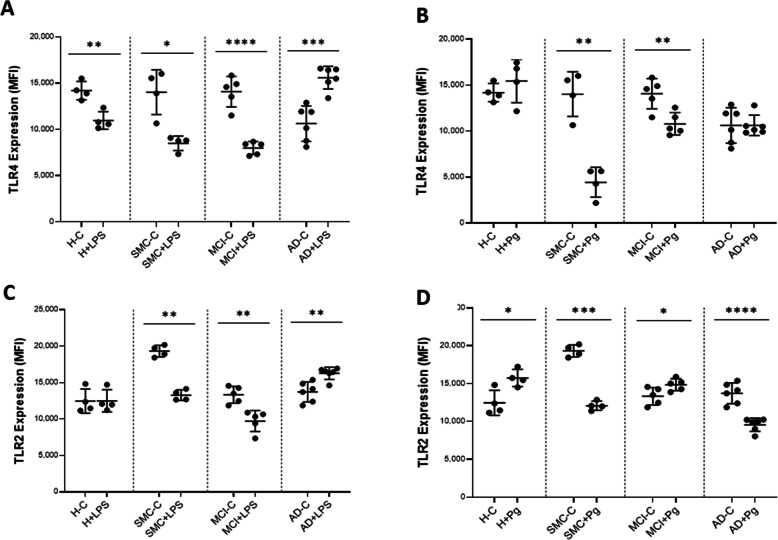
We show that there are distinct phenotypic and functional changes in monocyte and macrophage populations as the disease progresses. Higher free radical production upon stimulation could already be observed for the monocytes of SMC patients. The most striking results show that activation of peripheral monocytes (hyperactivation) is the strongest in the MCI group, at the prodromal stage of the disease. Monocytes exhibit significantly increased chemotaxis, free radical production, and cytokine production in response to TLR2 and TLR4 stimulation.
Our data suggest that the peripheral innate immune system is activated during the progression from SMC through MCI to AD, with the highest levels of activation being in MCI subjects and the lowest in AD patients. Some of these parameters may be used as biomarkers, but more holistic immune studies are needed to find the best period of the disease for clinical intervention.
阿尔茨海默病(AD)是最常见的神经退行性疾病,最终表现为临床痴呆。尽管付出了巨大努力并积累了大量实验数据,但与全身炎症相关的神经炎症作用仍未明确。虽然小胶质细胞的作用已得到充分认识,但外周单核细胞/巨噬细胞的确切贡献仍大多未知,尤其是它们在AD各个阶段的作用。
AD病程长达数十年,其临床表现之前有主观记忆主诉(SMC)和轻度认知障碍(MCI);因此,问题在于外周固有免疫反应如何随疾病进展而变化。因此,为了进一步研究单核细胞/巨噬细胞在AD进展中的作用,我们评估了SMC、MCI和AD阶段患者的单核细胞/巨噬细胞表型和功能,并将其与认知健康对照进行比较。我们还构建了一个理想化的数学模型来解释单核细胞/巨噬细胞在疾病进展过程中的功能。
我们发现,随着疾病进展,单核细胞和巨噬细胞群体存在明显的表型和功能变化。在SMC患者的单核细胞中,刺激后即可观察到更高的自由基产生。最显著的结果表明,在外周单核细胞激活(过度激活)在疾病前驱期的MCI组中最为强烈。单核细胞在受到TLR2和TLR4刺激时,趋化性、自由基产生和细胞因子产生显著增加。
我们的数据表明,外周固有免疫系统在从SMC经MCI到AD的进展过程中被激活,激活水平最高的是MCI受试者,最低的是AD患者。其中一些参数可作为生物标志物,但需要更全面的免疫研究来确定疾病的最佳临床干预时期。