Department of Psychology, Georgia State University, Atlanta, USA.
Gerontology Institute, Georgia State University, Atlanta, USA.
J Int Neuropsychol Soc. 2021 Sep;27(8):776-789. doi: 10.1017/S1355617721000710. Epub 2021 Jun 22.
To lay out the argument that exercise impacts neurobiological targets common to both mood and cognitive functioning, and thus more research should be conducted on its use as an alternative or adjunctive treatment for cognitive impairment in late-life depression (LLD).
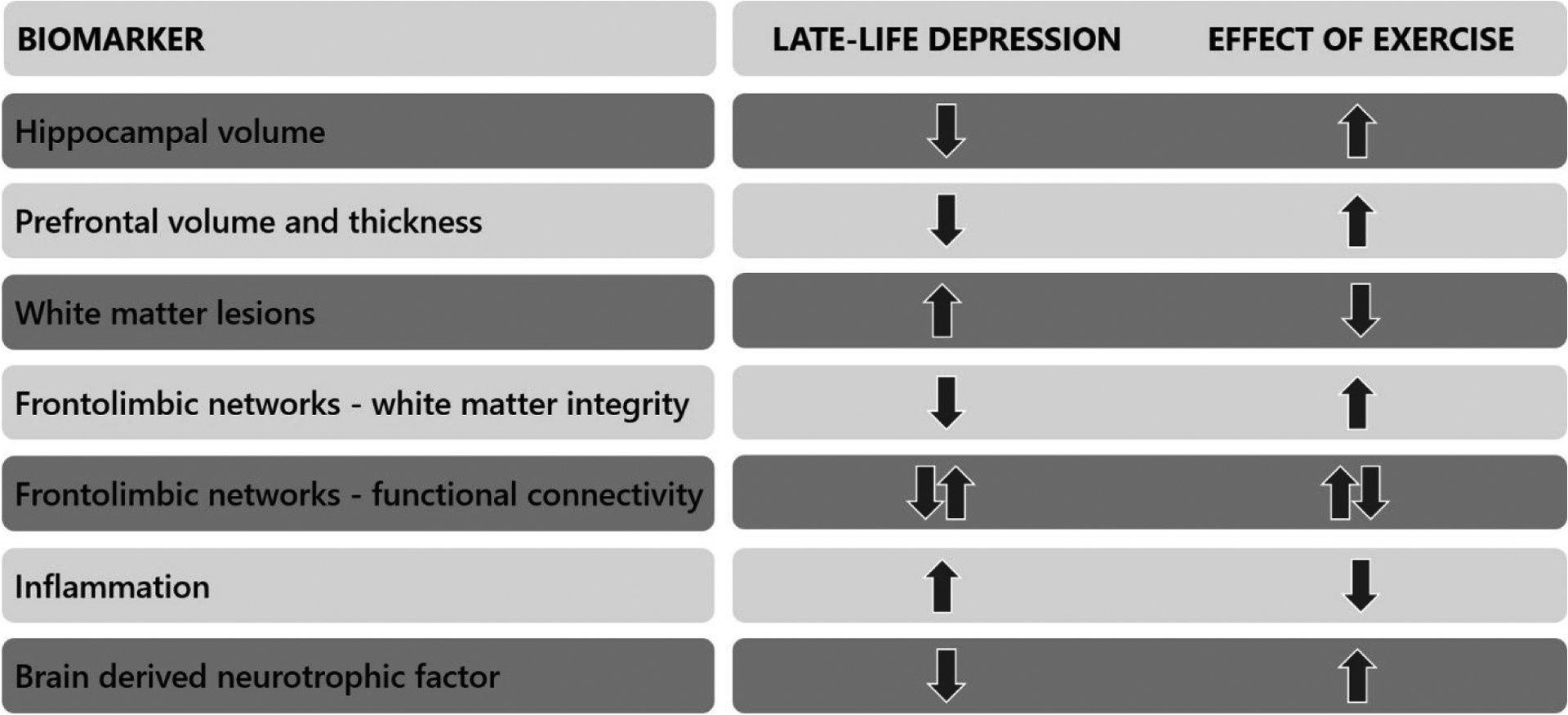
This narrative review summarizes the literature on cognitive impairment in LLD, describes the structural and functional brain changes and neurochemical changes that are linked to both cognitive impairment and mood disruption, and explains how exercise targets these same neurobiological changes and can thus provide an alternative or adjunctive treatment for cognitive impairment in LLD.
Cognitive impairment is common in LLD and predicts recurrence of depression, poor response to antidepressant treatment, and overall disability. Traditional depression treatment with medication, psychotherapy, or both, is not effective in fully reversing cognitive impairment for most depressed older adults. Physical exercise is an ideal treatment candidate based on evidence that it 1) is an effective treatment for depression, 2) enhances cognitive functioning in normal aging and in other patient populations, and 3) targets many of the neurobiological mechanisms that underlie mood and cognitive functioning. Results of the limited existing clinical trials of exercise for cognitive impairment in depression are mixed but overall support this contention.
Although limited, existing evidence suggests exercise may be a viable alternative or adjunctive treatment to address cognitive impairment in LLD, and thus more research in this area is warranted. Moving forward, additional research is needed in large, diverse samples to translate the growing research findings into clinical practice.
提出运动对情绪和认知功能共有的神经生物学靶点有影响的观点,因此,应该对运动作为治疗迟发性抑郁症(LLD)认知障碍的替代或辅助疗法进行更多研究。
本综述性研究总结了 LLD 认知障碍的文献,描述了与认知障碍和情绪障碍相关的结构和功能脑变化以及神经化学变化,并解释了运动如何针对这些相同的神经生物学变化,从而为 LLD 的认知障碍提供替代或辅助治疗。
认知障碍在 LLD 中很常见,并且可预测抑郁复发、抗抑郁治疗反应不佳和整体残疾。药物治疗、心理治疗或两者联合的传统抑郁症治疗方法并不能有效逆转大多数老年抑郁患者的认知障碍。身体锻炼是一种理想的治疗候选方法,因为有证据表明,它 1)是治疗抑郁症的有效方法,2)增强了正常衰老和其他患者群体的认知功能,3)针对了情绪和认知功能的许多神经生物学机制。现有的关于运动治疗抑郁症认知障碍的有限临床试验结果喜忧参半,但总体上支持这一观点。
尽管证据有限,但现有证据表明,运动可能是治疗 LLD 认知障碍的可行替代或辅助疗法,因此该领域需要进一步研究。未来,需要在大型、多样化的样本中进行更多研究,将不断增加的研究结果转化为临床实践。