Department of Applied Physics, Science for Life Laboratory, KTH Royal Institute of Technology, Solna, Sweden.
Department of Biochemistry, University of Cambridge, Cambridge, United Kingdom.
J Biol Chem. 2021 Aug;297(2):100899. doi: 10.1016/j.jbc.2021.100899. Epub 2021 Jun 19.
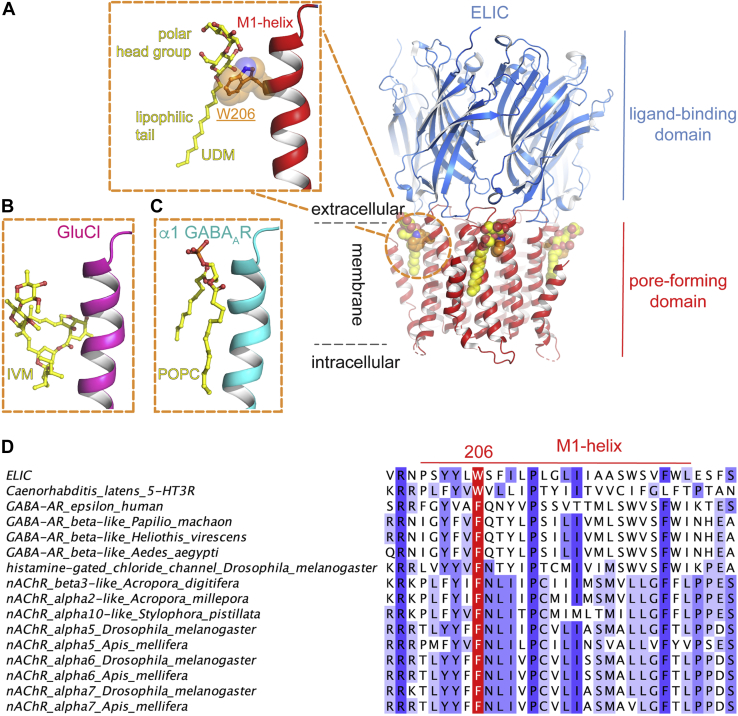
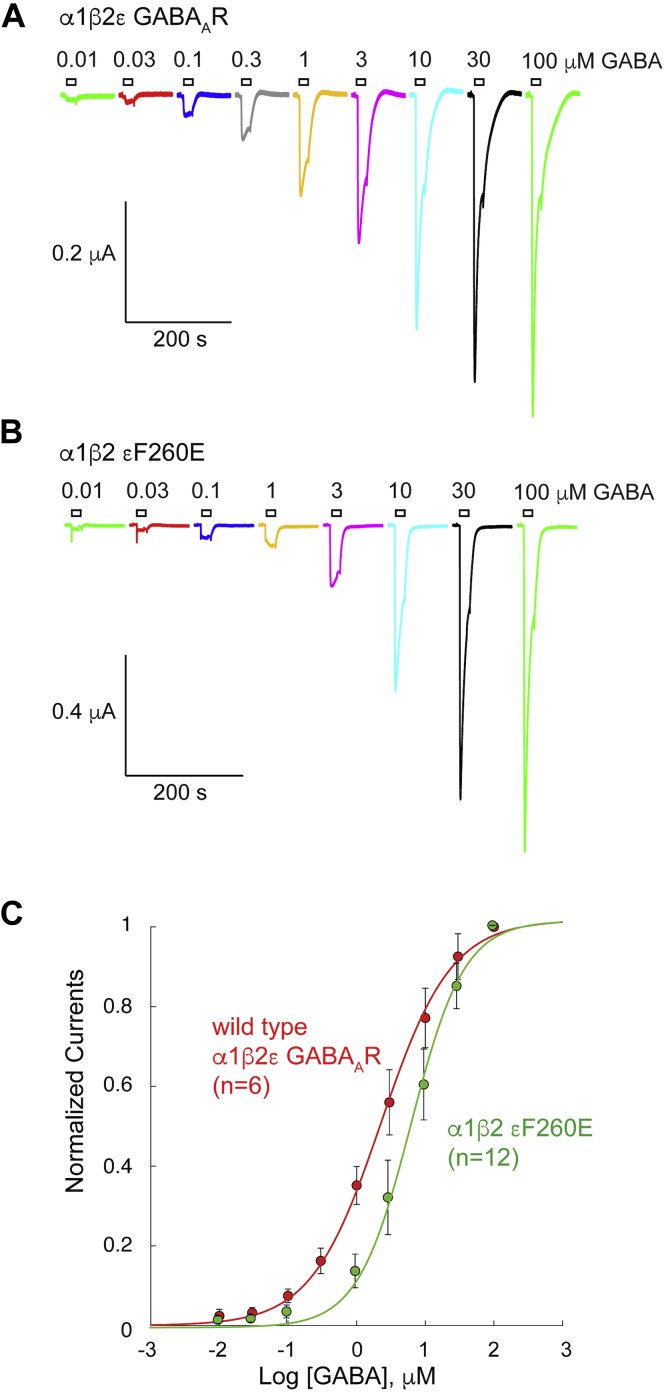
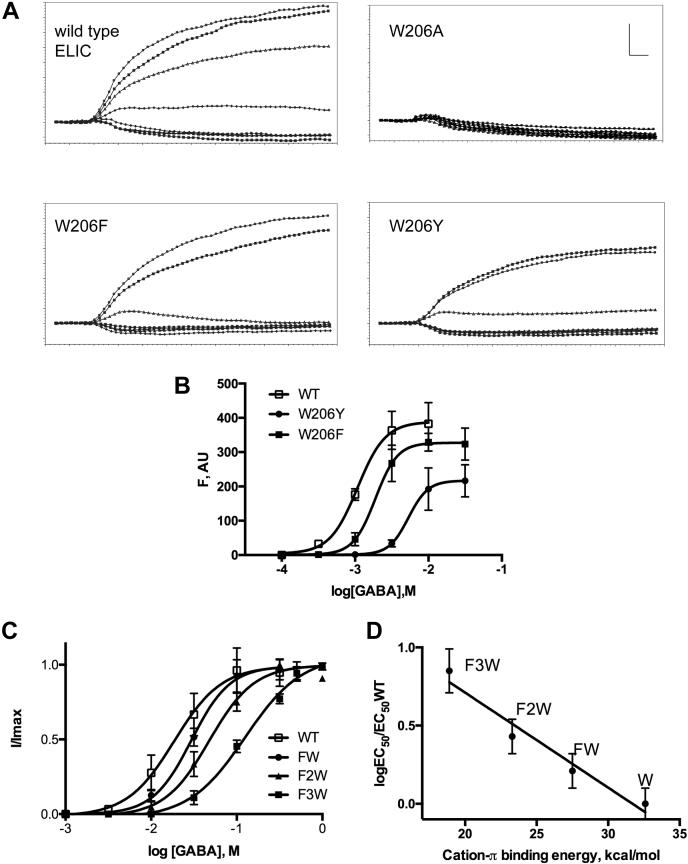
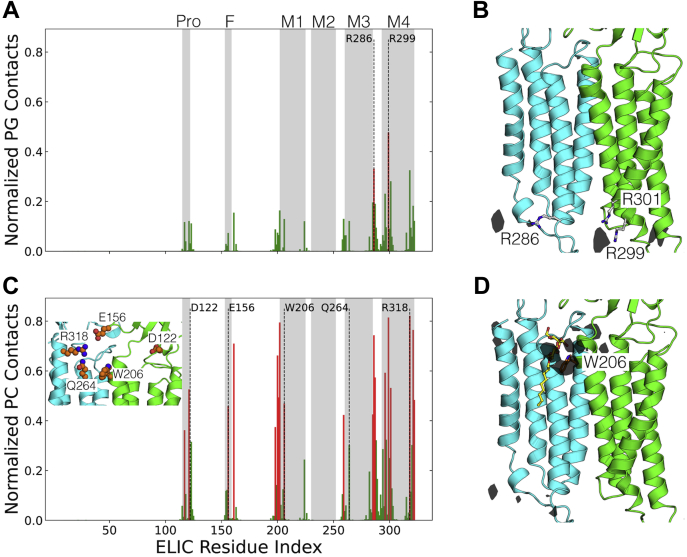
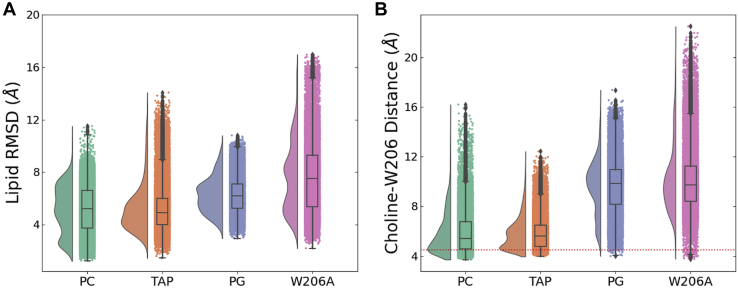
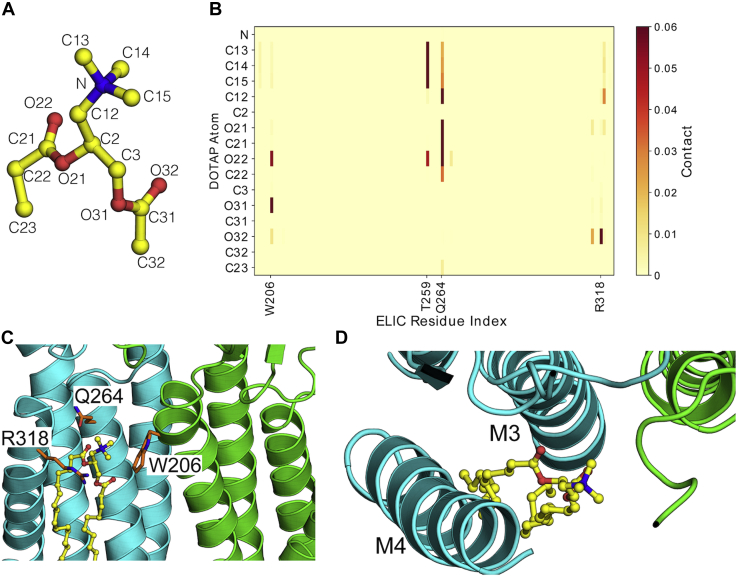
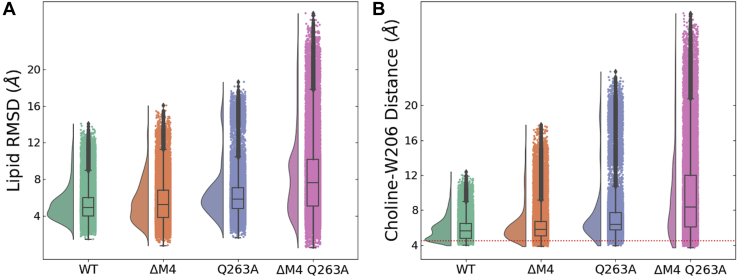
Pentameric ligand-gated ion channels (pLGICs) are crucial mediators of electrochemical signal transduction in various organisms from bacteria to humans. Lipids play an important role in regulating pLGIC function, yet the structural bases for specific pLGIC-lipid interactions remain poorly understood. The bacterial channel ELIC recapitulates several properties of eukaryotic pLGICs, including activation by the neurotransmitter GABA and binding and modulation by lipids, offering a simplified model system for structure-function relationship studies. In this study, functional effects of noncanonical amino acid substitution of a potential lipid-interacting residue (W206) at the top of the M1-helix, combined with detergent interactions observed in recent X-ray structures, are consistent with this region being the location of a lipid-binding site on the outward face of the ELIC transmembrane domain. Coarse-grained and atomistic molecular dynamics simulations revealed preferential binding of lipids containing a positive charge, particularly involving interactions with residue W206, consistent with cation-π binding. Polar contacts from other regions of the protein, particularly M3 residue Q264, further support lipid binding via headgroup ester linkages. Aromatic residues were identified at analogous sites in a handful of eukaryotic family members, including the human GABA receptor ε subunit, suggesting conservation of relevant interactions in other evolutionary branches. Further mutagenesis experiments indicated that mutations at this site in ε-containing GABA receptors can change the apparent affinity of the agonist response to GABA, suggesting a potential role of this site in channel gating. In conclusion, this work details type-specific lipid interactions, which adds to our growing understanding of how lipids modulate pLGICs.
五聚体配体门控离子通道(pLGICs)是从细菌到人类等各种生物体中电化学信号转导的关键介质。脂质在调节 pLGIC 功能方面起着重要作用,但特定 pLGIC-脂质相互作用的结构基础仍知之甚少。细菌通道 ELIC 再现了真核 pLGIC 的几种特性,包括神经递质 GABA 的激活以及与脂质的结合和调节,为结构功能关系研究提供了简化的模型系统。在这项研究中,对 M1 螺旋顶部潜在脂质相互作用残基(W206)的非典型氨基酸取代的功能影响,结合最近 X 射线结构中观察到的去污剂相互作用,与该区域是 ELIC 跨膜域外表面的脂质结合位点的位置一致。粗粒度和原子分子动力学模拟显示,带正电荷的脂质优先结合,特别是涉及与残基 W206 的相互作用,这与阳离子-π 结合一致。来自蛋白质其他区域的极性接触,特别是 M3 残基 Q264,通过头部酯键进一步支持脂质结合。在少数真核家族成员中,包括人类 GABA 受体 ε 亚基,在类似位置鉴定出芳香族残基,表明在其他进化枝中存在相关相互作用的保守性。进一步的突变实验表明,含有 GABA 的 ε 受体中该位点的突变可以改变激动剂反应对 GABA 的表观亲和力,表明该位点在通道门控中可能具有作用。总之,这项工作详细描述了特定类型的脂质相互作用,这增加了我们对脂质如何调节 pLGICs 的理解。