National Coagulation Centre, St. James's Hospital, Dublin, Ireland.
Irish Centre for Vascular Biology, School of Pharmacy and Biomedical Sciences, RCSI, Dublin, Ireland.
Br J Haematol. 2021 Oct;195(1):76-84. doi: 10.1111/bjh.17613. Epub 2021 Jun 22.
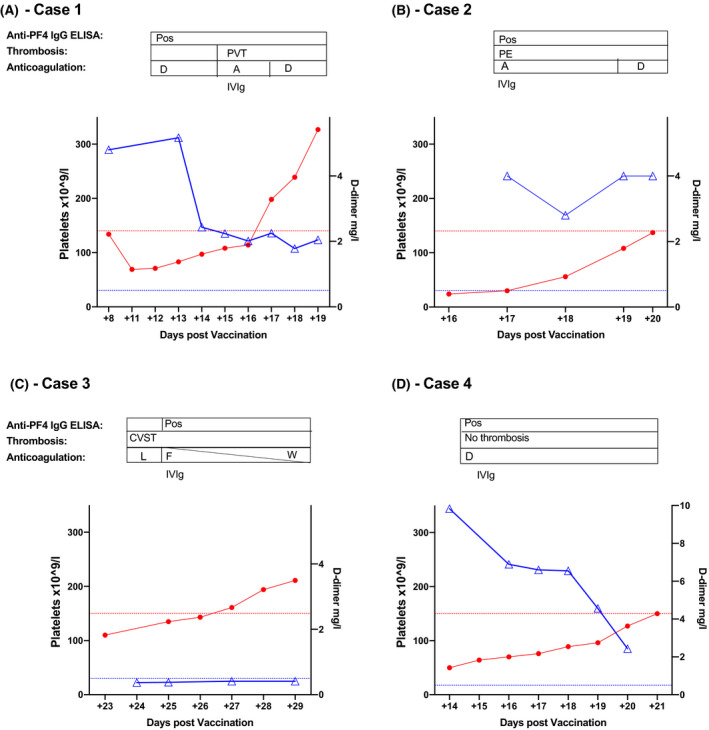
Vaccine-induced immune thrombotic thrombocytopenia (VITT) is a novel entity that emerged in March 2021 following reports of unusual thrombosis after ChAdOx1 nCoV-19, (AstraZeneca) vaccination. Following the recognition of this syndrome, multiple consensus guidelines have been released to risk stratify patients presenting with possible symptoms after ChAdOx1 nCoV-19 vaccination. All guidelines rapidly identify VITT in patients with the complete triad of thrombocytopenia, thrombosis and elevated D-dimers after ChAdOx1 nCoV-19 vaccination. However, with earlier recognition of the associated symptoms, the clinical manifestations are likely to be more heterogeneous and represent an evolving spectrum of disease. In this setting, current guidelines may lack the sensitivity to detect early cases of VITT and risk missed or delayed diagnoses. The broad clinical phenotype and challenges associated with diagnosis of VITT are highlighted in our present case series of four patients with confirmed VITT. Dependent on the guidance used, each patient could have been classified as a low probability of VITT at presentation. The present study highlights the issues associated with the recognition of VITT, the limitations of current guidance and the need for heightened clinical vigilance as our understanding of the pathophysiology of this novel condition evolves.
疫苗诱导的免疫性血栓性血小板减少症(VITT)是一种新出现的疾病实体,于 2021 年 3 月在报告接种 ChAdOx1 nCoV-19(阿斯利康)后出现异常血栓形成后被认识到。在认识到这种综合征后,已经发布了多个共识指南,以对可能在接种 ChAdOx1 nCoV-19 后出现症状的患者进行风险分层。所有指南都迅速在接种 ChAdOx1 nCoV-19 后出现血小板减少、血栓形成和 D-二聚体升高的完整三联征的患者中识别出 VITT。然而,随着对相关症状的更早认识,临床表现可能更加异质,并代表疾病的不断发展的谱。在这种情况下,目前的指南可能缺乏检测早期 VITT 的敏感性,导致漏诊或延迟诊断。在我们的确诊 VITT 的四名患者的病例系列中,突出了 VITT 的广泛临床表型和诊断相关的挑战。根据使用的指南,每个患者在就诊时都可能被归类为 VITT 可能性低。本研究强调了认识 VITT 相关的问题、当前指南的局限性以及随着我们对这种新型疾病病理生理学认识的发展,需要提高临床警惕性。