Turnin Marie-Christine, Gourdy Pierre, Martini Jacques, Buisson Jean-Christophe, Chauchard Marie-Christine, Delaunay Jacqueline, Schirr-Bonnans Solène, Taoui Soumia, Poncet Marie-France, Cosma Valeria, Lablanche Sandrine, Coustols-Valat Magali, Chaillous Lucie, Thivolet Charles, Sanz Caroline, Penfornis Alfred, Lepage Benoît, Colineaux Hélène, Mounié Michaël, Costa Nadège, Molinier Laurent, Hanaire Hélène
Department of Diabetology, Metabolic Diseases and Nutrition, University Hospital of Toulouse, 1 Avenue Jean Poulhès, TSA 50032, Toulouse cedex 9, 31059, Toulouse, France.
Institute of Metabolic and Cardiovascular Diseases, UMR1297 INSERM/UPS, Toulouse University, Toulouse, France.
Diabetes Ther. 2021 Jul;12(7):2059-2075. doi: 10.1007/s13300-021-01095-x. Epub 2021 Jun 23.
Telemonitoring in type 2 diabetes (T2D) is mainly based on glucose monitoring. A new type of connected device which routinely gathers data on weight, physical activity and food intake could improve patients' diabetes control. The main aim of this study was to assess the efficacy of an at-home interventional programme incorporating such devices and lifestyle education software on diabetes control, i.e., change in HbA1c, compared to standard care.
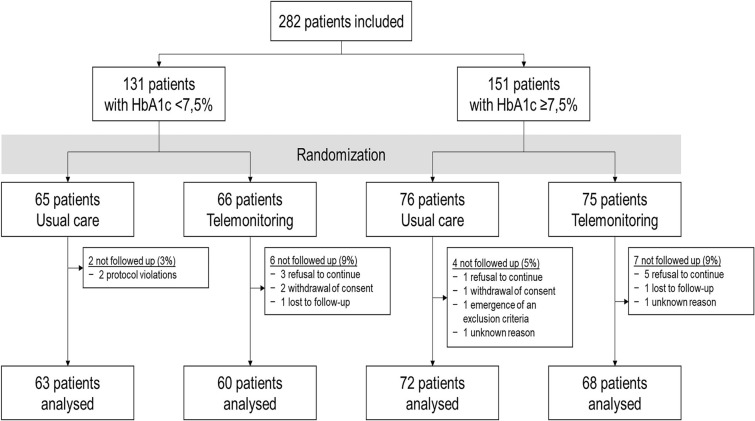
This multicentre study randomly assigned 282 people with T2D to either a telemonitoring group (TMG) or a control group (CG) for a 1-year intervention period. While routine follow-up was maintained in the CG, TMG subjects were provided with interactive lifestyle educational software (with artificial intelligence algorithms) and connected objects (blood glucose meters, scales and actimeters) for use in their own homes and were remotely monitored by their diabetologists. Changes in HbA were compared between groups using a mixed linear model.
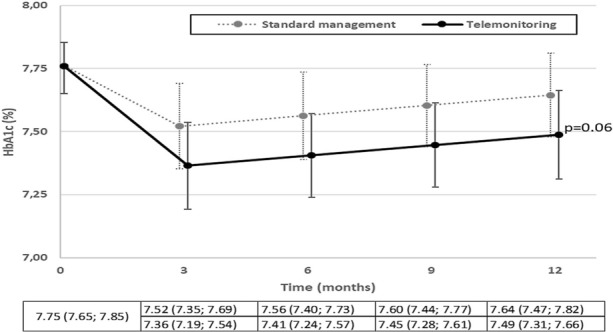
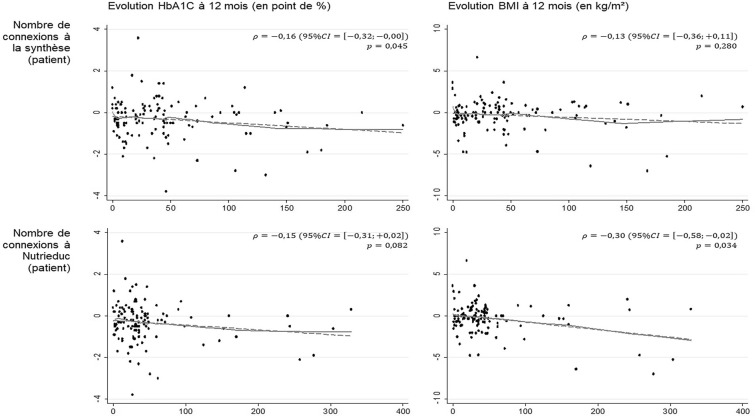
The mean HbA dropped from 7.8 ± 0.8% (62 mmol/mol) to 7.4 ± 1.0% (57 mmol/mol) in the TMG and from 7.8 ± 0.8% (62 mmol/mol) to 7.6 ± 1.0% (60 mmol/mol) in the CG, resulting in an intergroup difference of - 0.16 (p = 0.06) in favour of TMG, after adjustment for confounding factors. Within TMG, the decrease in HbA was greater in frequent users: - 0.23% (p = 0.03) in the case of connections to telemonitoring synthesis above the median and - 0.21% (p = 0.05) in the case of connections to tele-education software above the median compared to the CG. Significant weight loss was observed in the TMG but only in women (p = 0.01).
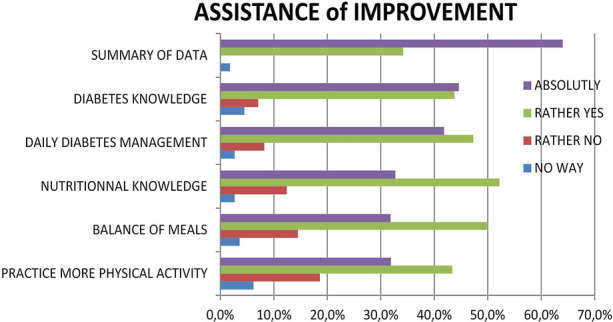
The EDUC@DOM telemonitoring and tele-education device did not highlight a significant decrease in HbA1c levels compared to routine management although a slight, albeit significant improvement in glycaemic control was observed in the frequent user subgroup as well as significant weight loss but only in women. A high level of satisfaction with the connected device was recorded amongst all participants.
This trial was registered in the Clinical Trials Database on September 27, 2013, under no. NCT01955031 and bears ID-RCB number 2013-A00391-44.
2型糖尿病(T2D)的远程监测主要基于血糖监测。一种新型的连接设备,能够定期收集体重、身体活动和食物摄入量的数据,可能会改善患者的糖尿病控制情况。本研究的主要目的是评估一项在家中实施的干预计划的效果,该计划结合了此类设备和生活方式教育软件,与标准护理相比,对糖尿病控制的影响,即糖化血红蛋白(HbA1c)的变化。
这项多中心研究将282名T2D患者随机分为远程监测组(TMG)或对照组(CG),进行为期1年的干预期。CG组维持常规随访,TMG组的受试者则获得交互式生活方式教育软件(带有人工智能算法)和连接设备(血糖仪、体重秤和活动计),供其在家中使用,并由他们的糖尿病专家进行远程监测。使用混合线性模型比较两组之间HbA1c的变化。
TMG组的平均HbA1c从7.8±0.8%(62 mmol/mol)降至7.4±1.0%(57 mmol/mol),CG组从7.8±0.8%(62 mmol/mol)降至7.6±1.0%(60 mmol/mol),在调整混杂因素后,组间差异为-0.16(p=0.06),有利于TMG组。在TMG组中,频繁使用者的HbA1c下降幅度更大:与CG组相比,连接远程监测综合数据高于中位数的情况下下降了0.23%(p=0.03),连接远程教育软件高于中位数的情况下下降了0.21%(p=0.05)。TMG组观察到显著的体重减轻,但仅在女性中(p=0.01)。
与常规管理相比,EDUC@DOM远程监测和远程教育设备并未显著降低HbA1c水平,尽管在频繁使用者亚组中观察到血糖控制有轻微但显著的改善,以及显著的体重减轻,但仅在女性中。所有参与者对连接设备的满意度都很高。
本试验于2013年9月27日在临床试验数据库中注册,编号为NCT01955031,ID-RCB编号为2013-A00391-44。