Section of Cardiac Surgery, Department of Surgery, Yale School of Medicine, 10 Amistad Street 337B, New Haven, CT, 06520, USA.
Department of Pathology, Yale School of Medicine, New Haven, CT, USA.
Sci Rep. 2021 Jun 23;11(1):13185. doi: 10.1038/s41598-021-92659-1.
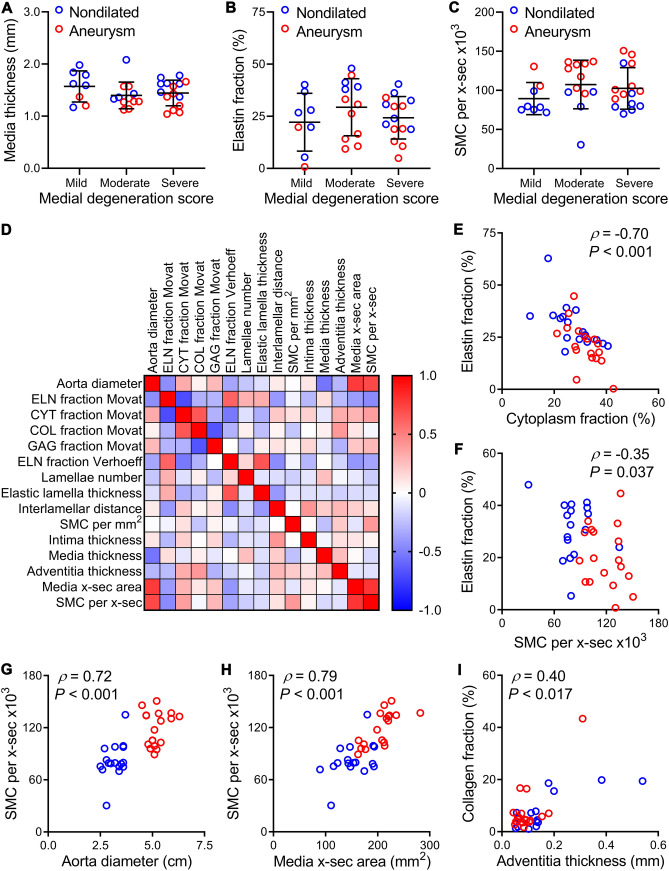
Medial degeneration is a common histopathological finding in aortopathy and is considered a mechanism for dilatation. We investigated if medial degeneration is specific for sporadic thoracic aortic aneurysms versus nondilated aortas. Specimens were graded by pathologists, blinded to the clinical diagnosis, according to consensus histopathological criteria. The extent of medial degeneration by qualitative (semi-quantitative) assessment was not specific for aneurysmal compared to nondilated aortas. In contrast, blinded quantitative assessment of elastin amount and medial cell number distinguished aortic aneurysms and referent specimens, albeit with marked overlap in results. Specifically, the medial fraction of elastin decreased from dilution rather than loss of protein as cross-sectional amount was maintained while the cross-sectional number, though not density, of smooth muscle cells increased in proportion to expansion of the media. Furthermore, elastic lamellae did not thin and interlamellar distance did not diminish as expected for lumen dilatation, implying a net gain of lamellar elastin and intralamellar cells or extracellular matrix during aneurysmal wall remodeling. These findings support the concepts that: (1) medial degeneration need not induce aortic aneurysms, (2) adaptive responses to altered mechanical stresses increase medial tissue, and (3) greater turnover, not loss, of mural cells and extracellular matrix associates with aortic dilatation.
中层变性是大血管病变中的一种常见组织病理学表现,被认为是扩张的机制。我们研究了中层变性是否是散发性胸主动脉瘤与未扩张主动脉的特异性特征。病理学家根据共识组织病理学标准,在对临床诊断不知情的情况下对标本进行分级。通过定性(半定量)评估,中层变性的程度对于动脉瘤与未扩张的主动脉并无特异性。相比之下,弹性蛋白数量和中层细胞数量的盲法定量评估可区分主动脉瘤和参照标本,尽管结果存在明显重叠。具体而言,中层弹性蛋白的分数减少是由于蛋白稀释而非丢失,因为尽管中层扩张,但横截面积的弹性蛋白数量得以维持,而平滑肌细胞的横截面积增加,尽管密度没有增加。此外,弹性板层没有变薄,板层间距离没有像预期的那样因管腔扩张而减小,这意味着在动脉瘤壁重构过程中,板层弹性蛋白和板层内细胞或细胞外基质存在净增加。这些发现支持以下概念:(1)中层变性不一定会导致主动脉瘤;(2)对机械应力改变的适应性反应会增加中层组织;(3)壁细胞和细胞外基质的更新,而非丢失,与主动脉扩张相关。