
小分子微阵列鉴定出酪氨酰-DNA磷酸二酯酶1的抑制剂,这些抑制剂可同时进入催化口袋和两个底物结合位点。
Small molecule microarray identifies inhibitors of tyrosyl-DNA phosphodiesterase 1 that simultaneously access the catalytic pocket and two substrate binding sites.
作者信息
Zhao Xue Zhi, Kiselev Evgeny, Lountos George T, Wang Wenjie, Tropea Joseph E, Needle Danielle, Hilimire Thomas A, Schneekloth John S, Waugh David S, Pommier Yves, Burke Terrence R
机构信息
Chemical Biology Laboratory, Center for Cancer Research, National Cancer Institute Frederick MD USA
Developmental Therapeutics Branch, Laboratory of Molecular Pharmacology, Center for Cancer Research, National Cancer Institute Bethesda MD USA.
出版信息
Chem Sci. 2021 Jan 28;12(11):3876-3884. doi: 10.1039/d0sc05411a.
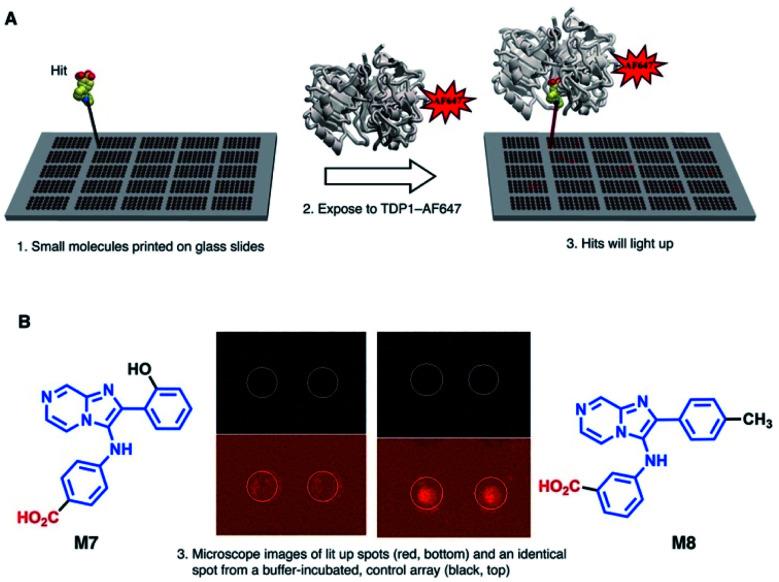
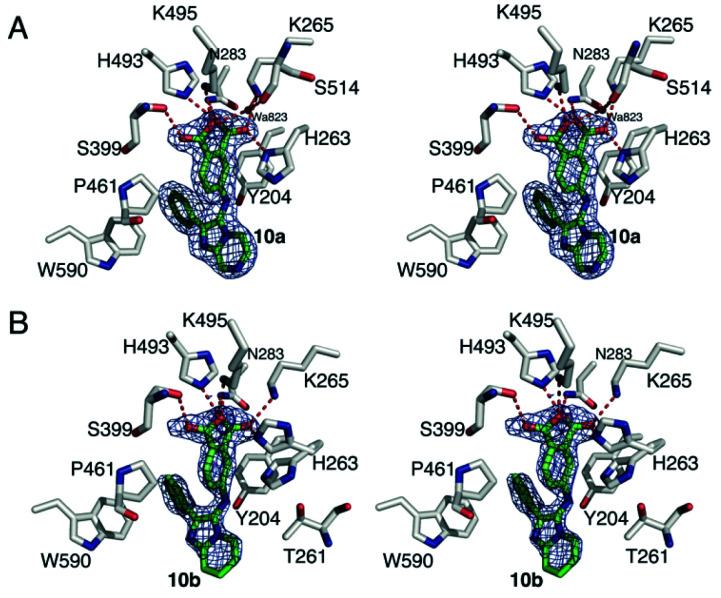
Tyrosyl-DNA phosphodiesterase 1 (TDP1) is a member of the phospholipase D family of enzymes, which catalyzes the removal of both 3'- and 5'-DNA phosphodiester adducts. Importantly, it is capable of reducing the anticancer effects of type I topoisomerase (TOP1) inhibitors by repairing the stalled covalent complexes of TOP1 with DNA. It achieves this by promoting the hydrolysis of the phosphodiester bond between the Y723 residue of human TOP1 and the 3'-phosphate of its DNA substrate. Blocking TDP1 function is an attractive means of enhancing the efficacy of TOP1 inhibitors and overcoming drug resistance. Previously, we reported the use of an X-ray crystallographic screen of more than 600 fragments to identify small molecule variations on phthalic acid and hydroxyquinoline motifs that bind within the TDP1 catalytic pocket. Yet, the majority of these compounds showed limited (millimolar) TDP1 inhibitory potencies. We now report examining a 21 000-member library of drug-like Small Molecules in Microarray (SMM) format for their ability to bind Alexa Fluor 647 (AF647)-labeled TDP1. The screen identified structurally similar ,2-diphenylimidazo[1,2-]pyrazin-3-amines as TDP1 binders and catalytic inhibitors. We then explored the core heterocycle skeleton using one-pot Groebke-Blackburn-Bienayme multicomponent reactions and arrived at analogs having higher inhibitory potencies. Solving TDP1 co-crystal structures of a subset of compounds showed their binding at the TDP1 catalytic site, while mimicking substrate interactions. Although our original fragment screen differed significantly from the current microarray protocol, both methods identified ligand-protein interactions containing highly similar elements. Importantly inhibitors identified through the SMM approach show competitive inhibition against TDP1 and access the catalytic phosphate-binding pocket, while simultaneously providing extensions into both the substrate DNA and peptide-binding channels. As such, they represent a platform for further elaboration of trivalent ligands, that could serve as a new genre of potent TDP1 inhibitors.
酪氨酰-DNA磷酸二酯酶1(TDP1)是磷脂酶D家族的一种酶,可催化去除3'-和5'-DNA磷酸二酯加合物。重要的是,它能够通过修复拓扑异构酶I(TOP1)与DNA的停滞共价复合物来降低TOP1抑制剂的抗癌效果。它通过促进人TOP1的Y723残基与其DNA底物的3'-磷酸之间的磷酸二酯键水解来实现这一点。阻断TDP1的功能是提高TOP1抑制剂疗效和克服耐药性的一种有吸引力的方法。此前,我们报道了通过对600多个片段进行X射线晶体学筛选,以鉴定邻苯二甲酸和羟基喹啉基序上结合在TDP1催化口袋内的小分子变体。然而,这些化合物中的大多数对TDP1的抑制效力有限(毫摩尔级)。我们现在报告检测一个以微阵列(SMM)形式存在的21000个成员的类药小分子文库与Alexa Fluor 647(AF647)标记的TDP1结合的能力。该筛选鉴定出结构相似的1,2-二苯基咪唑并[1,2-a]吡嗪-3-胺作为TDP1结合剂和催化抑制剂。然后,我们使用一锅法Groebke-Blackburn-Bienayme多组分反应探索核心杂环骨架,得到了具有更高抑制效力的类似物。解析一部分化合物的TDP1共晶体结构表明它们在TDP1催化位点结合,同时模拟底物相互作用。尽管我们最初的片段筛选与当前的微阵列方案有很大不同,但两种方法都鉴定出了包含高度相似元素的配体-蛋白质相互作用。重要的是,通过SMM方法鉴定的抑制剂对TDP1表现出竞争性抑制,并进入催化性磷酸结合口袋,同时向底物DNA和肽结合通道延伸。因此,它们代表了进一步构建三价配体的平台,可作为一类新型强效TDP1抑制剂。






 Zotero 插件