The Center for Children and Families, Department of Psychology, Florida International University.
Department of Special Education and Communication Disorders, University of Nebraska-Lincoln.
Psychol Bull. 2021 Apr;147(4):329-351. doi: 10.1037/bul0000322.
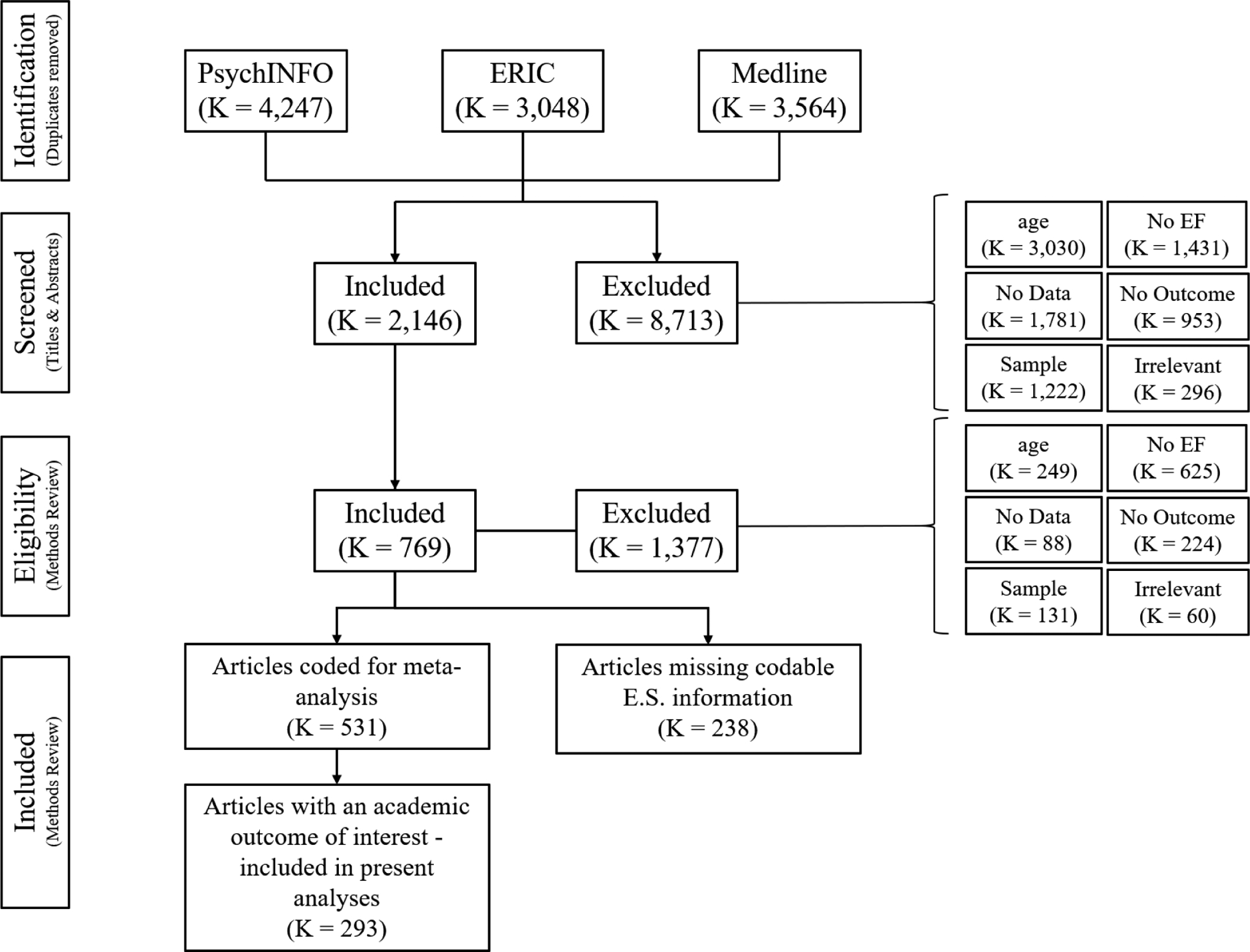
The primary goal of this study was to examine developmental patterns among the relations between components of executive function (EF; working memory [WM], inhibitory control, shifting), and academic outcomes (reading, mathematics, language) in elementary school-age children. These relations were examined within the context of the development of EF and of academic skills utilizing an extension of the unity and diversity, intrinsic cognitive load, and dual process theories. Using meta-analytic methods, we summarized results from 299 studies from 293 articles/dissertations, representing 65,605 elementary school-age children (42-191 months old [M = 101 months, SD = 24.49 months]). Results indicated that accounting for general EF (by including the correlations among EF tasks in meta-analytic path models and accounting for effects between all three EF components and academic outcomes simultaneously) produced weaker relations between EF and academic skills than the bivariate relations which have been reported in prior meta-analytic reviews. However, although reduced, all relations between EF and academic outcomes remained significant throughout elementary school. Whereas WM was consistently moderately associated with reading, math, and oral language across development, the developmental trends for the relations between inhibitory control and shifting with academic outcomes varied based upon the academic skill examined. On the academic side, whereas the relations between reading and language skills with EF components varied throughout elementary school, few developmental changes were found in the relations between EF components and math skills across elementary school. Future directions and implications of findings for the conceptualization of the impact of EF on academics are discussed within the context of relevant theoretical models. (PsycInfo Database Record (c) 2021 APA, all rights reserved).
本研究的主要目的是考察执行功能(EF;工作记忆 [WM]、抑制控制、转换)各成分与小学儿童学业成绩(阅读、数学、语言)之间的关系在发展过程中的模式。这些关系是在 EF 和学业技能发展的背景下,利用统一和多样性、内在认知负荷和双加工理论的扩展来检验的。我们使用元分析方法,总结了来自 293 篇文章/论文中的 299 项研究的结果,代表了 65605 名小学生(42-191 个月[M=101 个月,SD=24.49 个月])。结果表明,在元分析路径模型中考虑 EF 的一般因素(包括 EF 任务之间的相关性),并同时考虑所有三个 EF 成分与学业成绩之间的效应),与之前元分析综述中报告的二元关系相比,EF 与学业成绩之间的关系较弱。然而,尽管有所减弱,EF 与所有学业成绩之间的关系在整个小学阶段仍然显著。虽然 WM 与阅读、数学和口头语言的关系在整个发展过程中一直是中等相关,但抑制控制和转换与学业成绩之间的关系的发展趋势因所研究的学业技能而异。在学业方面,尽管 EF 成分与阅读和语言技能之间的关系在整个小学阶段都有所不同,但在 EF 成分与数学技能之间的关系在整个小学阶段几乎没有发现发展变化。在相关理论模型的背景下,讨论了未来对 EF 对学业影响的概念化的研究方向和意义。(PsycInfo 数据库记录(c)2021 APA,保留所有权利)。