MMWR Morb Mortal Wkly Rep. 2021 Jun 25;70(25):905-909. doi: 10.15585/mmwr.mm7025a1.
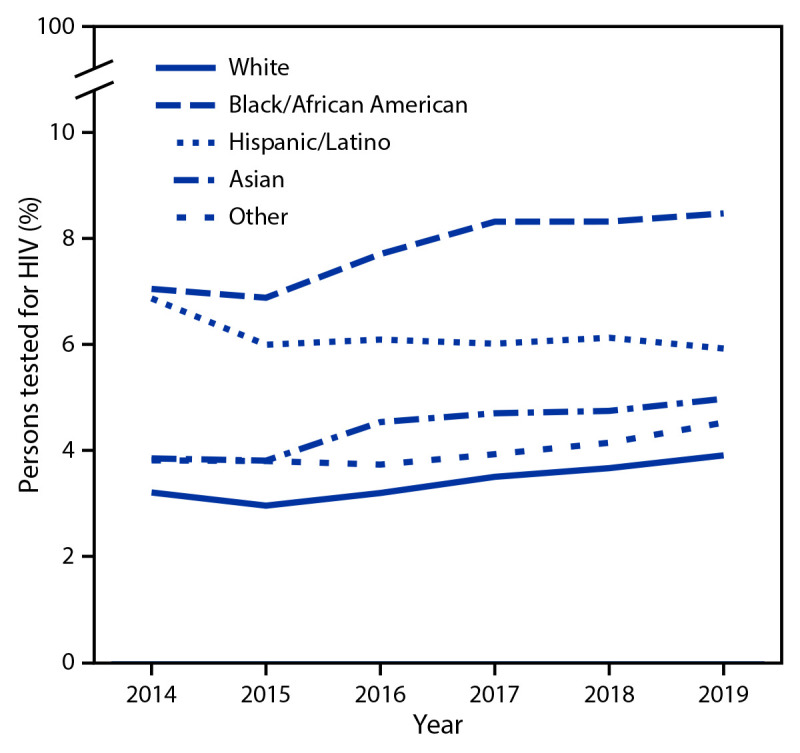
HIV testing is a critical component of effective HIV prevention and care. CDC recommends routine opt-out HIV testing in health care settings for all sexually active persons aged 13-64 years at least once in their lifetime and risk-based testing regardless of age for those who report behaviors associated with HIV acquisition (1). However, recent studies show low HIV testing rates in clinical settings; HIV testing rates at visits to physician offices did not increase during 2009-2016 (2). The objective of the current study is to estimate temporal trends in HIV testing among persons with commercial insurance or Medicaid from 2014 through 2019 and describe their demographic characteristics in 2019. Weighted data from the IBM MarketScan Commercial Claims and Encounters database* (commercial insurance) and from the Centers for Medicare & Medicaid Services (CMS) claims database (Medicaid) were analyzed to estimate the proportions of persons with commercial insurance or Medicaid who received testing for HIV. Testing rates increased among male and nonpregnant female persons aged ≥13 years with either type of coverage. In 2019, only 4.0% of those with commercial insurance and 5.5% of those with Medicaid received testing for HIV. Testing rates were higher among non-Hispanic Black or African American (Black) persons and Hispanic or Latino (Hispanic) persons. Based on mathematical modeling studies, these annual testing rates would need to increase at least threefold and be sustained over several years (3,4) to achieve the Ending the HIV Epidemic (EHE) in the U.S. initiative goal of ≥95% of persons with HIV being aware of their infection by 2025. Interventions need to be implemented to increase routine and risk-based HIV testing in clinical settings to higher levels that can help reduce disparities in HIV diagnoses between Black and Hispanic persons compared with non-Hispanic White (White) persons (5). Increased HIV testing is essential to achieve the goals of the EHE initiative and reduce disparities in HIV diagnoses; public health should partner with health care systems to implement interventions that support increased testing.
HIV 检测是有效预防和控制 HIV 的重要组成部分。疾病预防控制中心(CDC)建议在医疗保健环境中对所有 13-64 岁有过性行为的活跃人群,至少进行一次常规的自愿 HIV 检测,并对报告有 HIV 感染风险行为的人群进行基于风险的检测,无论其年龄大小(1)。然而,最近的研究表明,临床环境中的 HIV 检测率较低;在 2009-2016 年期间,医生办公室就诊时的 HIV 检测率并没有增加(2)。本研究的目的是估计 2014 年至 2019 年期间有商业保险或医疗补助的人群中 HIV 检测的时间趋势,并描述 2019 年他们的人口统计学特征。利用 IBM MarketScan 商业索赔和就诊数据库(商业保险)和医疗保险和医疗补助服务中心(CMS)索赔数据库(医疗补助)的加权数据,估计有商业保险或医疗补助的人群中接受 HIV 检测的比例。在有商业保险或医疗补助的 13 岁及以上的男性和非孕妇中,检测率有所上升。2019 年,只有 4.0%有商业保险的人和 5.5%有医疗补助的人接受了 HIV 检测。非西班牙裔黑人或非裔美国人(黑人)和西班牙裔或拉丁裔(西班牙裔)的检测率较高。基于数学建模研究,如果要实现美国终结艾滋病毒流行倡议(EHE)到 2025 年使 95%以上的艾滋病毒感染者知晓其感染状况的目标,这些年度检测率至少需要增加三倍并持续多年(3,4)。需要在临床环境中实施干预措施,以提高常规和基于风险的 HIV 检测水平,从而有助于减少黑人及西班牙裔与非西班牙裔白人(白人)之间 HIV 诊断方面的差异(5)。增加 HIV 检测对于实现 EHE 倡议的目标和减少 HIV 诊断方面的差异至关重要;公共卫生部门应与医疗保健系统合作,实施支持增加检测的干预措施。