Judith Lumley Centre, School of Nursing and Midwifery, La Trobe University, Bundoora Victoria, Australia.
Department of Obstetrics and Gynaecology, Monash University, Clayton, Victoria, Australia.
PLoS One. 2021 Jun 25;16(6):e0251588. doi: 10.1371/journal.pone.0251588. eCollection 2021.
Son preference and sex selective practices have resulted in a deficit of girls in several countries, primarily across Asia. Emerging evidence indicates that son preference survives migration to Western high-income countries. The objective of this study was to assess male-to-female (M/F) ratios at birth per mother's country of birth in Australia 1997-2016, in total and by parity, and by states/territories and over time.
Data for this national population-based cross-sectional study were obtained from the National Perinatal Data Collection (NPDC) and included all live births in Australia 1997-2016 (N = 5 614 847). M/F ratios with 95% Confidence Intervals were estimated.
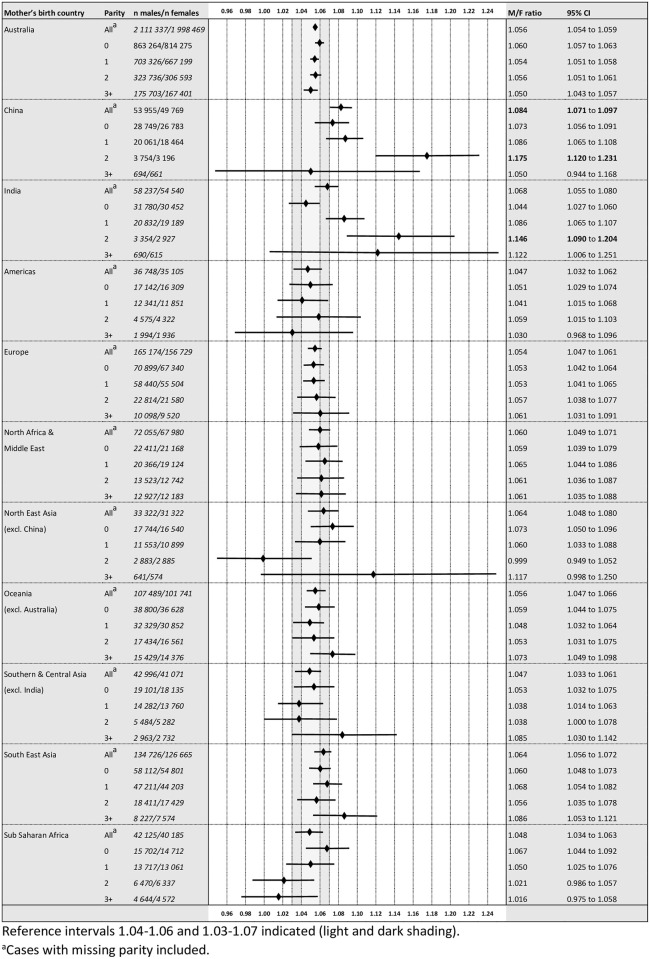
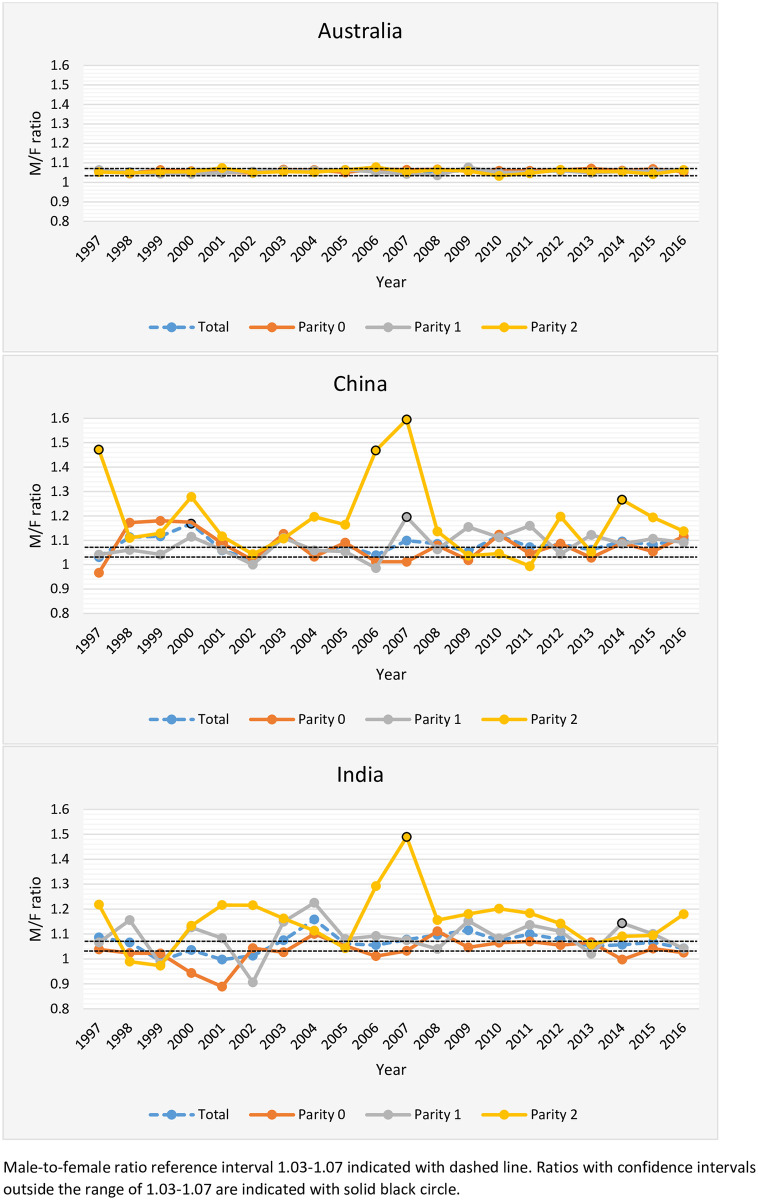
The M/F ratio for births to Australian-born mothers was within the expected range (1.03-1.07) regardless of parity and time period. M/F ratios were elevated above the expected range for births to mothers born in China in the total sample (M/F ratio 1.084, 95% confidence interval 1.071-1.097) and at parity 2 (1.175, 1.120-1.231), and for births to mothers born in India at parity 2 (1.146, 1.090-1.204). Parity 2 births were the most consistently male-biased across time. Across states, elevated M/F ratios were identified for both groups in New South Wales (China parity 2: 1.182, 1.108-1.260; India parity 2: 1.182, 1.088-1.285), for births to Chinese-born mothers in Victoria (total births: 1.097, 1.072-1.123; parity 1: 1.115, 1.072-1.159) and Australian Capital Territory (total births: 1.189, 1.085-1.302) and births to Indian-born mothers Western Australia (parity 2: 1.307, 1.122-1.523).
Son preference persists in some immigrant communities after migration to Australia. The consistent pattern of elevated M/F ratios across the larger states indicates that sex imbalances at birth are largely independent of restrictiveness of local abortion laws. Drivers and consequences of son preference in Western high-income settings should be explored to further promote gender equality, and to strengthen support for women who may be vulnerable to reproductive coercion.
性别选择性生育导致了一些亚洲国家女孩数量的不足。新出现的证据表明,男孩偏好现象在移民到西方高收入国家后仍然存在。本研究的目的是评估澳大利亚 1997-2016 年按母亲出生地计算的出生时男女性别比(M/F),按生育次数、州/领地和时间进行评估。
本全国性基于人群的横断面研究的数据来自国家围产期数据收集(NPDC),包括澳大利亚 1997-2016 年的所有活产儿(N=5614847)。估计了 95%置信区间的 M/F 比值。
无论生育次数和时间段如何,澳大利亚出生母亲的 M/F 比值均在预期范围内(1.03-1.07)。在总样本中,来自中国的母亲生育的 M/F 比值高于预期范围(M/F 比值为 1.084,95%置信区间为 1.071-1.097),生育两次的 M/F 比值为 1.175(1.120-1.231),来自印度的母亲生育两次的 M/F 比值为 1.146(1.090-1.204)。生育两次的婴儿性别比最一致地呈现出男性偏倚。在新南威尔士州,来自中国的母亲生育两次的 M/F 比值升高(1.182,1.108-1.260;印度生育两次:1.182,1.088-1.285),维多利亚州来自中国的母亲生育所有婴儿的 M/F 比值升高(1.097,1.072-1.123;生育一次:1.115,1.072-1.159),澳大利亚首都领地(所有出生婴儿:1.189,1.085-1.302)和西澳大利亚州来自印度的母亲生育两次的 M/F 比值升高(1.307,1.122-1.523)。
在移民到澳大利亚后,一些移民社区仍然存在男孩偏好现象。较大州的 M/F 比值升高的一致模式表明,出生时的性别失衡在很大程度上独立于当地堕胎法的限制程度。在西方高收入环境中,应探讨男孩偏好的驱动因素和后果,以进一步促进性别平等,并加强对可能容易受到生殖胁迫的妇女的支持。